

In this edition of Actionable Stock Set ups, myself and Position Journal will be taking a look at the Investment Case for Coinbase Global Inc (COIN). It is the 12th entrant into the Actionable Set-ups series.
Layout:
Executive Summary
Overview of Coinbase Global Inc
Bull and Bear Case
Management
Financials and Valuation
Chart
Current position and plans
This post is for informational purposes only and does not constitute financial advice. Please conduct your own due diligence before purchasing any equities or assets discussed herein.
Executive Summary
The world of payments is undergoing a massive transformation right before our eyes, and Coinbase is a key player within that space.
While Coinbase is currently transitioning from a crypto brokerage to agentic infrastructure, the current stock price still reflects its status as just a broker. Consequently, investors who wait for the transition to become obvious will pay a very different price than those who read the protocol adoption curve now.
Coinbase maintains three primary revenue streams:
Transaction revenue
Subscription and services
Custodianship
Historically, Coinbase has had a 0.59 correlation to Bitcoin, with 57% of its revenues tied to the asset, making the stock a proxy for crypto sentiment. However, Coinbase is undergoing an identity transition from a crypto brokerage to agentic infrastructure.
In this new paradigm, billions of AI agents will execute tasks on behalf of consumers and enterprises to instantly transact across geographies at fractions of a cent via USDC. This stablecoin recently recorded $21T in transaction volume, with 62% of all stablecoin volume settling on Base. Through the development of Base as the execution layer, Coinbase has positioned itself to be the trusted home for up to $5 trillion in on-chain stablecoin volume through its x402 protocol.
Coinbase provides three core offerings that support the digital economy: the Trading Exchange, Custodianship/Payments Infrastructure, and Subscription and Services Platform.
The Trading Exchange serves as Coinbase’s biggest revenue engine and has evolved into the Everything Exchange with crypto, derivatives, and prediction markets where in Q1 2026 it delivered $756 million in transaction revenue. Short-term it functions as a retention tool that keeps crypto users trading through the cycles and long-term intends to compete with other brokers like Robinhood.
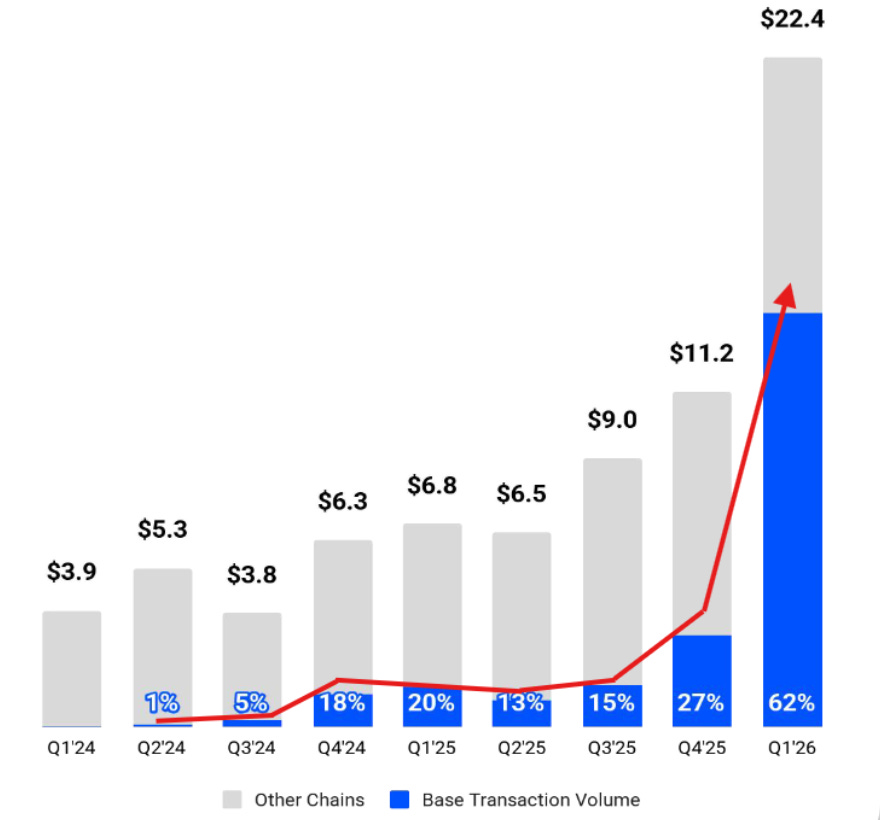
Custodianship positions Coinbase as the secure vault for retail, institutions, and governments where it holds over 80% of US Bitcoin and Ethereum ETF assets. Its payments infrastructure delivers fast, low-cost movement of value through Base, which is the focus of our bull case today as it processes 62% of global on-chain stablecoin volume.
The Subscription and Services Platform generates steady recurring revenue and hit $584 million in Q1 2026 or 44% of total revenue driven by USDC held in Coinbase products, staking rewards, interest and finance fees, and Coinbase One memberships.
Together these offerings look to reduce Coinbase’s dependence on pure crypto trading volatility and finance the company to build the home of the world's agentic economy. However, Coinbase and the world of payments is undergoing a massive transformation, right before our eyes.
In this article, we move beyond the “everything app” narrative to unpack how Coinbase has established itself as the execution layer for agentic workflows. It provides a home for agents to transact and communicate using a common language built on Base.
What are Agents and what can they do?
An agent is LLM-powered software that completes tasks on your behalf without you having to manage each step. There are many examples of this; on the consumer side, the most prominent example is Claude Code. There, you can input a prompt such as, “Design me a landing page for an Argentinean restaurant in Spanish,” and receive a prototype in minutes.
But that is just the surface level. Once you provide access to external knowledge bases (RAG/Vector DB), tools to execute more tasks (MCP), and plug-in procedural knowledge (Skill files), the agent can execute the same tasks a human can. It can make systematic decisions on behalf of an enterprise without the end-user or customer ever knowing.
Why companies are betting on Agents
Imagine you are a customer who knows a snowstorm is approaching and realizes at the last minute that you need a snow shovel. The problem is that everyone else had the same idea and was just as unprepared as you. In a typical scenario, this results in out-of-stock pages, extremely long delivery times, and you potentially being snowed in.
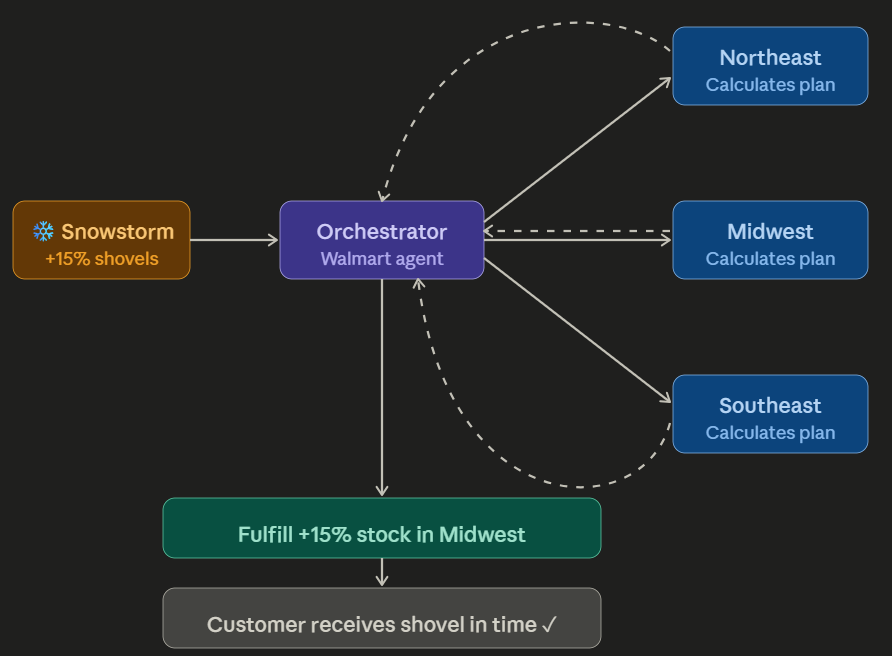
With agentic workflows, these problems disappear without the user ever realizing it. A primary example of how agents solve these last-minute issues involves an orchestrator agent (which coordinates tasks across sub-agents) and sub-agents (which execute tasks and report back to the orchestrator).
Here is the breakdown:
Walmart could deploy a sub-agent to manage each region of the U.S. (for example, one for the Midwest and one for the Northeast). Each agent understands its own warehouse capacity and supplier capabilities (such as lead times) and regularly executes decisions like placing purchase orders within its region.
Walmart’s Orchestrator receives a signal that a snowstorm is hitting the Midwest and determines that snow shovel inventory should be 15% above normal to fulfill last-minute orders. The orchestrator passes this requirement to the sub-agents. Using their specific data on product availability and supplier lead times, the sub-agents calculate the best way to reach that +15% threshold.
The sub-agents pass these calculations back to the orchestrator, which identifies the most economical option and assigns the task to the specific regional sub-agent whose suppliers can most reliably and cheaply fulfill the excess. That sub-agent places the purchase order, the suppliers ship the items in advance, and Walmart receives the extra stock. Ultimately, the customer never sees an “out-of-stock” notification and happily receives their shovel before the storm. This process maximizes revenue for Walmart.
Bull case
Similarly to how an agent requires multiple tools and functions to be effective, such as MCP, Skills, and RAG, an agent needs additional layers to be useful at an enterprise scale. To start, there is the intelligence layer, the LLMs that reason; these are dominated by frontier labs like Anthropic and OpenAI. Then there is orchestration, a collaborative effort across companies that handle authorization and hand-offs to payment execution. Finally, there is payment execution, the specific layer that Coinbase dominates through its x402 protocol. This is a machine-to-machine settlement layer where one agent pays another autonomously and instantly, with no human involved, at a fraction of a cent.
The x402 protocol is simply the language that agents use when calling a service, such as an external tool or data source. The service responds with the payment requirement, the agent pays in USDC on Base, and the agent receives immediate authentication and payment without any human in the loop. While companies like Visa might charge $0.30 per transaction, a cost that compounds at scale, Coinbase executes for fractions of a cent. These are not hypotheticals; this is the crux of the next evolution of AI.
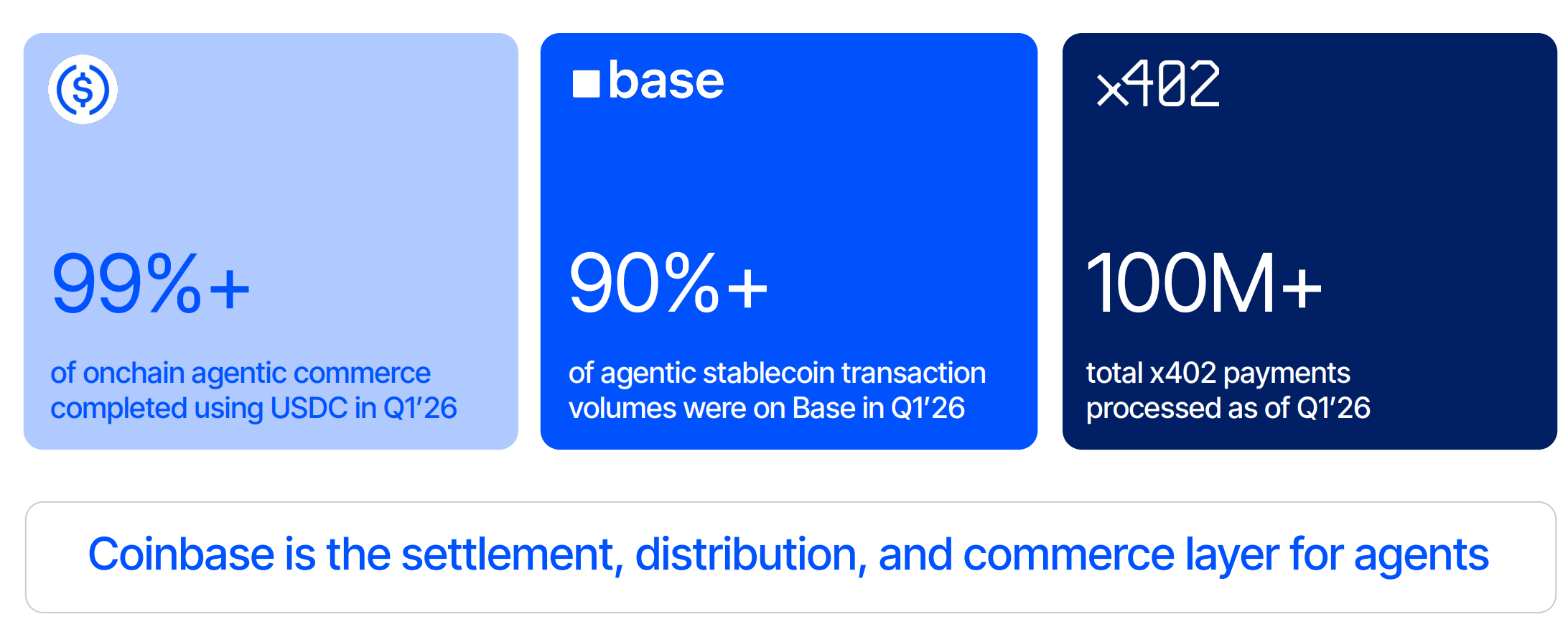
In Q1 2026, 99% of agent crypto payments used USDC, and 90% of those transactions were settled on Base. Consequently, Base now holds a 62% share of all stablecoin transactions.
Enterprises that have already launched agentic workflows and execution are already operating within Base. Coinbase has become the de facto platform, setting the standard that companies like Cloudflare, Google, and AWS are now using. Even its competitors, such as Visa and Mastercard, are backing the initiative. This indicates that Coinbase has authored a standard that the entire internet infrastructure is supporting. Another way to think about this is that the companies most capable of replacing x402 have already chosen to build on top of it instead, which is the strongest signal that the standard is working.
This is how Brian Armstrong is pivoting away from a heavy reliance on crypto trading to becoming the entity through which every AI agent will run. While Coinbase currently has 57% of its revenues tied to Bitcoin, it is moving toward owning the entire execution layer. This includes the protocol (x402), the settlement rail (Base and USDC), the developer tools (CDP and AgentKit), and the wallets. Meanwhile, agentic transactions are expected to reach $3 to $5 trillion in volume by 2030.
As Armstrong stated: “There will soon be billions of agents transacting and they need rails that can keep up. Coinbase is at the centre of the agent economy”
Bear Case
Short-term crypto reliance and future competition constitute the bear cases
Crypto reliance
The numbers from Q1 2026 show that transaction revenue still accounted for $756 million out of the company’s total revenue of $1.4 billion, meaning 54% of revenue remains tied to crypto trading. Subscription and services revenue, a major bet to diversify away from trading, reached $584 million. However, $305 million of that figure is still linked to the market capitalisation of USDC.
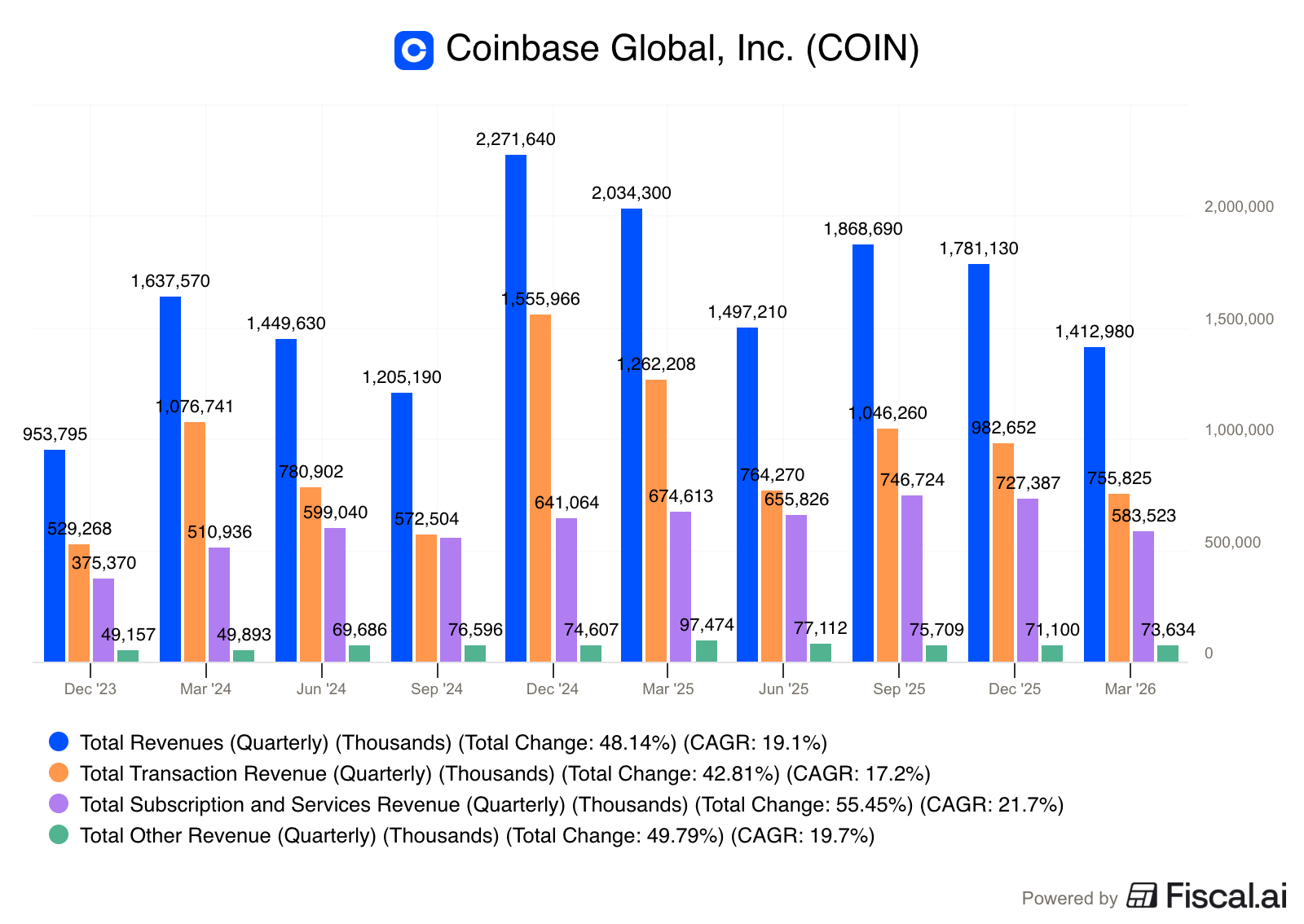
Blockchain rewards, lending income, and even Coinbase One subscriptions ultimately depend on users and institutions continuing to hold or actively transact in crypto assets. When cryptocurrency prices trend upward, it serves as a tailwind for Coinbase; conversely, when prices drop and volatility decreases, it creates a headwind. Q1 2026 served as a primary example of how lower transaction volumes can impact Coinbase’s business.
COIN reported a net loss of $394 million in Q1 2026, resulting from softer crypto prices, a >20% drop in trading volumes, and $482 million in losses on crypto assets held for investment. Furthermore, Coinbase maintains a 0.59 correlation to Bitcoin, meaning its price action represents an ongoing risk for investors.
Competition
The execution layer through x402 does not function as a closed moat because it exists as an open standard, and competing protocols are now contending for the same agentic commerce volume. The Google Agent Payments Protocol (AP2), for example, delivers cryptographically signed mandates that support broader authorization and work across multiple rails, including cards and stablecoins. Simultaneously, the Stripe and OpenAI Agentic Commerce Protocol, together with their Machine Payments Protocol, concentrate on crypto checkout flows.
Although Coinbase currently leads in pure on-chain machine-to-machine micropayments (with 90% of agentic stablecoin activity settled on Base), the ecosystem is built to be multi-protocol by design. Consequently, enterprises routinely combine x402 with Google AP2 and Stripe ACP to gain resilience.
If agents ultimately favour fiat rails, hybrid mandates, or even competing Layer 2 networks for reasons of cost or regulatory compliance, then Coinbase’s de facto standard status could fade rapidly.
The protocol’s success still rests on the continued adoption of USDC and Base, which remain fundamentally crypto-native and therefore exposed to the same volatility and regulatory risks that have historically limited the practical utility of crypto overall. In other words, Coinbase built the protocol but handed it to the world to use freely; if the world decides a competing option works better, there is nothing stopping them from walking away.
Management
Brian Armstrong is the co-founder, CEO, Chairman of the Board of Directors, and strategic lead behind the company. He has delivered real innovation in payment processing and settlements. Specifically, he established Coinbase as the primary distributor of USDC, capturing 25% of USDC circulation and holding $19B in stablecoin assets. He also launched Base as Coinbase’s Layer 2 blockchain, providing USDC with a fast and cheap native settlement rail, and oversaw the development of the x402 protocol.
Before founding Coinbase, Armstrong served as a software engineer at Airbnb from May 2011 to June 2012. From August 2003 to May 2012, he was the founder and CEO of Universitytutor.com, an online tutoring directory. He also served as a consultant for the enterprise risk management division at Deloitte & Touche LLP from July to November 2005.
More recently, in January 2020, Armstrong founded ResearchHub Technologies, Inc., a scientific research platform where he currently serves as CEO and a director. In December 2021, he co-founded NewLimit, Inc., a healthcare research company, where he remains an investor and board member. Armstrong holds a B.A. in Computer Science and Economics and an M.S. in Computer Science from Rice University.

The rest of the executive team brings clear strengths as well.
Alesia Haas serves as CFO; she joined in 2018 with a background in banking and finance and has maintained 13 straight quarters of positive adjusted EBITDA.
Emilie Choi is the President and COO. Having spent years at LinkedIn in corporate development, she now oversees operations and acquisitions at Coinbase.
Paul Grewal serves as the Chief Legal Officer; he previously acted as Deputy General Counsel at Facebook and has been leading the effort to pass the CLARITY Act with terms favorable to Coinbase and its customers.
This leadership group has steered Coinbase through crypto winters and regulatory challenges, and they continue to deliver operational improvements across the board.
Financials and Valuation
Financials
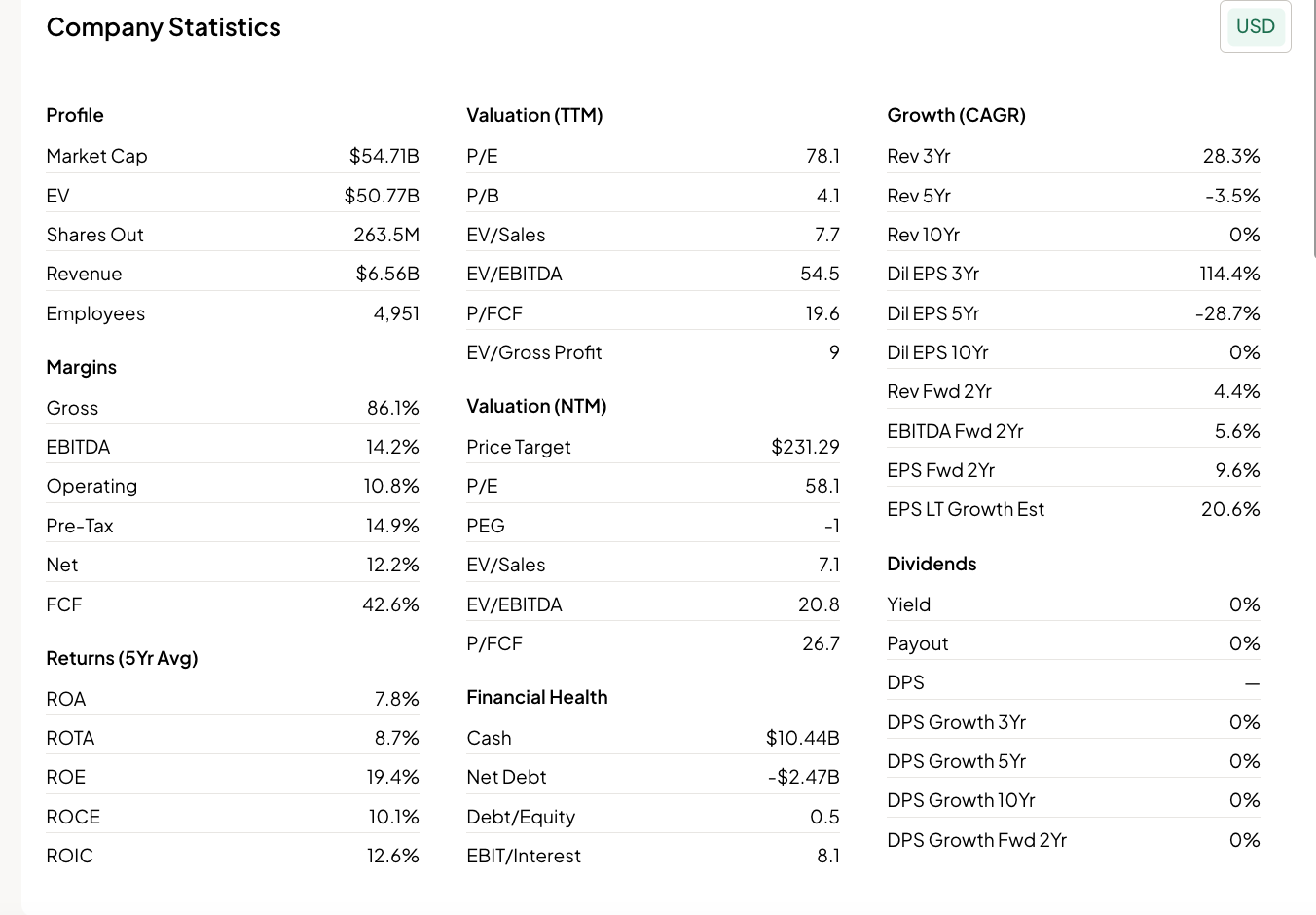
At the time of writing, COIN has a Market Cap of $54.7B with a Net Cash position of >$2.47B. Debt to Equity ratio is is 0.5
All financials were taken from Fiscal AI’s website. You can access a free trial of the premium offering via the following link, no card required. Fiscal AI
TTM Performance:
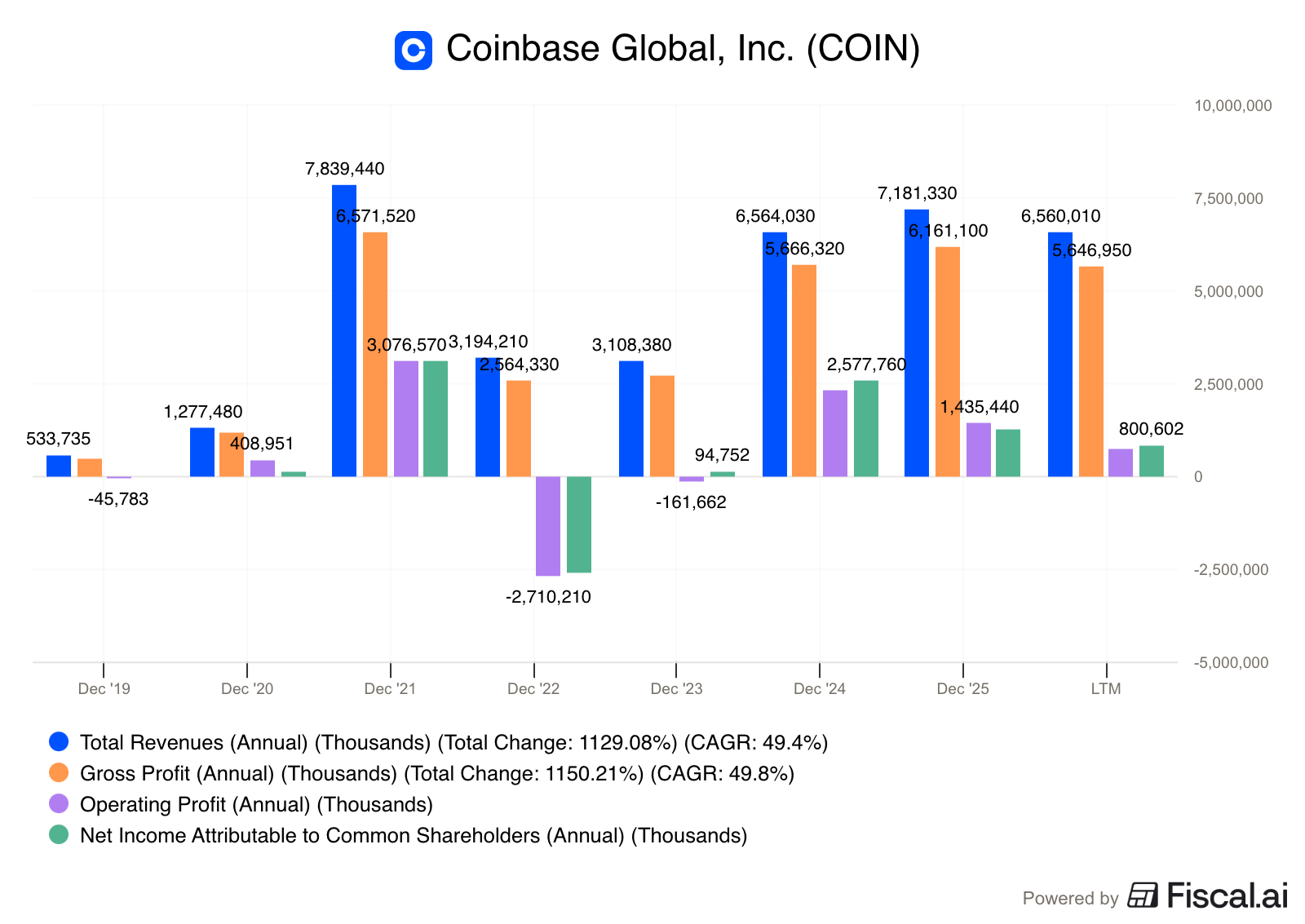
Revenue TTM: $6.56 (B)
Gross Profit TTM: $5.647(B)
Operating Income TTM: $0.708 (B)
Net Income TTM: $0.801 (B)
Q1 2026 Results:
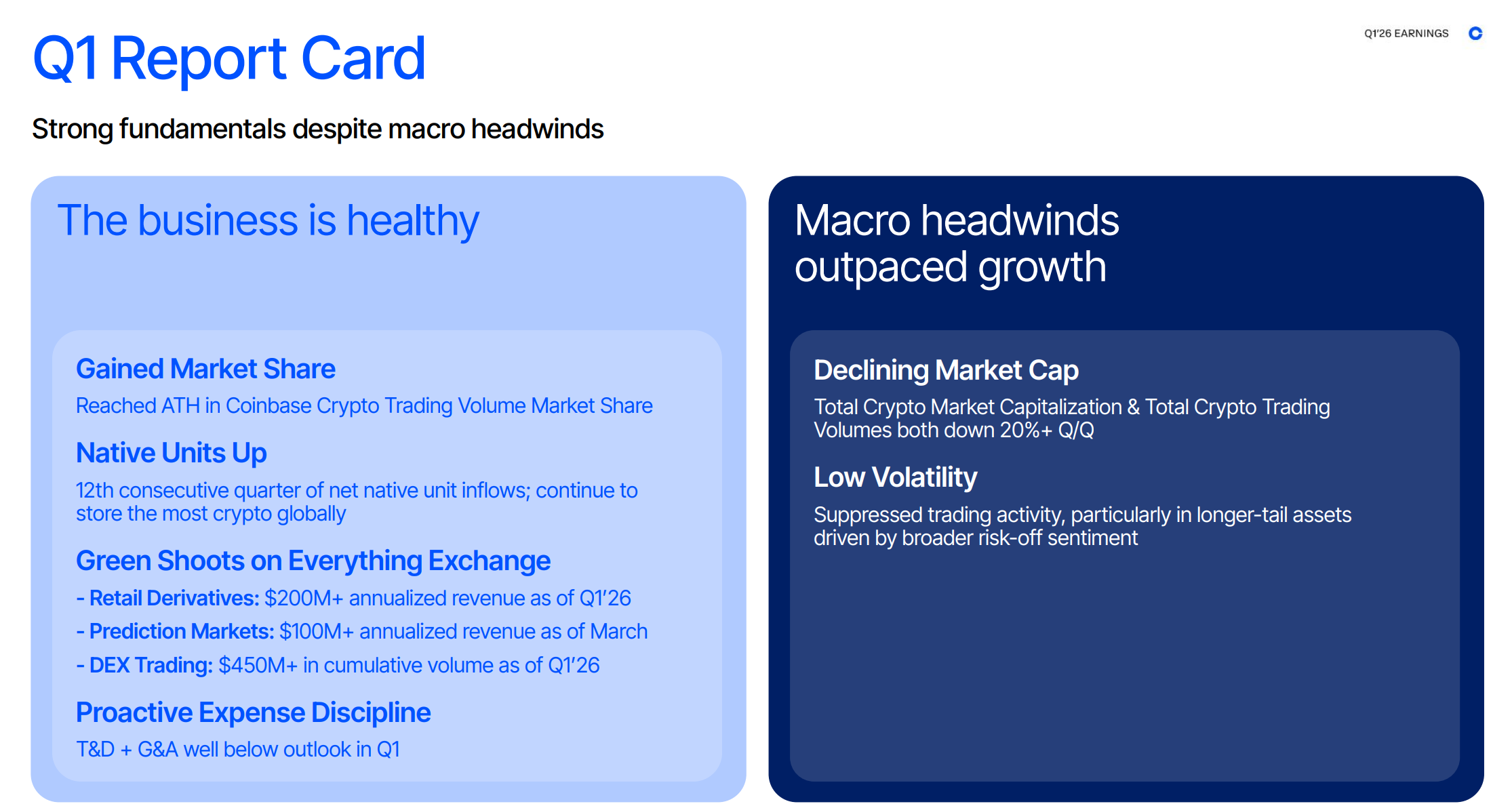
Revenues of $1.413B which represented a 30.5% decrease YOY
Operating Loss ($21.421M) which is down from 705.8M YOY (Q1 25)
GAAP Net Loss ($394.1M) down from $65.6M in the same period Y/Y
Total Transaction revenue 755.8M down from 1,262M in the same period Y/Y
Subscription Revenue 585.52M vs 674.61M in the same period Y/Y.
Subscription revenue reached 44% of Net Revenue
Assets on Platform 294M down from 328M in the same period Y/Y
Although management was able to gain market share in a contracting market, the quarterly results were somewhat weak in the face of macro headwinds.
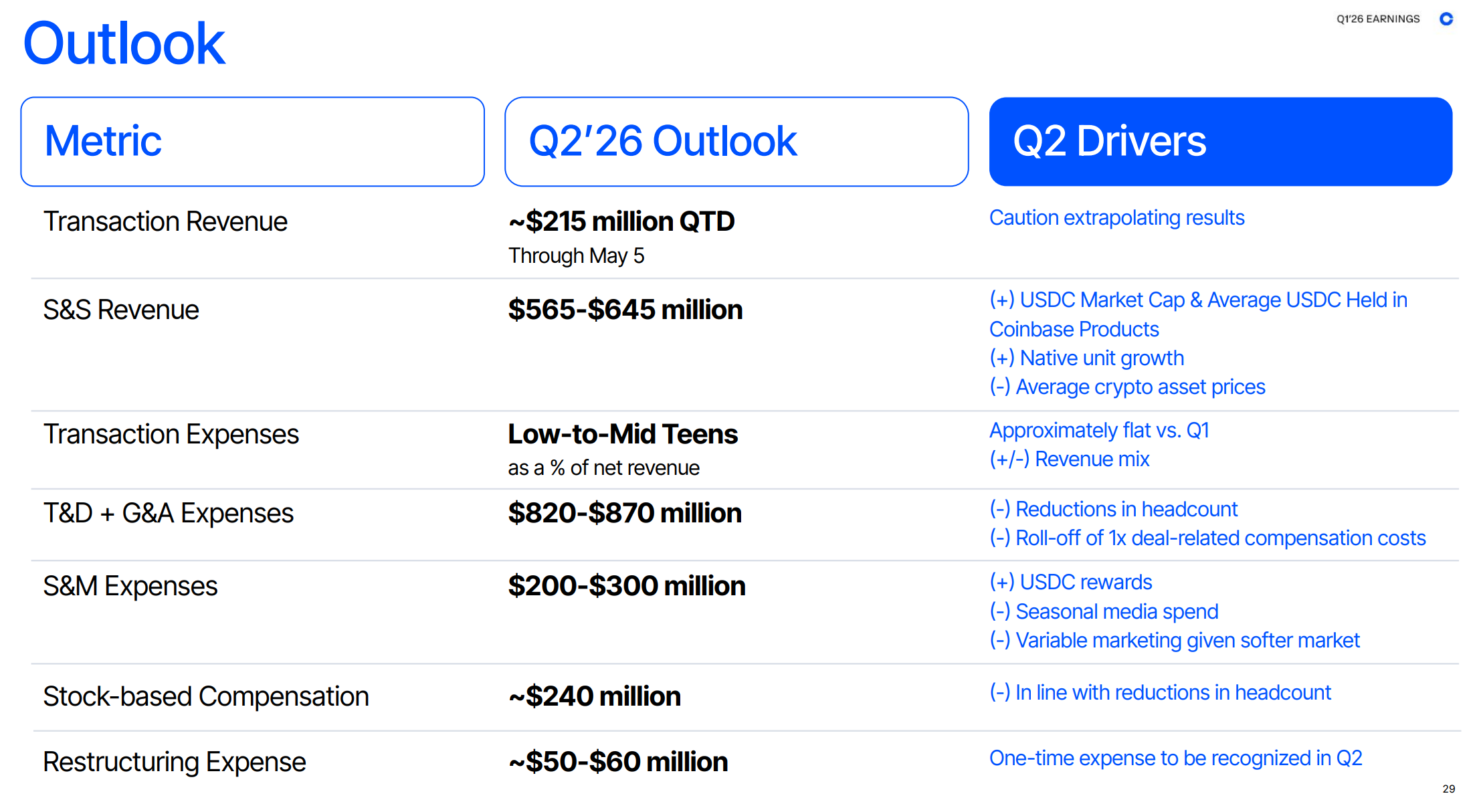
Management expects second-quarter subscription revenue to be in the $565 million to $645 million range. They have not provided guidance for transaction revenue, though it was $215 million quarter-to-date through May 5. Additionally, there will be restructuring costs in the coming quarter resulting from a reduction in headcount.
Valuation:
COIN trades at:
7.7x LTM EV/S and 7.1x NTM EV/S.
54.5x LTM EV/EBITDA and 20.8x NTM EV/EBITDA
78x LTM PE and 58x NTM PE.
19.5x trailing P/FCF and 26.7x NTM P/FCF
Coinbase is not a cheap stock by traditional valuation metrics.
Chart and Technicals
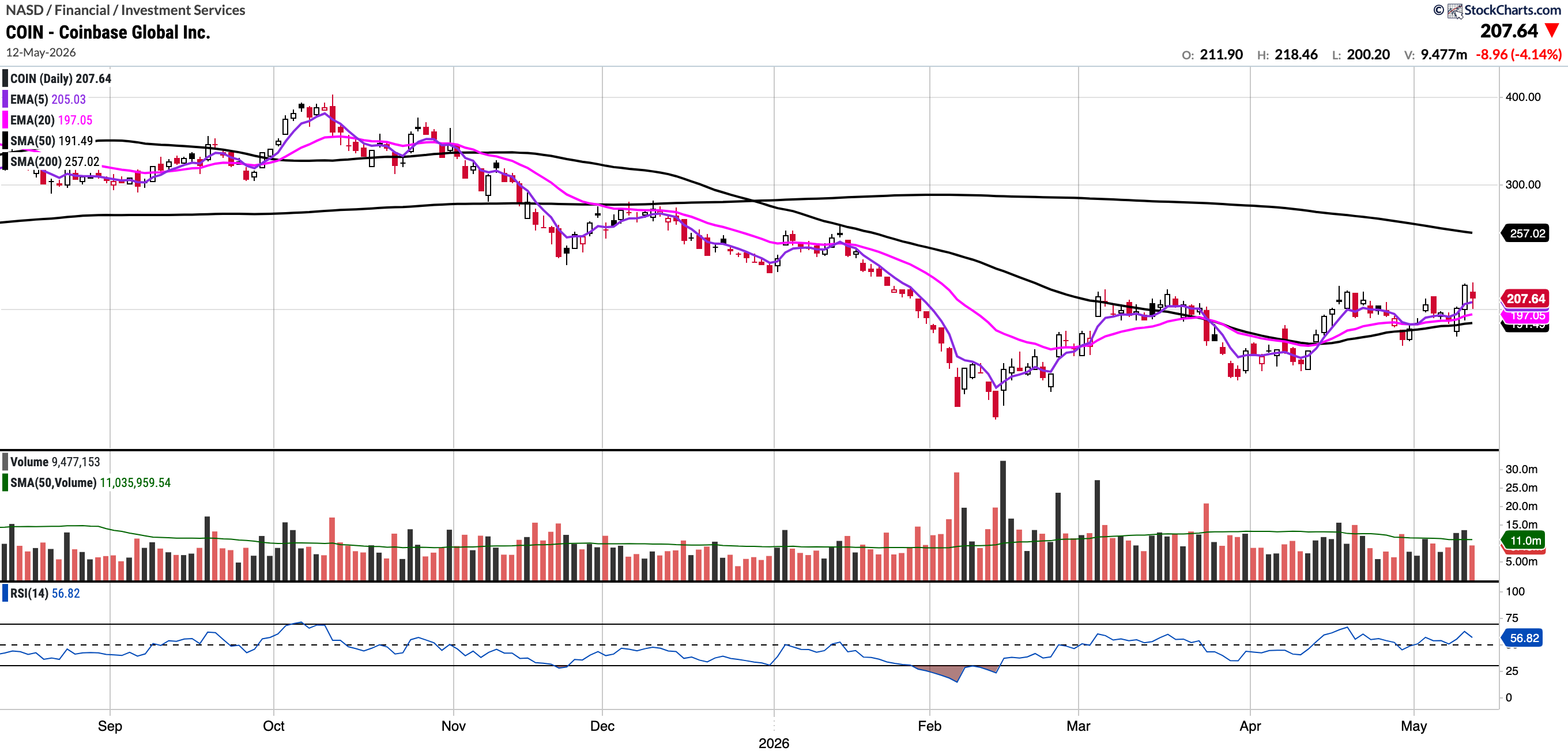
Currently trades at $207.64, 8.44% above the 50SMA and 19.21% below the 200SMA.
RSI 56.82
-12.21% YTD
COIN is forming a nascent uptrend, with the near-term moving averages trending above one another, although the stock remains below the 200-day SMA.
The $216 mark may serve as near-term resistance; if surpassed, COIN could make a run toward the overhead 200-day moving average, which may itself act as resistance.
To the downside, $192 has proven to be a critical support level where one could look to take an entry with a tight stop. A longer term support area below that has been the mid 140’s.
Current position and plans
SixSigmaCapital holds a small position at the time of writing, just over a 2% portfolio allocation at an average of $135
Position Journal has a full position, below are his final thoughts and plans. (Ensure to subscribe to his substack and give him a follow on X Position Journal if you have enjoyed this write up!)
Agentic is not just a feature or a buzzword; it is the natural progression of AI.
The whole premise of AI was that it would replace tedious tasks, improve productivity, allow you to focus on other priorities, and improve the quality of life for consumers. It cannot achieve that through chatbots answering questions alone; it does so by actually executing tasks for you. Execution with no human in the loop is the natural evolution of AI and the destination that every layer is striving for, from the intelligence layer improving reasoning to the execution layer enabling transactions.
Betting against the agentic shift is an active bet that AI will stop short of its ultimate destination. Investors who bet against this shift will sit on the sidelines as the world transforms. My bet is that Coinbase, as the trusted and auditable American partner, owns the execution layer where trillions of dollars settle on Base. This occurs through a protocol Coinbase authored and built by a team that prepared for this moment before the market even understood what the moment was.
I hold approximately 10% of my portfolio in Coinbase with a $174 cost average. Not Financial Advice.
Thank you for reading and if you enjoyed this post, please leave a like and Restack.
Subscribe to the plan that best suits your needs (free or premium), and will see you in the next one!
king
Great read!
How do you envision the thesis changing if Circle is able to re-negotiate their USDC terms with COIN? I’m bullish on the company myself, having done my own DD here but see that being a possible risk. Especially as the economics currently heavily favor COIN (50/50 off platform 100% on platform)
Mgmt reiterated the contract renews in perpetuity but can see Circle pushing to change things.