

Alphabet Inc. (GOOGL) just released its financial report for its second quarter of fiscal 2026. We will take a closer look below.
Full disclosure: I am currently long GOOGL from $124/share, having already taken off close to 3x my initial cost basis.
Overview
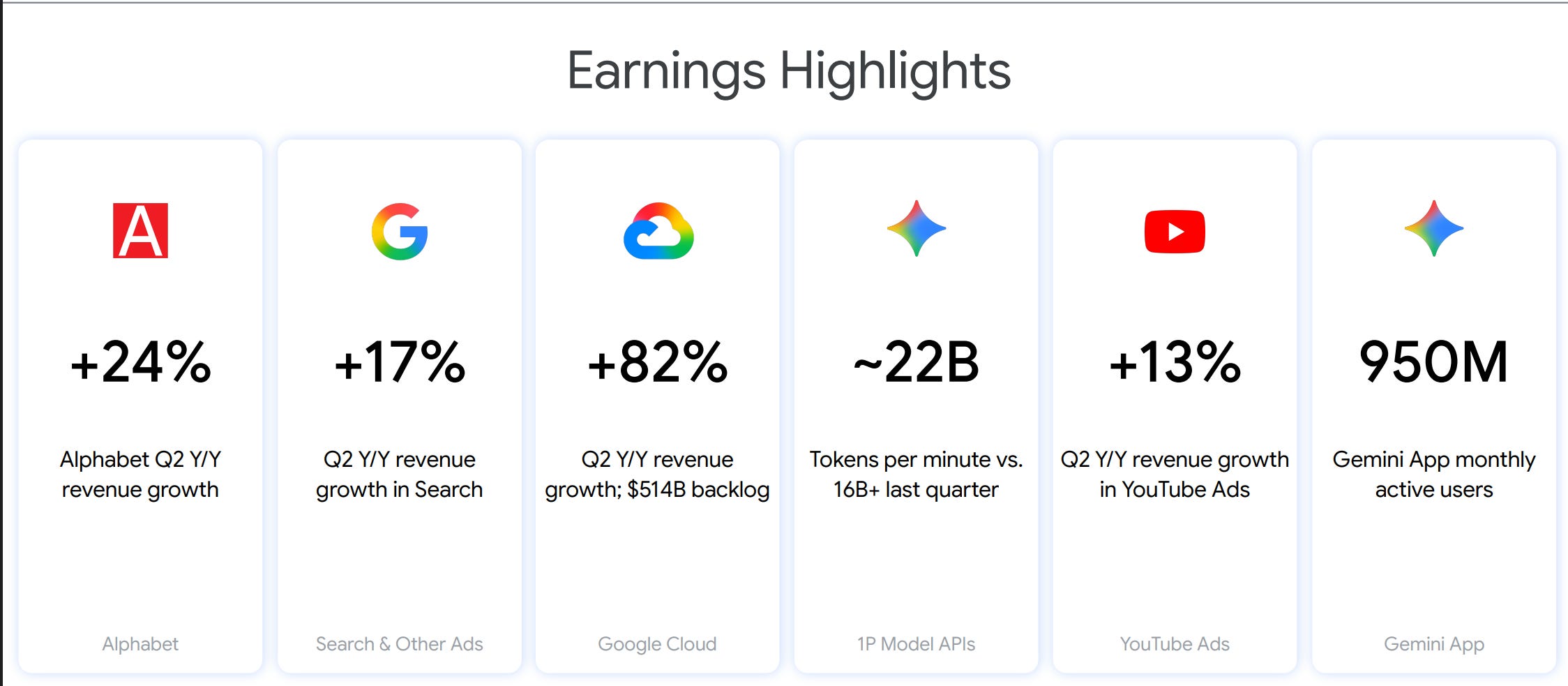
Alphabet delivered a solid second quarter , characterised by a 24% year-over-year revenue growth and significant momentum across its AI-integrated product ecosystem.
Their performance is primarily driven by the rapid adoption of its AI-powered Search experiences and the explosive growth of Google Cloud, which is benefiting from strong demand for AI infrastructure and enterprise-grade agentic solutions.
While the company faces a supply-constrained environment for compute resources, it is aggressively scaling its technical infrastructure to meet demand, resulting in a strategic shift toward increased capital expenditure and the utilisation of third-party capacity to bridge near-term supply gaps.
Second Quarter of Fiscal Year 2026 Financial Highlights
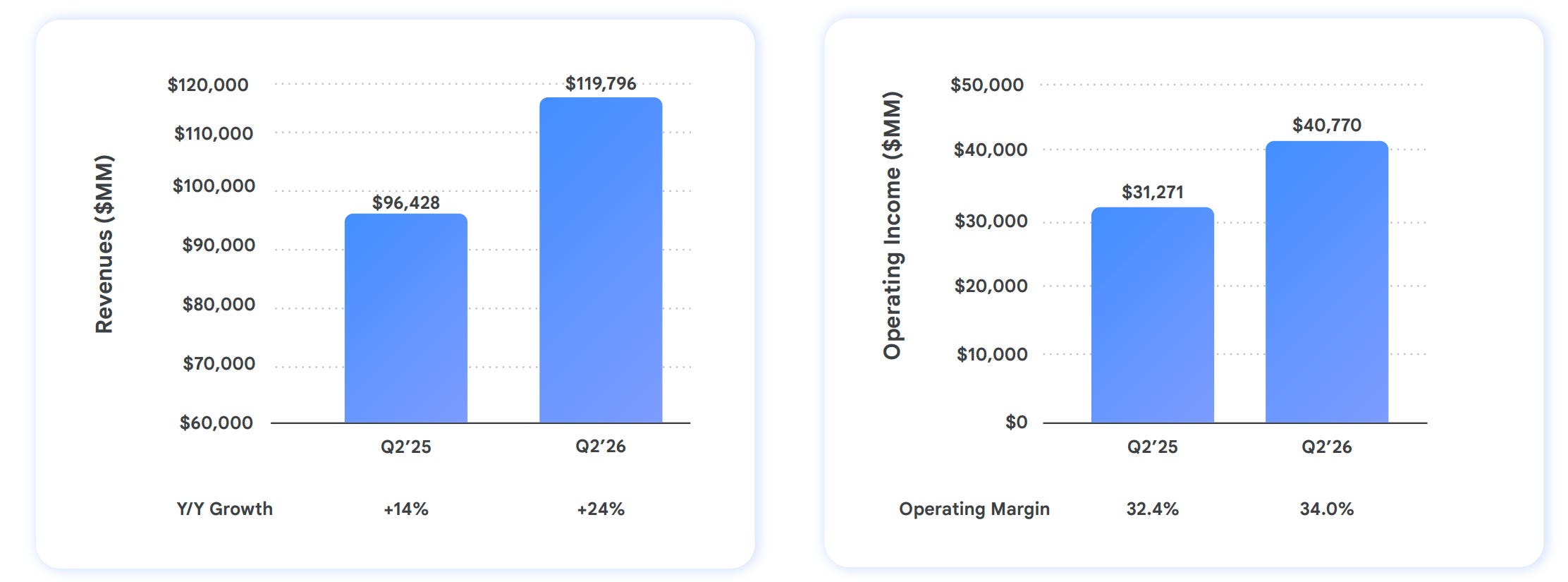
Consolidated Revenue: $119.8 billion, up 24% year-over-year with Operating margins rising to 34% from 32.4% Y/Y
Google Cloud Revenue: $24.8 billion, an 82% increase with operating margins rising to 35.6% from 20.7% Y/Y
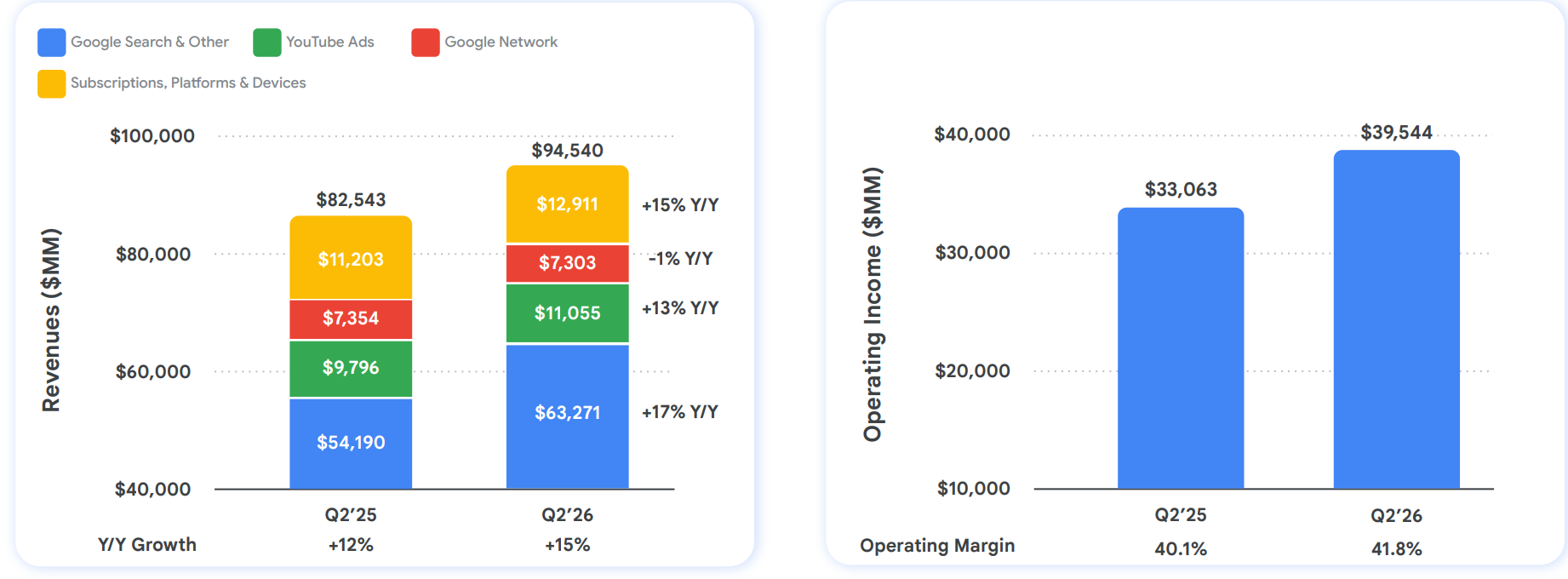
Google Services Revenue: $94.54B, +15% Y/Y with operating margins rising to 41.8% from 40.1%
Search and Other Revenue: $63.3 billion, representing 17% growth .
Operating Income: $40.8 billion, reflecting a 30% increase .
Net income: $112.19B; +298% YoY (Sizeable equity gain impact)
Cloud Backlog: Reached $514 billion, increasing by over $50 billion sequentially.
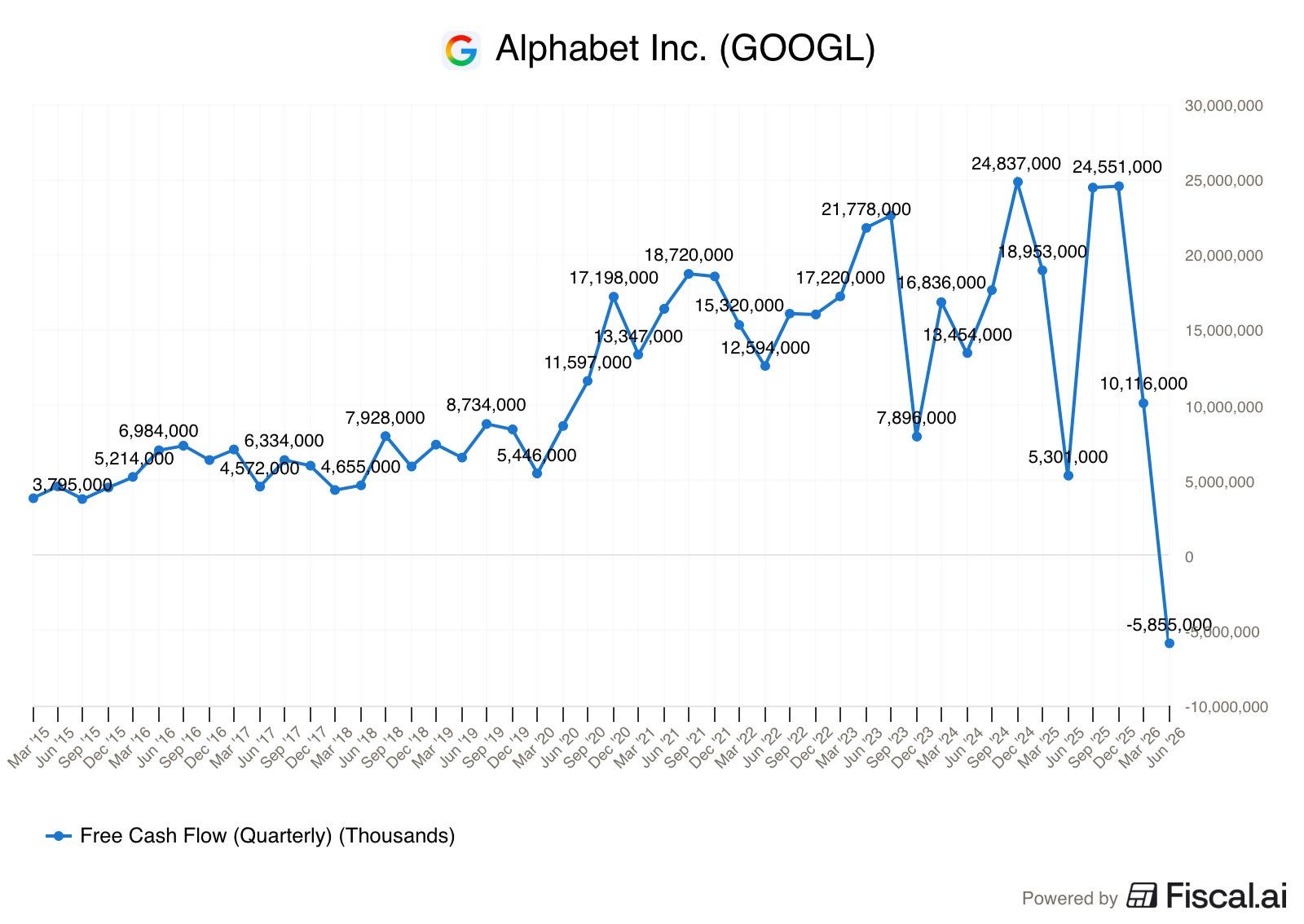
Free Cash Flow: ($5.855B) from $5.3B in Q2 25.
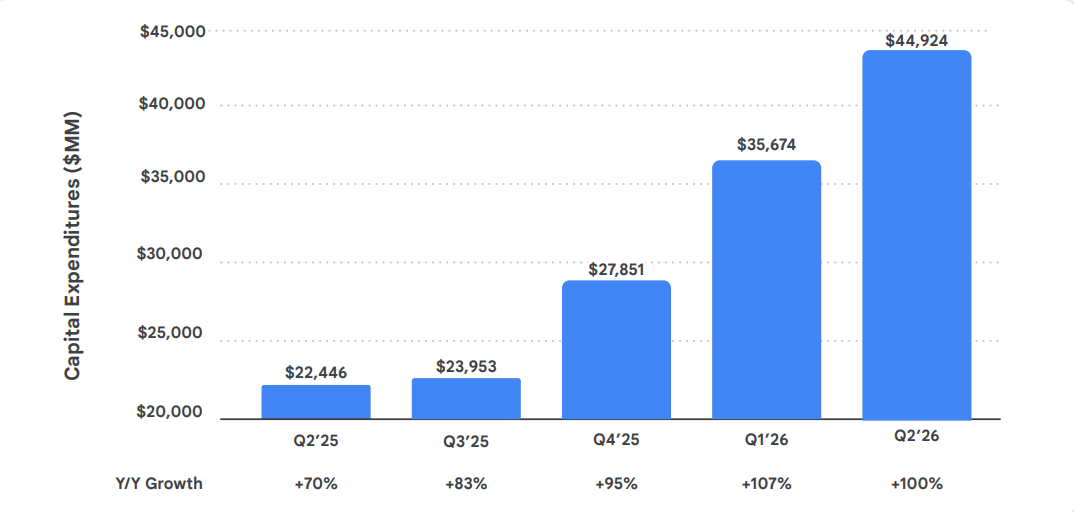
Capital Expenditures: $44.9 billion for the quarter rising from $22.45B in Q2 ‘25
Financial Guidance and Outlook
Alphabet has raised its full-year 2026 capital expenditure guidance to a range of $195 billion to $205 billion (up from its previous estimate of $180 billion to $190 billion) in an effort to accelerate the rollout of compute capacity.
Management expects this significant technical infrastructure investment to weigh on the P&L via elevated depreciation and data centre operating costs. Additionally, the company plans to utilise third-party capacity in the third quarter as a bridge to meet customer demand, which will create modest, near-term margin pressure.
Looking further ahead, Alphabet expects the majority of revenue from its current TPU system sales agreements to be realised in 2027, while remaining focused on long-term Return on Invested Capital (ROIC) across its full-stack AI strategy.
Key Takeaways
AI-Driven Search Evolution: The integration of AI Overviews and AI Mode is driving an incremental increase in total query volume, with AI Mode surpassing 1 billion monthly active users.
Enterprise AI Adoption: Nearly 90% of Fortune 100 companies are now utilising Gemini Enterprise, signaling deep penetration into the corporate sector for agentic workflows and data analytics .
Infrastructure Scaling: Alphabet is aggressively expanding its AI infrastructure, including the deployment of the NVIDIA Vera Rubin platform and proprietary TPU 8t/8i chips, to support a “million AI accelerators” connected into a unified supercomputer .
Agentic Development: The company’s “Antigravity” platform has reached 2.4 million weekly active users, significantly accelerating internal development timelines, such as a Chrome team project that compressed a two-year timeline into three months .
Strategic Hardware Sales: Alphabet has begun recognising revenue from the sale of TPU systems directly to customer data centres, a new revenue stream that is expected to ramp significantly through 2027.
Final thoughts and my plans:
GOOGL delivered a very solid set of numbers. However, the sheer size of their investments is finally showing up on the statements, with a massive capex number resulting in their first negative free cash flow quarter in history as a publicly traded company.
That is not to say they are not seeing an ROI: revenue is increasing, and so are margins. An obvious example is GCP, which grew revenue at 82% (!) while operating margins expanded from 20.7% to 35.6%.
Going forward, however, management stated that they expect this significant infrastructure investment to weigh on the P&L due to elevated depreciation and data centre operating costs.
Looking more broadly, the huge capex guidance is bullish for the AI infrastructure space, especially for the companies Google plans to utilise for third-party capacity as a bridge to meet customer demand.
This is likely to benefit CoreWeave, which serves as their primary specialised AI cloud provider via CoreWeave Interconnect. Other likely beneficiaries include Lambda Labs, Nebius, and Applied Digital, as well as Oracle via Oracle Cloud Infrastructure (OCI). xAI is also in the mix.
I have been long GOOGL as a core position for several years, and my plan is to continue holding. I recently took off my cost basis, and while I am unlikely to add here given the potential near-term pressure from their massive investments, I am comfortable holding. Google remains one of, if not the single best, full-stack AI stories in the market. The takeaway from this report is clear: the ultimate winner here is the AI infrastructure complex.
Thank you for reading and see you for the next one!
GOOGL earnings matter less than what they signal for mega cap concentration. Top 10 S&P weights sit near 40 percent. A beat that broadens leadership is bullish, one that piles onto the same five names is a crowding risk.
Nice overview, I didn’t dig into the earnings just read the headlines about FCF. Do you think hyper scalers will start to see some love from investors in the future despite shrinking FCF? Or should we expect to see the same sell off in other hyper scalers with the exception of like Microsoft which seems to have better FCF (despite OpenAI concerns). Thanks