

Last night, Alphabet submitted its third-quarter financial results for the period ending September 30. It was a strong quarter overall. Revenue rose 25% year over year to $127.6 billion, operating income grew 30%, and Search kept growing in double digits.
Few developments stood out on this quarter:
Google Cloud revenue more than doubled to $30.7 billion, while its operating margin rose to 36.2%, with a $561 billion backlog behind it.
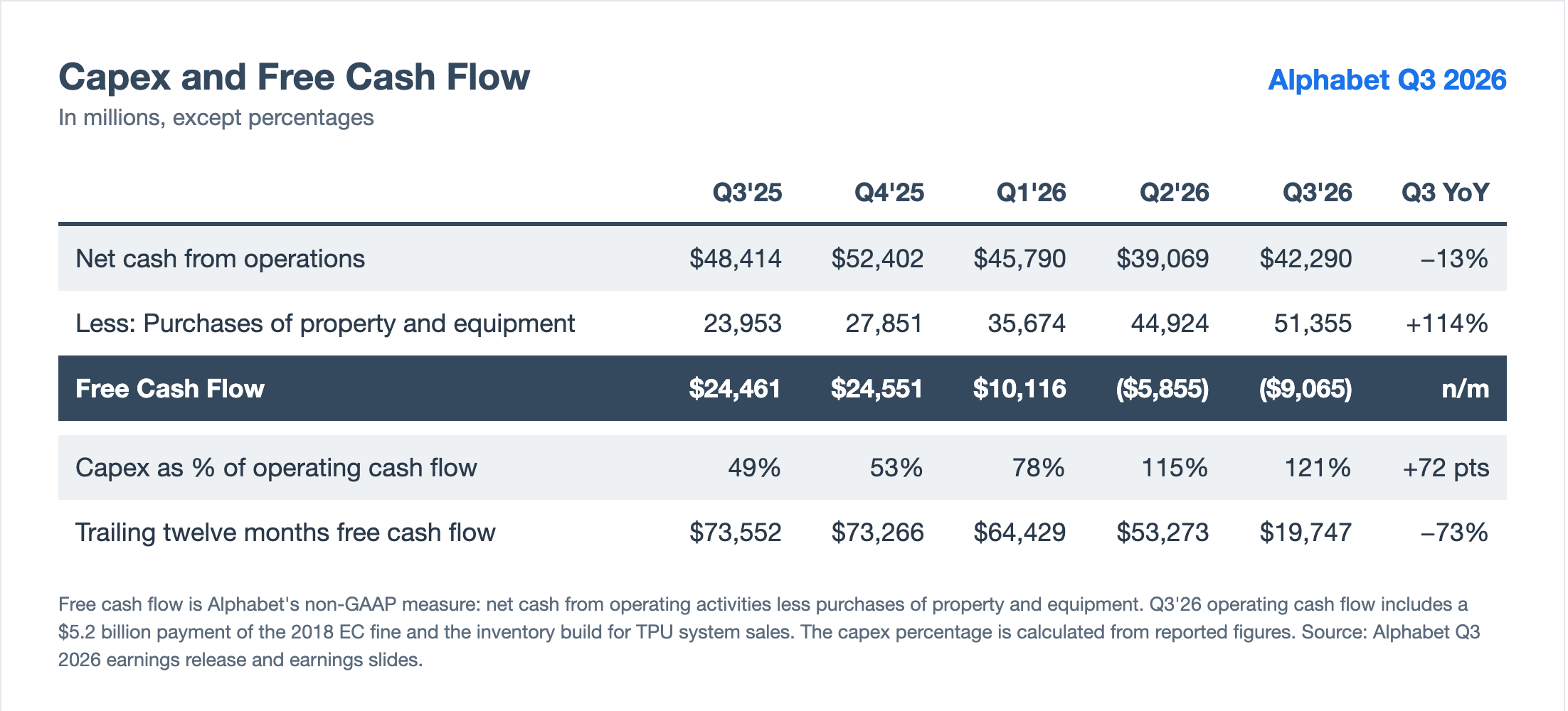
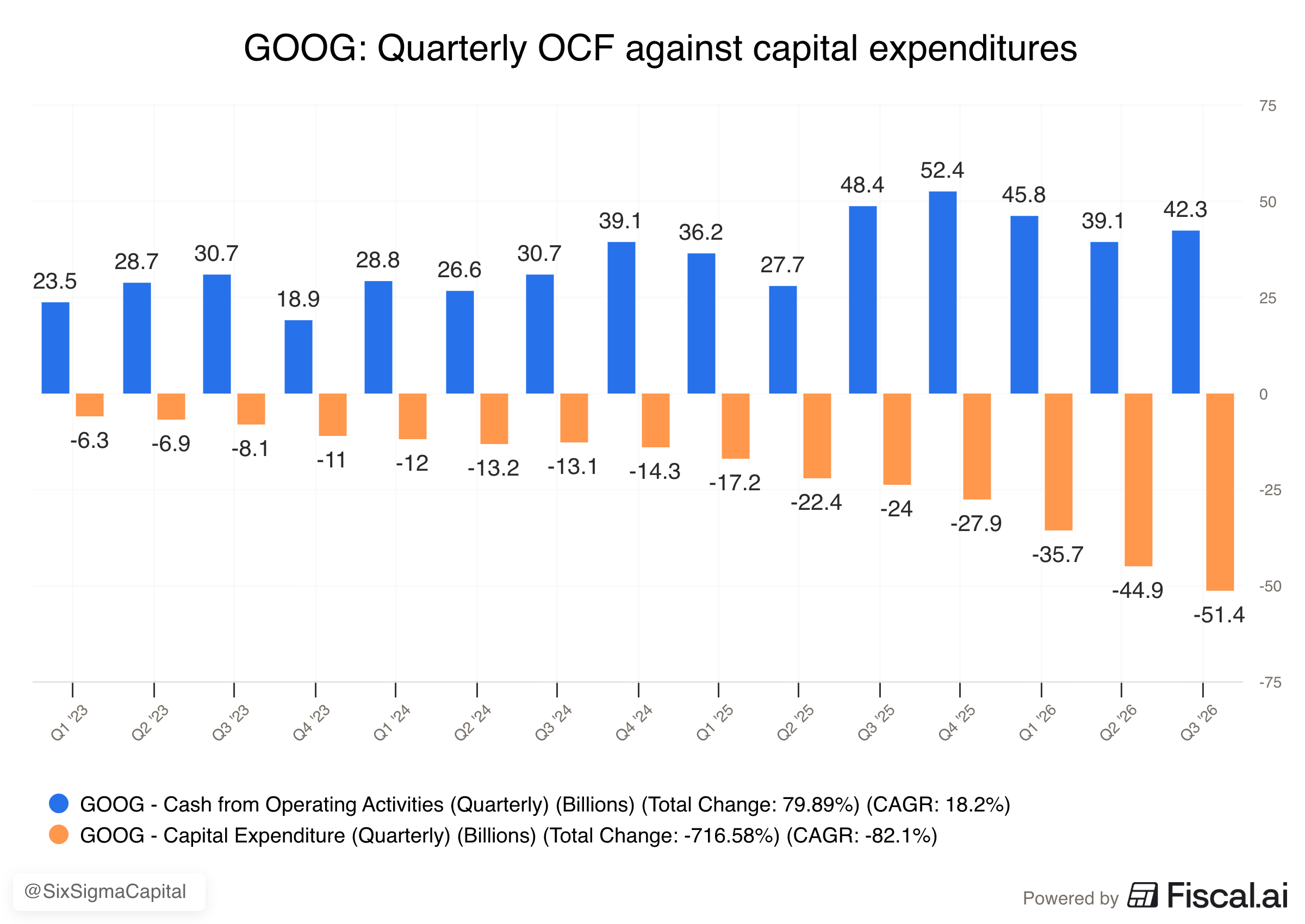
Capex reached $51.4 billion, up 114%, and free cash flow was negative for a second straight quarter.
Google Search came in below estimates.
Below we will take a further look at the quarter.
Overview
Google Cloud was the headline. Revenue rose 103% to $30.7 billion, led by Google Cloud Platform across enterprise AI infrastructure, AI solutions and core GCP, while operating margin widened to 36.2% from 23.7%. TPU system sales were also a meaningful contributor, so the Cloud line now includes hardware product revenue as well as cloud services. Google Cloud’s backlog was $561 billion, and management expects to recognise just over 55% of it over the next 24 months.
The core search business crucially came in below analyst estimates. Search and other revenue grew 12% to $63.35 billion even with the fastest query growth in five years (more on that below). YouTube ads grew 9% and Network 1%.
Alphabet operating income rose 30% to $40.6 billion, a 31.8% margin. EPS fell 26% to $2.12, but that came from investment marks (SpaceX) rather than the business, as covered below.
Key Financial Highlights
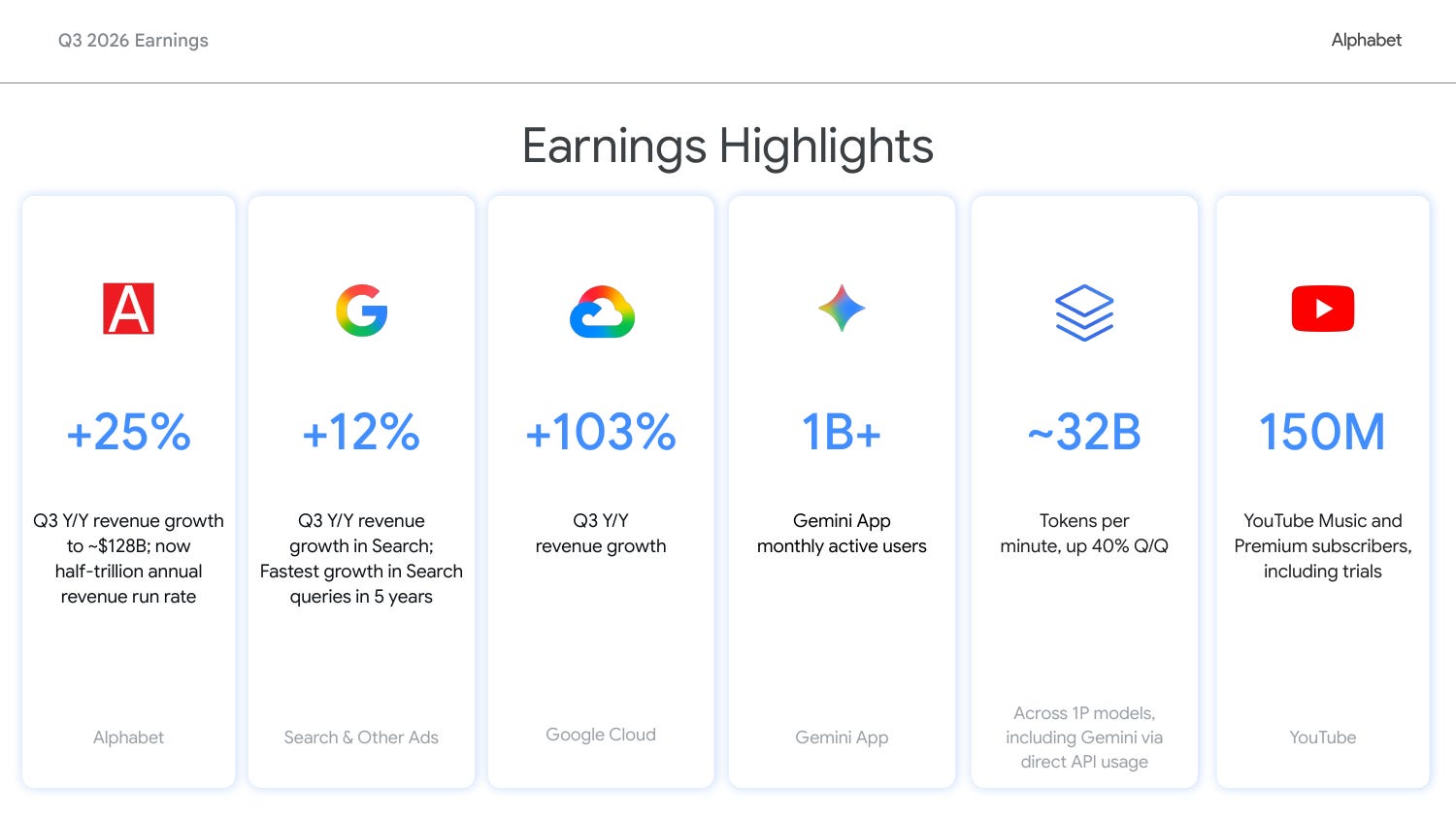
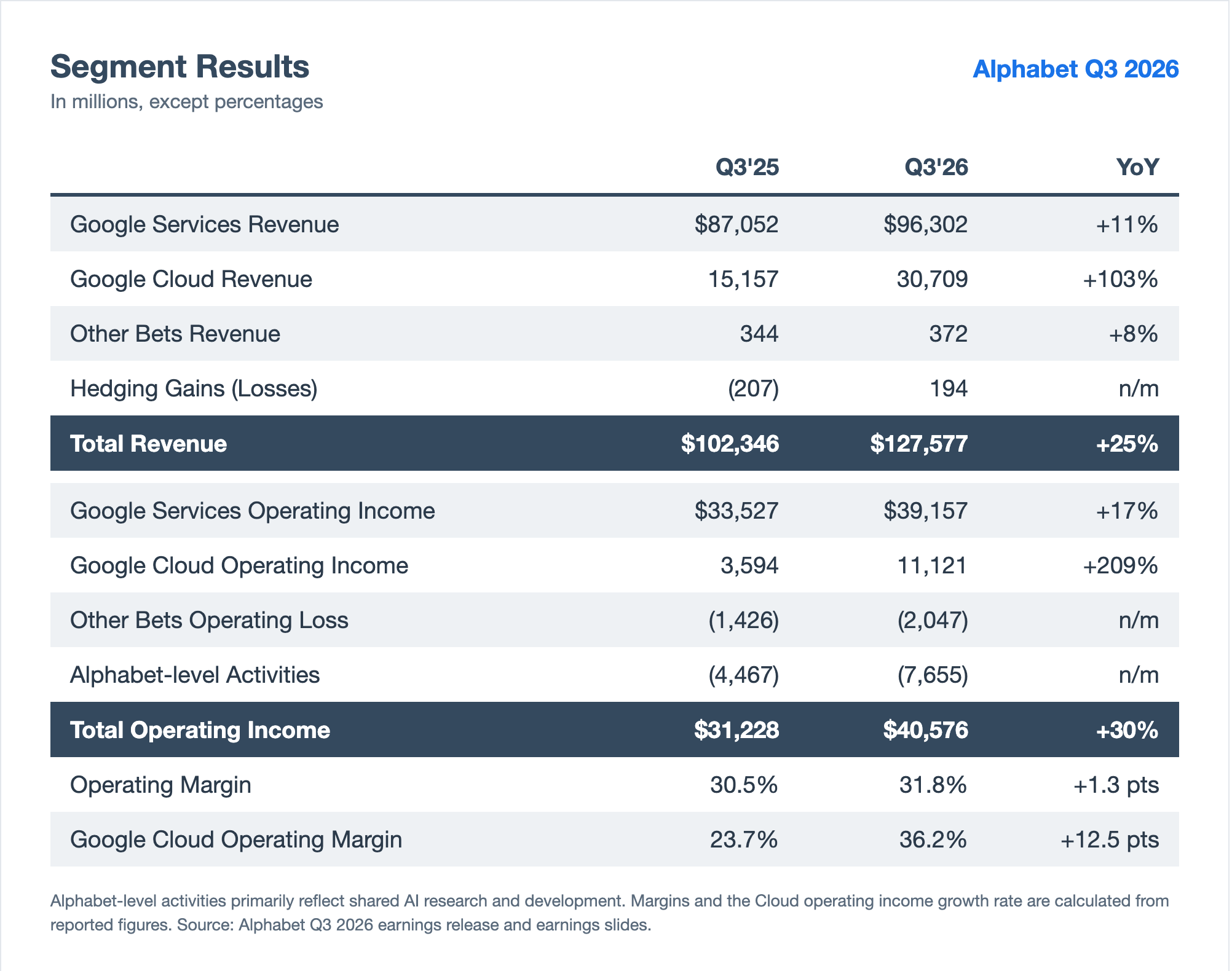
Total Revenue: $127.6 billion, up 25% year-over-year (25% constant currency), the 13th straight quarter of double-digit growth.
Google Services: $96.3 billion, up 11%.
Google Cloud: $30.7 billion, up 103%.
Other Bets: $372 million, up 8%.
Google Search & Other: $63.35 billion, up 12%.
YouTube Ads: $11.2 billion, up 9%.
Google Network: $7.5 billion, up 1%.
Subscriptions, Platforms and Devices: $14.3 billion, up 11%.
Google Cloud Backlog: $561 billion, with just over 55% expected to be recognised over the next 24 months.
Operating Income: $40.6 billion, up 30%, a 31.8% operating margin (vs. 30.5% a year ago).
Google Services: $39.2 billion, up 17%, a 40.7% margin (vs. 38.5%).
Google Cloud: $11.1 billion, more than triple last year, a 36.2% margin (vs. 23.7%).
Other Bets: a $2.0 billion loss.
Alphabet-level activities (mainly shared AI R&D): a $7.7 billion loss, vs. $4.5 billion a year ago.
Costs: R&D rose 36% to $20.6 billion. Other cost of revenues rose 32% YoY to $35.1 billion on TPU hardware costs, depreciation, content and infrastructure operations. Depreciation of property and equipment rose 49% to $8.4 billion.
Net Income: $26.2 billion to common stockholders, down 25%, or $2.12 per diluted share, down 26%. Other income (expense) was negative $8.2 billion, including an $8.7 billion loss on equity securities worth $0.55 per share.
Operating Cash Flow: $42.3 billion, down 13%, held back by the inventory build for TPU system sales and a $5.2 billion cash payment of the 2018 EC fine.
Capital Expenditures: $51.4 billion, up 114%. Of the technical infrastructure investment, about 65% was servers and networking equipment (useful lives of six years) and 35% data centers (seven to 40 years).
Free Cash Flow: negative $9.1 billion (vs. positive $24.5 billion a year ago). Trailing twelve months free cash flow was $19.7 billion, down 73%.
Cash and Marketable Securities: $265.1 billion, including $90.4 billion of marketable equity securities, up from $126.8 billion at the end of 2025.
Long-Term Debt: $125.1 billion, up from $46.5 billion at the end of 2025.
Share Repurchases: none in the quarter or the year to date, vs. $11.5 billion in Q3 2025. The quarterly dividend is $0.22 per share, payable December 14.
Inventory: $13.3 billion, up from $2.4 billion at the end of 2025.
Headcount: 204,757, up 8%.
Key Takeaways
Operating Leverage, and Why EPS Fell:
Underneath the headline, the business did show operating leverage. Revenue grew 25% and operating income grew 30%, lifting operating margin to 31.8% from 30.5%. That came even as depreciation rose 49%, R&D rose 36%, and the shared AI research costs held at the Alphabet level climbed to $7.7 billion from $4.5 billion. Google Cloud did most of the work: its operating income rose by $7.5 billion, about 80% of the $9.3 billion increase in total operating income. Google Services margin also improved, to 40.7% from 38.5%, and G&A fell 17% as Alphabet lapped higher legal costs from a year ago.
So why did EPS fall 26%? Almost entirely below the operating line. Other income and expense swung from a $12.8 billion gain a year ago to an $8.2 billion loss, a $21.0 billion swing, driven by an $8.7 billion loss on equity securities, mainly the mark on Alphabet’s SpaceX investment. That loss took $0.55 off EPS, so EPS would have been about $2.67 without it. Last year’s quarter was flattered the other way by a $10.7 billion gain, which is why operating income, up 30%, is the cleaner read on how the business did.
Capex is Still Climbing:
Capex was $51.4 billion, up 114% and the third straight quarter of growth of about 100% or more. The 2026 guide of $195 billion to $205 billion is unchanged, implying roughly $63 billion to $73 billion in Q4, and management expects capex to “increase significantly” in 2027.
That spending took 121% of operating cash flow this quarter, against 49% a year ago, and depreciation is already up 49%. Beyond the balance sheet, the CFO cited $924 billion of future purchase commitments and $152 billion of pre-commencement leases and other obligations, though some carry pricing and volume flexibility.
How It Is Being Funded:
Alphabet has also been tapping the capital markets, even with $265 billion of cash and marketable securities. Long-term debt has risen to $125.1 billion from $46.5 billion at the end of 2025, it raised $12.4 billion through its at-the-market stock program this quarter, and buybacks have stopped, after $39.8 billion in the first nine months of last year.
Google Cloud:
Management says Cloud growth excluding TPU systems was “incredibly strong” but gave no number, so the 103% cannot yet be split. TPU systems work differently from cloud services: a signed contract goes into backlog, Alphabet builds inventory, and cash arrives on delivery, which is why inventory rose to $13.3 billion from $2.4 billion. Kurian said all of TPU system inventory is tied to signed contracts, and customers include Anthropic and Apple, with new partnerships through Oracle and Crux AI. Demand is not the constraint: Kurian said Alphabet could serve a lot more with more capacity, and the third-party capacity coming on in Q4 will weigh on Cloud margins in the near term.
Search: Faster Query Growth, Slower Revenue Growth:
Search and other revenue grew 12% to $63.35 billion, below analyst estimates of about $65 billion, even though Alphabet said year-over-year query growth was the fastest in five years. On the call, Philipp Schindler gave four reasons for the slowdown from Q2.
FX was the biggest single factor.
In retail, some APAC advertisers were hurt by the EU ending its de minimis exemption.
Media and entertainment spend normalised after a World Cup-boosted Q2.
AI Mode queries grew strongly but monetise at a lower rate for now, so more searches did not turn into revenue one for one.
YouTube ads were also a little light at $11.2 billion, up 9%, against estimates of about $11.4 billion, with brand the largest contributor and notable strength in living room viewing.
The CFO added that Search is lapping the acceleration that began in the third quarter of last year, which she put at about 3 points of growth this quarter, with a couple more points of that drag expected in Q4 alongside a slightly larger FX headwind. Most of these are timing, currency and comparison effects rather than a loss of demand, with AI Mode monetisation the one structural factor to watch. Management is scaling ads inside AI Overviews and AI Mode, including international markets and multi-turn ads in the US, and Schindler said ad experiments have shown promising results. The number I would most like to see is how much AI Mode’s lower monetisation cost in the quarter, which Google did not disclose.
Services:
Google Services operating income rose 17% to $39.2 billion, a 40.7% margin. The Gemini app reached one billion monthly users, and YouTube Music and Premium passed 150 million subscribers including trials.
Guidance
Alphabet gave qualitative guidance only, with one number:
Capex: the 2026 range of $195 billion to $205 billion is unchanged. Capex is expected to increase significantly in 2027, with more detail on the Q4 call.
Google Cloud: TPU system sales should continue to scale in Q4, followed by a meaningful revenue ramp in 2027. Cloud margins face near-term headwinds as third-party compute capacity ramps in Q4.
Google Services: Search growth faces tougher comparisons in Q4 as it laps last year’s acceleration, and FX is expected to be a slightly larger headwind to revenue, mainly in Search and YouTube ads.
Expenses: higher depreciation and data center operating costs such as energy will keep weighing on the P&L.
Free cash flow: management expects strong operating cash flow but says the investment in technical infrastructure and the TPU system inventory build will keep pressure on free cash flow.
Current position and final thoughts
SixSigmaCapital is currently long GOOGL with a nominal cost basis in the low 100’s but more than 3x principal has been removed. I last trimmed shares at $372 in July and prior to that at 401 in May and have not added since in SixSigmaCapital portfolios.
The business remains in robust shape although there are some valid concerns notably Search, YT missing and the ongoing cash burn. Google Cloud more than doubled while its margin rose to 36.2%, Search is still growing double digits with the fastest query growth in five years, and the Gemini app has passed a billion users. Operating income grew faster than revenue even as depreciation and AI spending climbed, which is what you want to see in a heavy investment cycle.
The headline numbers do have some nuance: EPS fell because of investment marks, chiefly SpaceX, not because of the business, and the Search shortfall was impacted by FX, timing and the early economics of AI Mode.
What I am watching is cash. Capex exceeded operating cash flow, free cash flow has been negative for two quarters, and buybacks have given way to debt and equity raises. That is fine while Cloud grows like this, but I want to see the 2027 capex number on the Q4 call and how quickly TPU inventory turns back into cash.
I rate GOOGL as a Hold at current levels, unchanged from last quarter. For investors seeking a fresh entry point, waiting for a base to form or a pullback toward technical support (such as the $270-$275 level) would be prudent. For now, I will continue to monitor the story quarter by quarter.
Thank you for reading, leave a like and see you for the next one!