


This time last year, after evaluating the healthcare and life sciences sector, I established a basket in Twist Bioscience (TWST), Regeneron (REGN), and Bruker (BRKR), plus a speculative position in Intellia (NTLA). That basket returned over 150%, and I recently closed out TWST for roughly a 6x gain. As of today, I no longer hold any of these positions.
A lot has changed in a year, with the XBI up nearly 40%, yet the opportunity across healthcare and life sciences remains somewhat compelling.
In April, Anthropic bought Coefficient Bio, a small drug discovery startup, for $400 million. In June it hired John Jumper, who shared the 2024 Nobel Prize in Chemistry for AlphaFold, away from Google DeepMind. In August, Merck (MRK) and Moderna (MRNA) reported the first positive Phase 3 result for a personalized mRNA cancer vaccine designed with the help of an algorithm. A few weeks before that, Tempus AI (TEM) agreed to buy Personalis (PSNL), which is the company that sequences the tumours it’s built from.
Zooming out, medicine faces two big problems. First, developing new medicines is slow and expensive: Deloitte estimates the average new drug cost ~$2.7 billion to take from discovery to launch in 2025, with clinical trials alone taking over 100 months to complete. Second, physician burnout remains high (42% in 2025, per the AMA), driving strong clinical demand for AI automation.
AI is starting to tackle both sides: life sciences, where treatments are created in the lab, and healthcare, inside clinics and hospitals. Currently, most attention centres on the latter, largely because it has been easier to integrate. Tools like AI scribes that draft clinical notes are useful, but they are quickly becoming commodities. We believe the bigger opportunity lies in biology, where AI is beginning to design molecules and medicines, and where the majority of designs still have to be synthesised, sequenced, and tested in a wet lab.
This is the first post in our series. Together with AKS Research , we explore where AI is already delivering results across the lab, the clinic, and the hospital, the guardrails slowing its adoption, where the technology is heading, and four focus areas we will examine going forward.
This post is for informational purposes only and does not constitute financial advice. Please conduct your own due diligence before purchasing any equities or assets discussed herein.
Layout:
Preface
AI in the Lab
What DeepMind Built
The AI Companies Move In
Faster Clinical Trials
AI in the Clinic
AI in the hospital
The Guardrails
The Horizon
Conclusion
AI in the Lab
For decades, finding a new drug mostly came down to trial and error. Scientists would screen huge libraries of chemical compounds, hoping a few would stick to the disease target, and then spend years refining the ones that did. AI is helping change that by making the process more efficient. Models can now predict what a disease protein looks like in 3D and draft brand new molecules on a computer before anything gets made, which could cut years off early discovery. The bigger leap, which came out of a games lab in London, was AI that could understand biology itself.
What DeepMind Built:
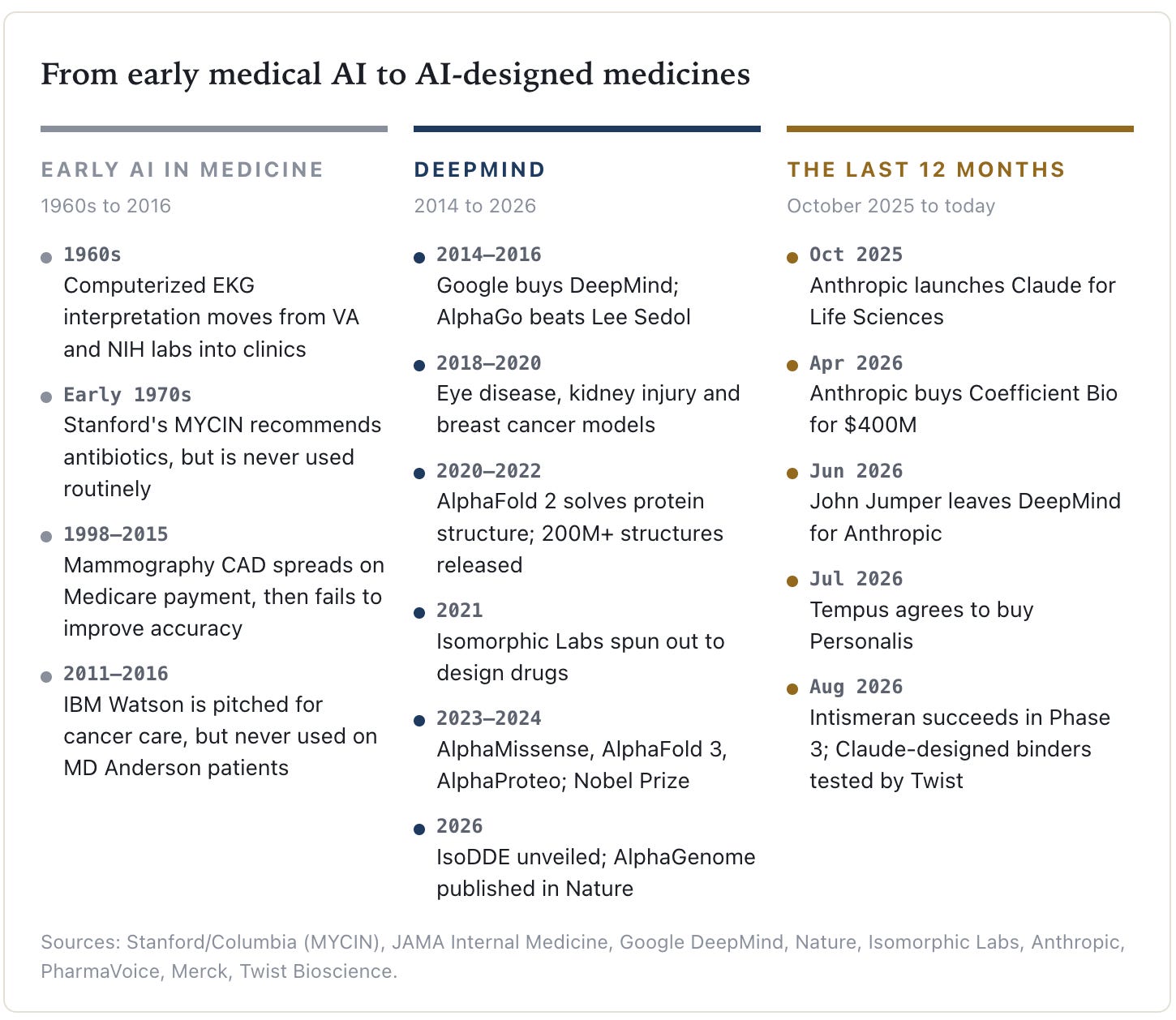
It could be argued that no company has done more to push AI into biology than Google’s DeepMind. Demis Hassabis co-founded it in London in 2010, and Google bought it in 2014. It became famous in March 2016 when its AlphaGo program beat Lee Sedol, one of the best Go players in the world. Around the same time, it started working on healthcare directly, with mixed results. A DeepMind app built for London’s Royal Free hospital led the UK’s data regulator to rule in 2017 that the hospital had broken data protection law by sharing 1.6 million patient records.
The research side, however, did much better. In 2018, a model built with Moorfields Eye Hospital matched expert doctors at recommending the right referral for more than 50 eye diseases. In 2019, a model built with the US Department of Veterans Affairs predicted acute kidney injury up to 48 hours before it happened. Google then moved DeepMind’s health team into Google Health in 2018/2019. Two years later, a joint model cut both missed cancers and false alarms in breast cancer screening.
AlphaFold is what took DeepMind to the next level. Working out a protein’s 3D shape from its sequence had been one of biology’s hardest problems for about 50 years, since shape determines what a protein does and how a drug can bind to it. In November 2020, AlphaFold 2 effectively solved it at the CASP14 competition. DeepMind then gave the predictions away, and the AlphaFold database it runs with EMBL’s European Bioinformatics Institute now holds more than 200 million structures, covering nearly every known protein. Hassabis and John Jumper shared the 2024 Nobel Prize in Chemistry for it.
Since then, DeepMind has kept moving from protein shapes toward actual medicines:
Isomorphic Labs (2021) - Spun out to turn the science into drugs. In January 2024 it signed deals with Eli Lilly and Novartis worth up to ~$3 billion. On top of that, it raised $600 million in March 2025 and another $2.1 billion in May 2026. In February 2026 it unveiled IsoDDE, a proprietary drug design engine. Hassabis has said its first clinical trials should start by the end of 2026, about a year later than he originally hoped.
AlphaMissense (2023) - Classified 89% of 71 million possible single-letter protein changes as likely harmful or harmless, which helps doctors interpret genetic tests.
AlphaFold 3 (May 2024) - Built with Isomorphic, it predicts how proteins interact with DNA, RNA and drug molecules, not just their shape.
AlphaProteo (September 2024) - Designs brand new proteins that bind to a chosen target.
AMIE and the AI co-scientist (2025) - AMIE, a diagnostic chatbot, outperformed primary care physicians in simulated consultations in a Nature paper, and Google’s AI co-scientist proposed drug repurposing candidates for liver fibrosis that held up in lab tests.
AlphaGenome (2025) - Predicts how changes in DNA affect the way genes are switched on and off, with its peer-reviewed paper published in Nature in January 2026.
While DeepMind was leading the space initially, more companies started to compete. A clear sign of that is when John Jumper left DeepMind for Anthropic in June 2026. Based on that, one can infer that the big AI labs see biology as one of their next major markets.
The AI Companies Move In:
In October 2025, Anthropic launched Claude for Life Sciences, connecting Claude to standard industry tools like Benchling and 10x Genomics, with drugmakers such as Sanofi, Novo Nordisk, and AstraZeneca among its users. In April 2026, it acquired Coefficient Bio, an eight-month-old drug discovery startup founded by former Genentech scientists, for $400 million, followed in June by the marquee hire of AlphaFold lead John Jumper. Then, on August 18, Anthropic revealed that Claude had designed protein binders against 15 targets; Twist Bioscience synthesized and tested 1,260 of those designs in under three weeks, successfully confirming binders for 14 of the 15. Between Anthropic's momentum, Google's Isomorphic Labs, and Eli Lilly building what it calls the most powerful drugmaker supercomputer alongside Nvidia, the race in computational biology is rapidly escalating.
One way to approach this is to focus on the companies that make and measure biology, rather than the ones designing the drugs. AI makes designing a molecule cheap, but every design still has to be physically made, sequenced and tested. The more designs AI produces, the more lab work there is to do. Twist’s revenue grew 23% to a record $118.4 million last quarter, and its CEO said more and more groups are “leveraging AI as their first antibody discovery screen.”
Bruker’s instruments can measure more than 10,000 proteins from a single tissue sample, and its spatial biology platform is being used to train biology foundation models, including Noetik’s on more than 3,500 patient samples. The genetic data side matters too. The Regeneron Genetics Center has sequenced roughly 3 million exomes, which is in line with the data AI models need to find new drug targets.
Faster Clinical Trials:
AI is also starting to accelerate clinical trials, which account for much of that time and expense. One of the biggest bottlenecks is identifying qualifying patients, a process that historically requires staff to review medical records manually. In a randomised trial at Mass General Brigham, published in JAMA in 2025, 4,476 patients were evaluated for a heart failure study using either manual chart review or an AI screening tool. The AI arm yielded nearly twice as many enrolments (35 versus 19), with the lead author noting such tools could nearly halve the time required to recruit a trial.
It is still early days, however. The most comprehensive analysis to date, published by BCG researchers in Drug Discovery Today (2024), found that AI-discovered molecules advanced through Phase I trials 80% to 90% of the time, compared to roughly 40% to 65% historically. In Phase II, however, their success rate stood around 40%, aligning closely with industry averages. No AI-discovered drug has secured regulatory approval yet; the furthest along, Insilico Medicine’s rentosertib, only entered Phase III in July 2026.
AI in the Clinic
AI in medicine is a lot older than most people think. Here’s a quick history overview:
Computerised EKG interpretation came out of the US Veterans Administration and the NIH in the 1960s, and it’s still printed on EKGs today because a doctor can check it in seconds.
In the 1970s, Stanford’s MYCIN recommended antibiotics about as well as Stanford’s own faculty, but it was never used routinely, since doctors had to type every detail in by hand.
Mammography CAD spread quickly once Medicare started paying for it in 2001, even though a 2015 study of 625,625 mammograms found it didn’t improve accuracy.
After MD Anderson spent $62 million on IBM’s Watson, an internal audit in 2016 found it wasn’t being used on patients at all.
Today, AI is already part of the job. The American Medical Association’s March 2026 survey found that 81% of US physicians now use AI in their practice, more than double the 38% reported in 2023. Meanwhile, the FDA’s list of authorized AI-enabled medical devices reached 1,614 by the end of June 2026, with roughly three-quarters concentrated in radiology.
Medical imaging remains the most mature clinical application to date, far outperforming legacy CAD systems. Crucially, newer tools can flag subtle, early-stage tumours that human readers easily miss. In Sweden’s MASAI trial of approximately 106,000 women, AI-supported mammography detected 29% more cancers while reducing radiologists’ screen-reading workload by 44%. Final results published in The Lancet (January 2026) also demonstrated a 12% drop in interval cancers between screenings. On the commercial side, GE HealthCare (GEHC) leads the FDA’s authorized roster with 134 devices, followed by Siemens Healthineers (SHL) at 101 and Philips (PHG) at 62.
Beyond diagnostics, AI is also moving treatment away from one-size-fits-all regimens toward individualised care. Tempus, for instance, sequences patient tumours and cross-references them against one of the world’s largest clinical and molecular databases to help oncologists select targeted therapies.
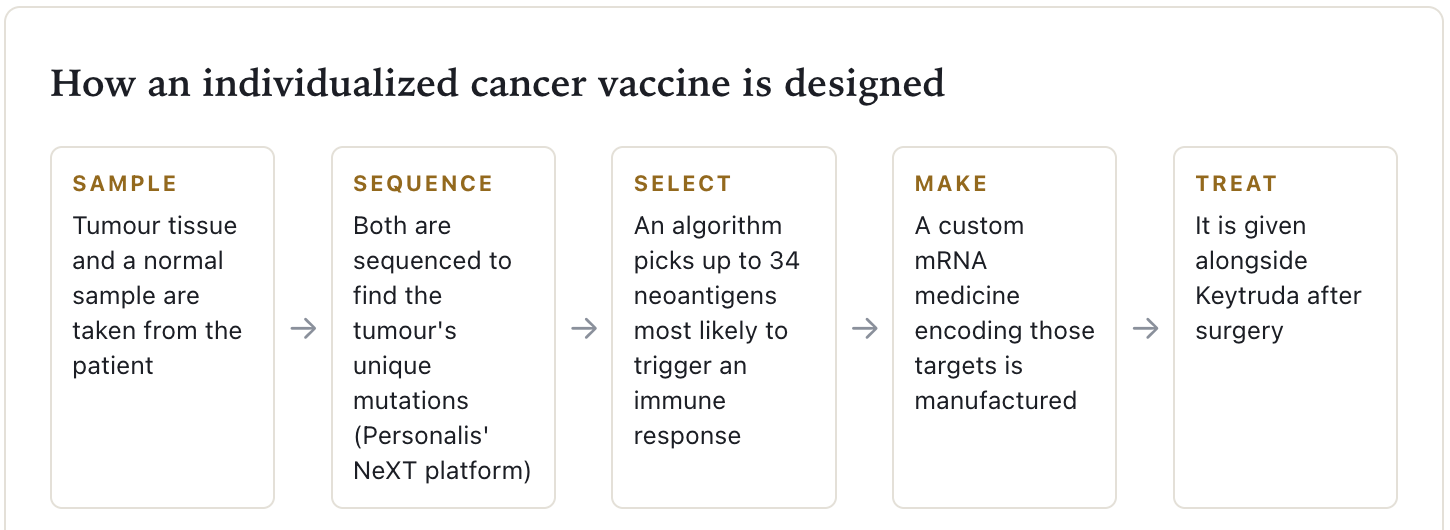
Recent progress in personalised mRNA demonstrates where this convergence is heading. On August 19, 2026, Merck and Moderna announced that intismeran met its primary endpoint in a Phase 3 trial of 1,137 patients with resected, high-risk melanoma. Each patient’s tumour is sequenced, an algorithm selects up to 34 neoantigens for the immune system to target, and those instructions are synthesized into a custom mRNA vaccine administered alongside Keytruda. Adding the personalized vaccine significantly improved recurrence-free survival compared to Keytruda alone, although detailed figures remain pending. Personalis has provided the clinical tumour sequencing for the program since the Phase 2b trial.
AI in the Hospital
Unsurprisingly, the fastest-adopted hospital tool has been the AI scribe, which drafts notes during visits so doctors can focus on patients. With documentation tied directly to billing, US scribe spending led healthcare AI in 2025 at ~$600 million (Menlo Ventures). Still, it is low-hanging fruit. A major April 2026 JAMA study found scribes saved just 16 minutes of charting a day and added only ~$167 a month per clinician. Because Epic integrates scribes natively and Doximity (DOCS) gives one away for free, enduring value will likely sit with workflow owners like Microsoft (MSFT), Oracle (ORCL), and Epic, rather than standalone startups.
Behind the scenes, hospitals are using AI for operations. A Johns Hopkins command centre built with GE HealthCare forecasts patient volumes, opening the equivalent of 16 extra beds a day without new staff or wings.
Prior authorisation is next: US insurers covering 257 million people pledged that 80% of electronic requests will resolve in real time by 2027, while Medicare’s six-state WISeR pilot has tested AI-assisted approvals since January 2026.
The Guardrails
Healthcare cannot “move fast and break things” the way consumer tech does. Doctors are clearly open to AI, but in the same AMA survey, 88% said robust safety and efficacy validation was critical for broader adoption, and 86% said the same about data privacy. In no particular order, the main challenges are:
No guessing allowed: Medical AI cannot afford hallucinations. In October 2024, the AP reported that OpenAI’s Whisper (the speech recognition model behind Nabla’s scribe used by over 30,000 clinicians) sometimes invented sentences no one had spoken, including made-up treatments. On top of that, doctors need clear explainability: they must see why a model made a recommendation before acting on it.
Avoiding bias: A 2019 study in Science revealed that a widely used triage algorithm relied on past healthcare spending as a proxy for illness. Because less money had historically been spent on Black patients, the model rated them as healthier than equally sick white patients. Correcting that bias would have increased the share of Black patients flagged for extra care from 17.7% to 46.5%. Similarly, an algorithm trained mostly on large urban academic centers often falters when applied to rural populations.
Privacy and liability: Health records are among the most sensitive personal data that exists. As the UK’s Royal Free case proved, sharing patient data carelessly can breach privacy laws even when intentions are good. Legal liability remains another gray area. The Federation of State Medical Boards stated in 2024 that physicians remain ultimately responsible for their care decisions, regardless of AI input. Unsurprisingly, clear liability frameworks topped doctors’ wish-list for regulators in the AMA survey.
The Horizon
Over the next three to five years, the bigger change will likely be multimodal AI that reviews everything at once: lab results, scans, genetic tests, and clinical notes, acting as a co-pilot for the entire care team. Early versions are already here. In June 2025, Microsoft released a preprint showing its MAI-DxO system correctly diagnosed about 85% of 304 complex New England Journal of Medicine case challenges, compared with 20% for experienced physicians. However, those physicians were barred from consulting colleagues, textbooks, or AI tools. In January 2026, OpenAI launched ChatGPT Health and Anthropic released Claude for Healthcare, both of which allow patients to connect their own medical records.
What these tools have in common is that they are only as good as their underlying data. An algorithm cannot interpret a genetic panel, a tumour sequence, or a protein readout until someone physically generates it in a lab. Consequently, the more clinicians lean on AI, the more wet-lab testing must happen upstream before any real progress can occur.
What We’ll Cover Next
Each of these themes deserves a deeper dive. Here are a few questions we plan to dig into:
AI-Designed Drugs: Key players include Isomorphic Labs (Alphabet, GOOGL), Eli Lilly, Nvidia, Recursion Pharmaceuticals (RXRX), and Insilico Medicine. The central question is whether AI-designed molecules can improve Phase II success rates, where most drugs fail, and who captures the economics when they do. Isomorphic’s first clinical trials and rentosertib’s Phase III readout are the next major checkpoints.
mRNA and Personalised Cancer Vaccines: Looking at Merck, Moderna, Tempus, and Personalis, we will examine the full intismeran dataset, the regulatory pathway, and what it actually takes to manufacture a bespoke medicine for every individual patient at commercial scale.
The Lab Behind the Models: Focusing on Twist Bioscience, Bruker, Danaher (DHR), Agilent (A) Illumina (ILMN) and others, the core question is how much incremental demand AI-driven biology creates for DNA synthesis, sequencing, and proteomics, and which toolmakers are best positioned to capture it.
Genomics and Gene Editing: Covering Regeneron (REGN), Amgen (AMGN), Vertex (VRTX), CRISPR Therapeutics (CRSP), Intellia (NTLA), Beam Therapeutics (BEAM), and Prime Medicine (PRME). On the data side, pharma giants like Amgen (via deCODE Genetics) and Regeneron are racing to mine massive human genetic databases, with Regeneron partner Truveta aiming to sequence up to 10 million patients. On the therapeutic side, following the landmark approval of Vertex and CRISPR Therapeutics’ Casgevy, pure-play biotechs like Intellia, Beam, and Prime are advancing next-generation modalities such as in vivo delivery, base editing, and prime editing. We will explore who controls the most valuable genomic datasets for target discovery, how AI is beginning to design novel gene editors, and which platforms are best positioned for commercial scale.
Conclusion
In years past, much of the conversation around AI in healthcare may have been focused on things like saving doctors time on paperwork. That has happened. Scribes caught on so quickly that they are already widely adopted across hospitals and clinics.
The harder and more valuable frontier is biology. DeepMind spent a decade proving AI can model proteins and DNA, Anthropic and Google are now racing to turn those insights into medicines, and the intismeran readout shows what an algorithm-designed treatment can achieve in a late-stage trial. AI-designed drugs still have to prove themselves in Phase II and clear the FDA, but every candidate must be synthesized and tested along the way, which is where the revenue is showing up first.
Because of healthcare’s necessary guardrails, AI integration will likely take longer to play out here than in most industries. For now, we believe the companies that synthesize, sequence, and measure biology, alongside those that own the underlying genetic data, offer the cleanest way to play the theme. We will take a closer look at each of these areas over the next few write-ups.
Thank you for reading. If you enjoyed this post, please leave a like and Restack.
Subscribe to the plan that best suits your needs and will see you in the next one!