

In this post, Nik Tirupathi and I break down the investment case for Cerebras Systems Inc. (CBRS). Note: All first-person references ('I,' 'me,' 'my') refer to Nik.
This post is for informational purposes only and does not constitute financial advice. Please conduct your own due diligence before purchasing any equities or assets discussed herein.
Layout:
Overview of Cerebras Systems Inc
Bull and Bear Case
Management
Financials and Valuation
Chart
Current position and plans
Executive Summary
Cerebras Systems Inc. produces the fastest inference hardware available, and its wafer-scale architecture differs fundamentally from traditional GPUs. The core differentiation is speed, not cost or capacity. Bears argue that Cerebras’s Wafer-Scale Engine 3 (WSE-3) cannot reach the cost floor of a batched GPU, confining it to a premium, latency-sensitive niche rather than the broad inference market.
However, I largely agree with bulls like UBS analyst Tim Arcuri regarding an industry shift toward disaggregated inference, where prefill and decode run on separate, specialized hardware, expanding latency-sensitive solutions into mainstream inference workloads. I remain more cautious than Tim on two fronts: the total share of the decode TAM that Cerebras can capture, and the on-chip memory constraint, which I expect will bind more tightly as long-context reasoning models and agentic workflows become the primary AI use cases.
I would turn more constructive on evidence of revenue scaling beyond anchor customers, such as converting all tranches of the OpenAI agreement, accelerating the AWS rollout, and recovering gross margins in line with UBS’s optimistic projections. Conversely, I would downgrade my view if competing solutions from Nvidia or Groq capture greater decode market share, or if memory constraints limit adoption sooner than anticipated.
Rating: Buy
12 month Price Target: $260
Current Price: $218
Upside: 19%
I give Cerebras (NASDAQ: CBRS) a buy rating. I estimate 2029 revenue of approximately $10B in my base case and a price target of $260, against a UBS price target of $300.
Cerebras Systems Inc. (CBRS)
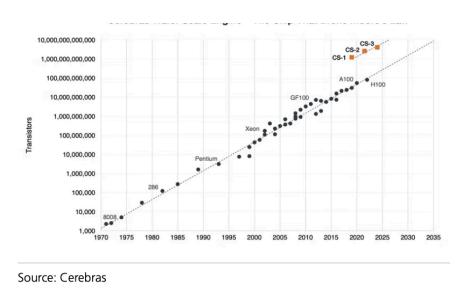
Cerebras builds AI compute systems around the WSE-3, the largest chip in production, comprising roughly 46,225 mm2 of silicon, 4 trillion transistors, 900,000 cores, and 44 GB of on-chip SRAM on TSMC's 5nm process.
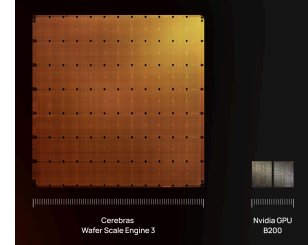
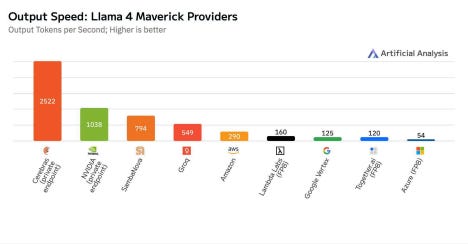
By integrating compute and memory on a single wafer, the design delivers 21 PB/s of on-chip bandwidth and single-stream decode roughly 10 to 20 times faster than a standard GPU rack. The chip ships in the CS-3 system, which costs an estimated $2M to $3M, draws roughly 23 kW, and requires proprietary liquid cooling and dedicated power delivery. The company generated $510M in revenue in 2025 and completed its IPO in May 2026. Its revenue base is anchored by a 750 MW, $20B-plus inference agreement with OpenAI and a disaggregated inference partnership with AWS, alongside a roster of enterprise customers.
Inference Economics
Transformer inference runs in two phases:
Prefill: Processes the prompt in parallel and is compute-bound.
Decode: Generates output one token at a time and is memory-bandwidth bound. Decode dictates latency, which is where Cerebras’s bandwidth advantage applies.
On GPUs, weight reads during decode are shared across batches, amortizing memory costs as batch sizes grow. Cost per token falls until the processor reaches its “balance batch” (where it becomes compute-bound), determined by the compute-to-memory bandwidth ratio ($F/BW$).
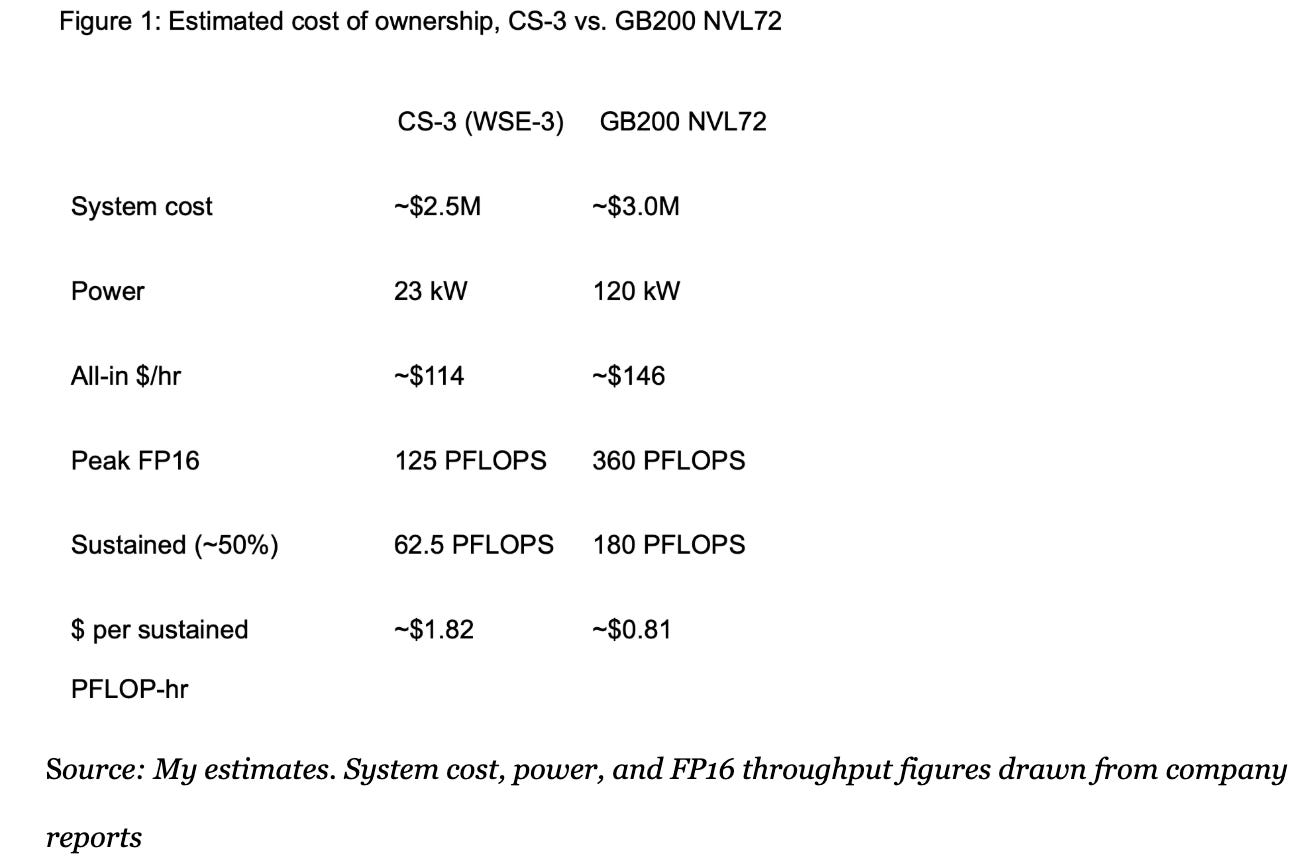
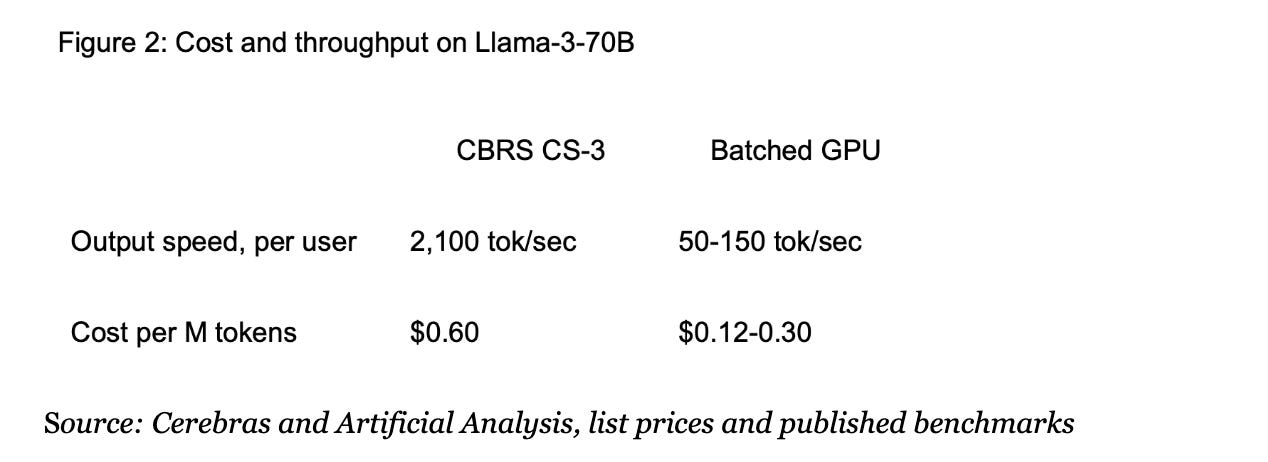
According to MatX CEO Reiner Pope, standard GPUs operate at an $F/BW$ ratio of ~300 and balance in the low thousands of sequences. By contrast, Cerebras dedicates far more silicon to bandwidth, operating at an $F/BW$ near 10–15 and balancing at just a few dozen sequences. Figures 1 and 2 illustrate the resulting cost impact.
Bull Case
The Moat Exists in Speed
Historically, wafer scale integration is very difficult to replicate given yield, packaging, high-density power delivery, thermal, and software-stack, and CBRS’s on-wafer interconnect gives it an advantage over peers such as Groq. That advantage is concentrated in single-model, low-concurrency, serving a premium tier of buyers.
The Total Addressable Market (TAM) is Large
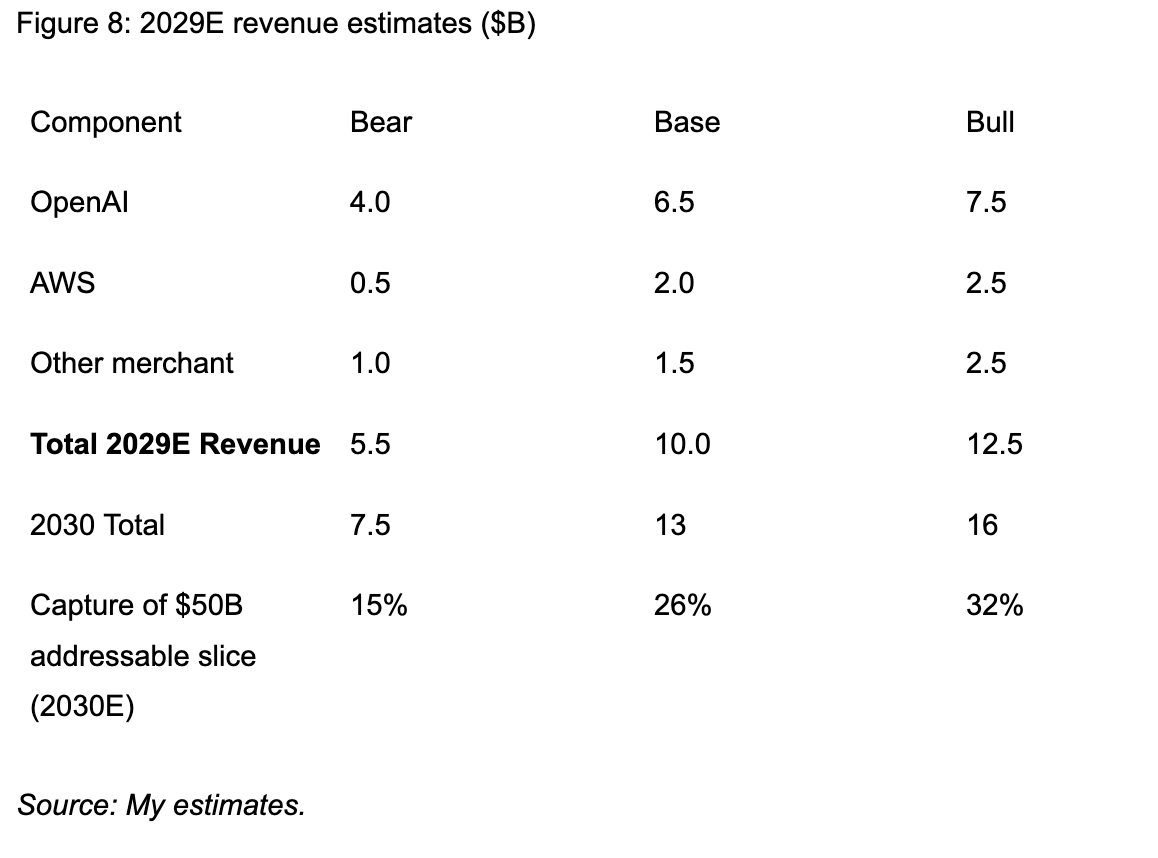
Looking at the addressable-market analysis (See Figure 3 in Financials and Valuation), the revenue estimates (See Figure 8 in Financials and Valuation), and disaggregated build outs at Nvidia and AWS, the TAM is large. CBRS has a year end 2025 backlog of $24.6B, and adoption across Mistral, Perplexity, Cognition, Meta’s Llama API, and Notion which is positive for enterprise.
The TAM question is critical and hinges on two dynamics:
Inference Disaggregation: The industry is decoupling compute-bound prefill (on GPUs/custom ASICs) from memory-bound decode (on bandwidth-optimized silicon). For example, AWS pairs Trainium for prefill with CS-3 for decode via Amazon Bedrock. Early adoption by OpenAI and hyperscalers suggests disaggregation could define the future of inference architecture.
Shift to Agentic Workloads: Rising demand for reasoning and agentic workflows places a premium on token speed, expanding the fast-inference TAM and Cerebras’s target opportunity.
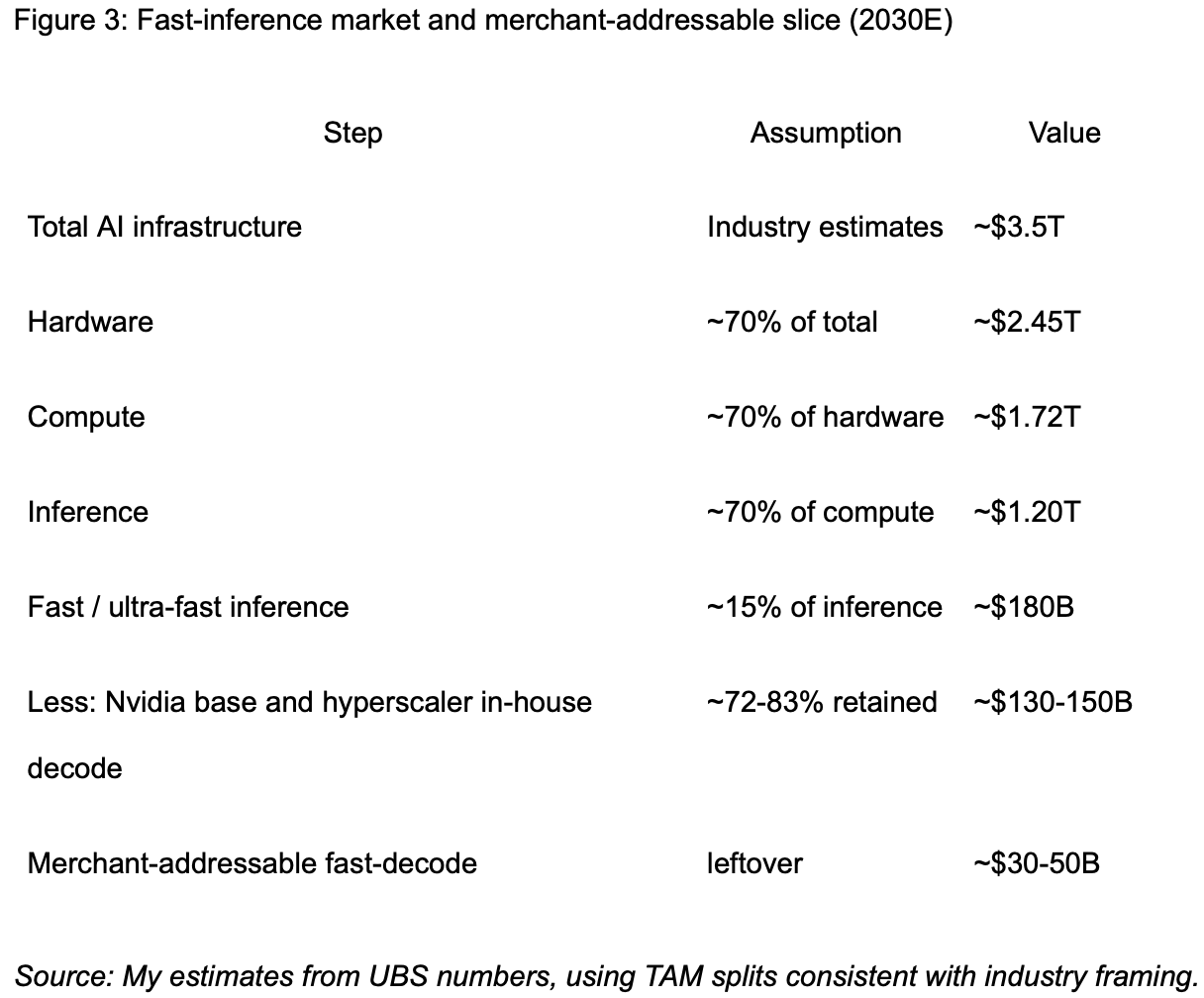
However, several hyperscalers rely on in-house silicon (Google TPUs, Microsoft Maia, Meta’s MTIA) and are unlikely to adopt Cerebras. Meanwhile, Nvidia and Groq will capture substantial decode share via existing moats and scale. This leaves an addressable market of roughly $30B–$50B for Cerebras.
Cerebras engineers estimate fast inference at ~5% of general inference TAM (~$60B), far more conservative than UBS’s $180B projection, yielding an addressable slice of $30B–$60B. Cerebras currently commands 1–5% of latency-sensitive inference; by my estimates, it must capture 16.7%–33.3% of this slice to achieve $10B in revenue by 2029.
CBRS CS-3 is Competitive Compared to Batched GPUs
When workloads demand ultra-low latency, GPUs must drop batch sizes, wiping out their throughput advantage and narrowing the gap to pure compute costs. While Figure 2 highlights a 2–5x cost penalty for a latency-optimized CS-3 compared to a throughput-optimized GPU, Cerebras becomes price-competitive when GPUs are locked into the same low-latency constraints (see Inference Economics in Financials and Valuation).
Applications of CBRS-Class Latency
Applications of CBRS-class latency are interactive assistants, voice, and real-time agents, sectors where I see a real and growing opportunity. Latency is important in interactive models, and where the bulk of enterprise and merchant revenue will flow for Cerebras.
Creation of Ultra Premium Tier to Capture Revenue for Price-Insensitive Buyers
For cost-insensitive buyers, pooling multiple Cerebras CS-3 systems enables support for larger parameter models without sacrificing low latency, establishing an ultra-premium tier for coding and general-purpose agents. This allows Cerebras to capture revenue across diverse buyer segments
Bear Case:
An Increasingly Competitive Market
The TAM is large but increasingly competitive, as disaggregated inference is adopted by both Nvidia and AWS. UBS projects fast inference at roughly $180B by 2030, a figure I agree with, but I believe the addressable slice for Cerebras is smaller at $30B to $50B once Nvidia’s installed base and decode-capable hyperscaler silicon are excluded, such as Google TPUs, Microsoft Maia, and Meta MTIA. Furthermore, the conversion of the OpenAI and AWS programs within this fast-inference niche is already priced in (see Figure 3)
On raw compute, GPUs are roughly 2.25x cheaper per sustained PFLOP-hour than the CS-3.
Memory Capacity: The Binding Constraint
The main reason my target sits below analyst estimates is the on-chip memory constraint, which I expect will cap Cerebras’s upside in the long-context, high-concurrency segment of the market.
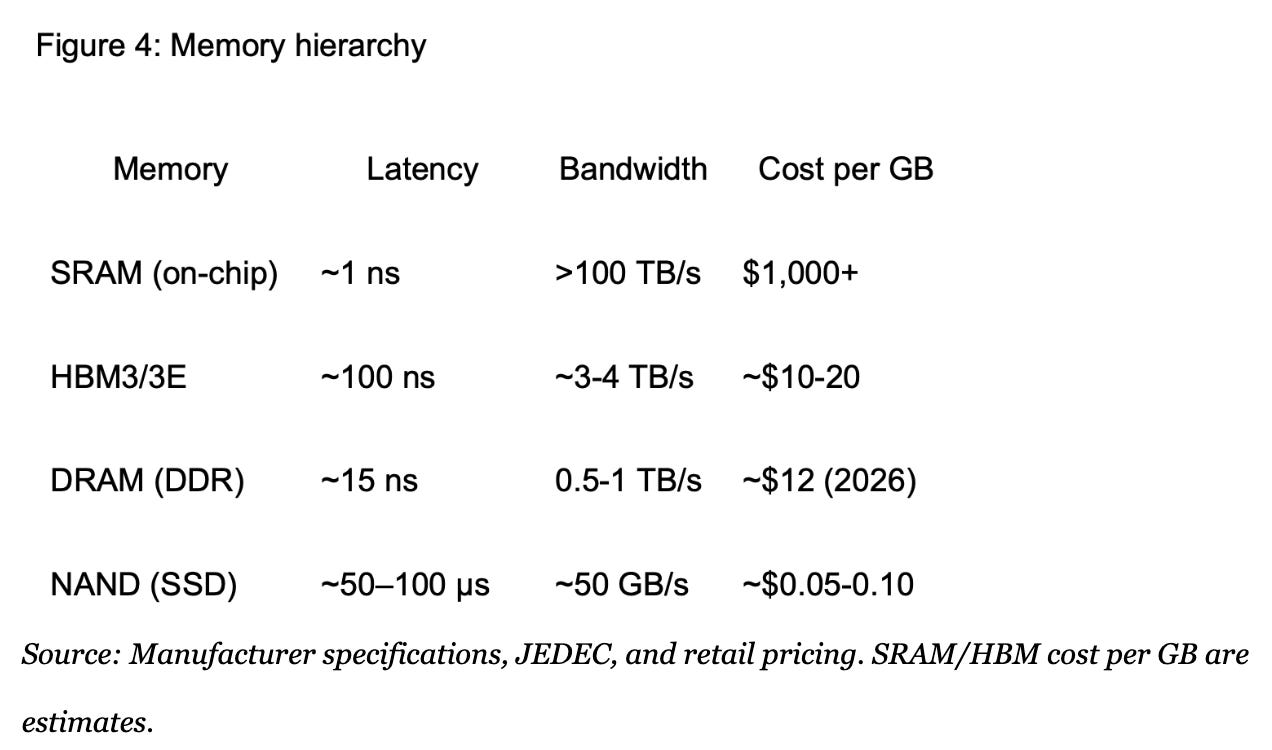
During decode, the KV cache stores the attention state for every token in context. Its size is approximately batch size times context length times bytes per token ($B \times L \times b$). Unlike the weight read, which amortizes across a batch, the KV cache is unique to each sequence and never amortizes. Cerebras’s advantage holds only while the weights plus KV cache fit within its 44 GB of on-chip SRAM. Once memory overflows, the excess must be served from external memory with higher communication latency, causing the system to perform more like a standard GPU. However, a GPU carries far more base memory and efficiently directs overflow into DDR, flash, and disk storage. Figure 4 illustrates why on-chip capacity remains constrained: SRAM costs roughly two orders of magnitude more per gigabyte than HBM.
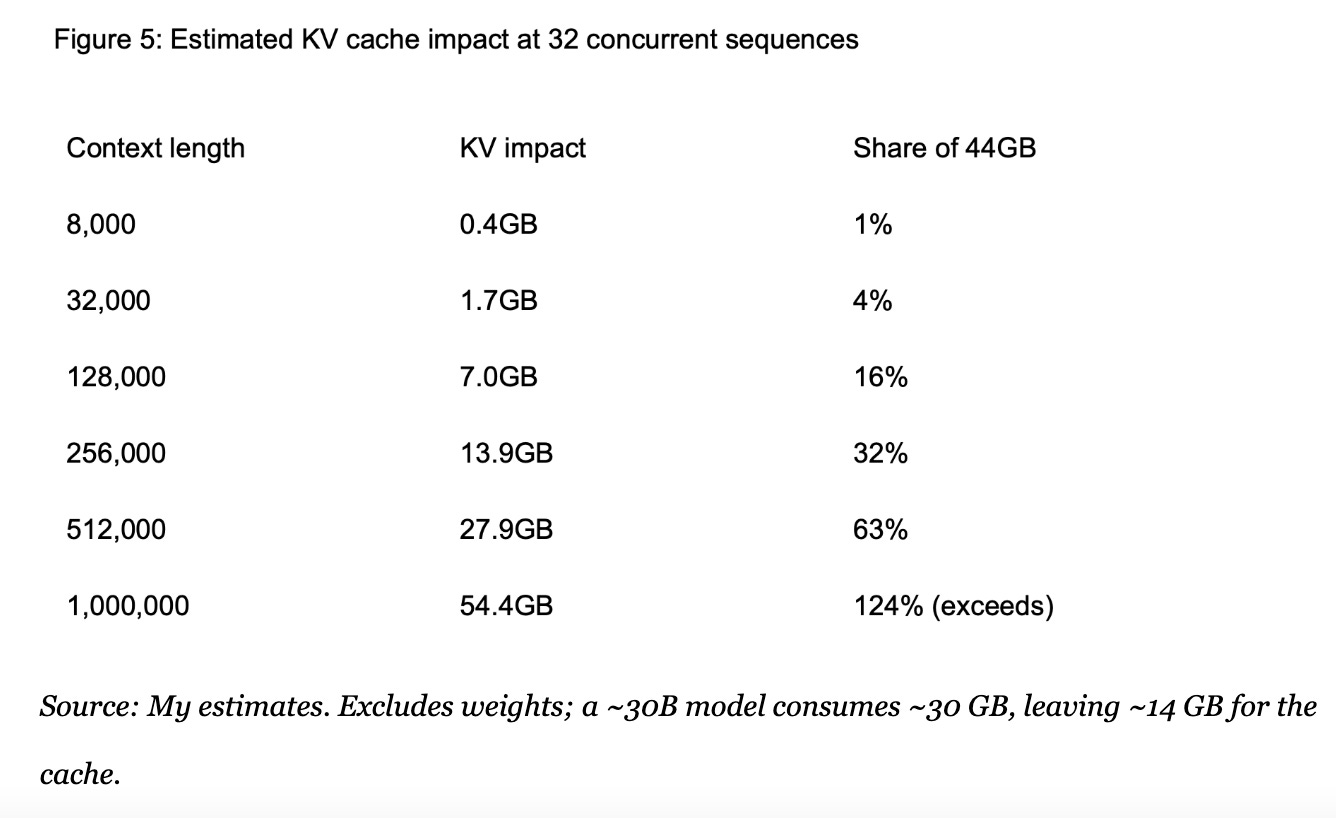
The 44 GB holds weights and cache together. For smaller models like the roughly 30B Codex-Spark model that’s fine, because weights at FP8 (a computation format to save memory) consume roughly 30 GB, leaving low-teens GB for the cache. But this does not work as well for larger models, Figure 5 shows the data at a concurrency of 32 sequences, consistent with CBRS's low-batch.
Recent algorithmic shifts directly address the KV cache bottleneck. Both grouped-query attention (4–8x reduction) and multi-head latent attention (10–40x reduction) drastically lower the per-token memory footprint. The specifics of what each does exactly is not relevant, except that this lower footprint expands the effective token capacity of a single wafer, enabling multi-million token contexts to run on-chip without hitting memory walls (Figure 6).
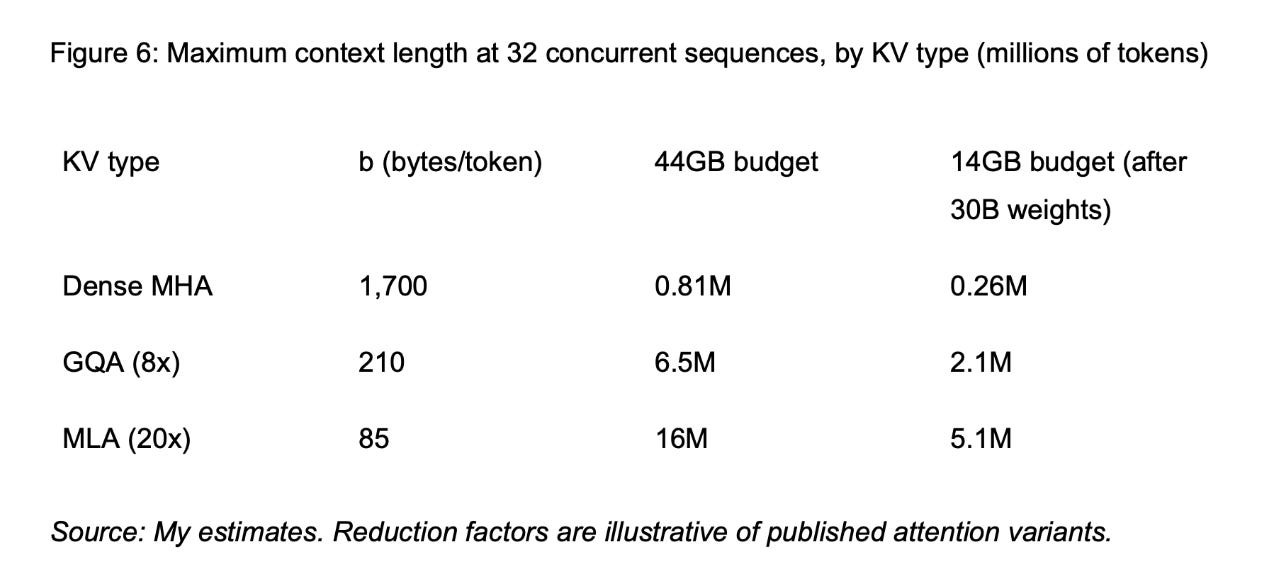
But KV cache compression does not change Cerebras’ competitive position. First, shrinking the memory per token is a one-time gain, but as context lengths grow larger and there are a higher frequency of queries from broader AI use this matters less. A 10x reduction provides just ~3 doublings of context headroom which exponential context growth will consume quickly. Second, the saving is not unique to Cerebras. A GPU reaps the exact same benefit, improving its decode performance proportionally more than the CS-3 (Figure 7).
The better solution is expanding capacity rather than compressing it by clustering multiple wafers. Cerebras’s compiler and Cluster Manager stitch several CS-3s into a single logical machine where a pod of four acts as a single chip with ~176 GB of SRAM, avoiding the more complex multi-GPU interconnects required by CUDA.
While clustering solves memory capacity, multi-system scaling raises hardware costs and introduces inter node communication that hurts cost efficiency, whereas GPUs can handle context growth locally up to their HBM limits. Also, pooled SRAM is not as fast. When one wafer requests data stored on another, it must reach across a system-to-system link that is slower than local on chip SRAM. The pod functions less like one massive memory pool and more like isolated islands of ultra fast memory connected by slow bridges (Figure 7).
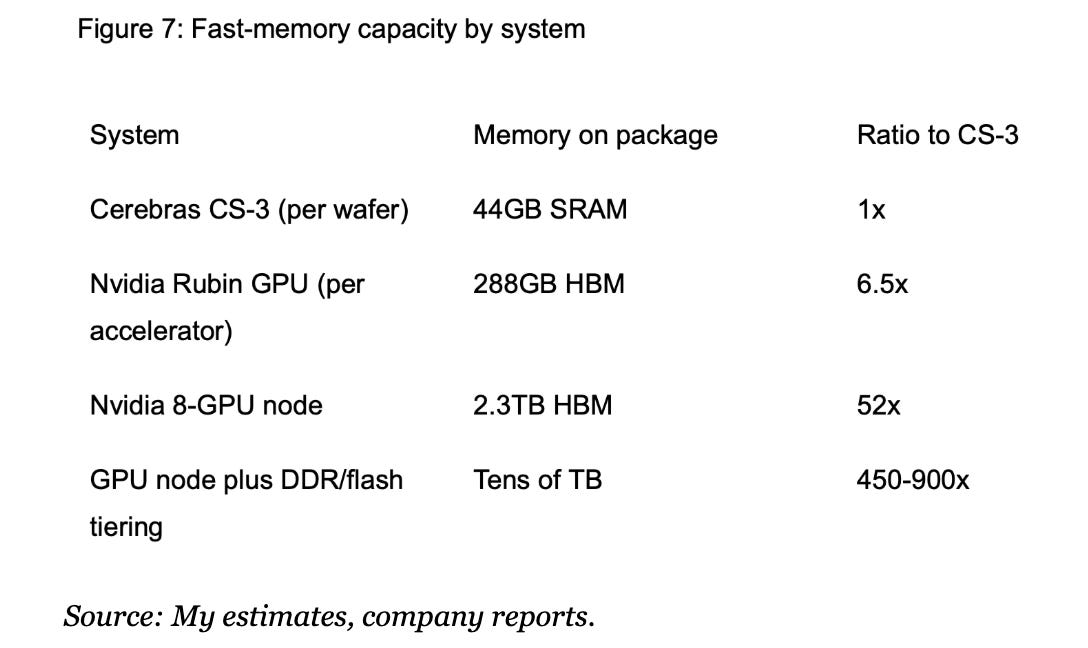
A multi-GPU node holds roughly fifty times more KV in HBM than a CS-3, and two to three orders of magnitude more once cheaper tiers are included, at any per-token KV size. CBRS cannot tier without surrendering the bandwidth that is its competitive advantage, and its SRAM scale up advances slowly, from 44 GB on WSE-3 to only slightly more in later generations. The number of concurrent long-context sessions a CS-3 can serve is therefore a small fraction of a GPU node’s.
This defines the central tension in the hardware. The reasoning and agentic wave raises the value of token speed, which favors CBRS, and inflates the KV cache, which does not. As long as the memory wall has no straightforward solution and HBM capacity is not improving quickly enough, I would expect any advance to slightly favour tiered GPU systems more than CBRS, except for latency sensitive workflows, which is why I’m more pessimistic than the analysts.
KV cache. approximately B x L x b, with b roughly 1.7 KB/token under dense attention. At B=2,000 and L=100,000 this is roughly 340 GB against 44 GB. Compression (Figure 6) lowers b by roughly 4 to 40x and moves the absolute ceiling to multi-million-token contexts; the relative gap (Figure 7) is unchanged, as a GPU node holds roughly 50x more KV in HBM and 450 to 900x+ with tiering.
Latency Advantage: Application by Application
The applications where Cerebras-class latency provides a definitive edge remain mixed.
First, in high-frequency and quantitative trading, industry feedback indicates that ultra-low latency requirements operate on timescales far below what any language-model silicon can reach. The Taalas HC1, for instance, hardwires model weights and architecture directly into the silicon to achieve over 16,000 tokens per second, roughly 8x faster than any Cerebras chip. Quantitative trading firms would likely favor hardwired solutions like Taalas, despite higher unit costs.
Second, as noted in the bull case, Cerebras boasts a backlog of roughly $24.6B with adoption across Mistral, Perplexity, Cognition, Meta’s Llama API, and Notion. However, a notable counterexample is the May 2026 Thinking Machines interaction model, a 276-billion-parameter mixture-of-experts activating only 12 billion parameters. By combining a low active parameter count with software optimization, it achieved a turn-taking latency of 0.40 seconds (versus 1.18 seconds for its nearest competitor) on Nvidia Blackwell GPUs without specialized silicon. This demonstrates that ultra-low latency can be achieved on general-purpose hardware, potentially narrowing Cerebras’s addressable market over time.
Lastly, in coding and agentic workflows, Cerebras hosts OpenAI’s Codex-Spark and Cognition’s SWE-1.6, both of which are well-regarded for high-tool-turn tasks. However, developer feedback and industry surveys point to a clear preference for higher reasoning capabilities over raw speed for complex execution. Furthermore, the market is shifting toward autonomous background agents that operate without a human on the critical path, making workloads batchable and inherently better suited to standard GPUs.
Other Risks:
Merchant capture. My base case relies on OpenAI conversion. Competition from peers (SambaNova, d-Matrix, Etched, Tenstorrent, Taalas) and hyperscaler in-house silicon could limit share beyond the anchor customers.
Memory capacity. The relative capacity gap versus tiered GPU systems survives KV compression (Figure 7), and could bind sooner than I assume as context and concurrency rise.
Erosion of the latency advantage. Nvidia is raising scale-up domain size (8 to 72 to a planned 500-plus) and per-chip bandwidth (~8 to ~22 TB/s), lowering the GPU latency floor and making fast-enough cheaper for a widening set of workloads.
Customer concentration and backloading:
Three customers individually represented 34%, 32% and 10% of second-quarter 2026 revenues,
OpenAI dependence: The OpenAI agreement is three 250 MW tranches, roughly 15% expected across 2026 and 2027, the remainder milestone based, with a working-capital loan of roughly $1B carrying repayment triggers and warrants vesting only above thresholds including a $40B market cap and full delivery.
Supply-chain scaling. CBRS must scale nearly tenfold while relying on third parties, and a higher liquid-cooling flow requirement (~100 L/min against ~80 for a comparable Nvidia deployment) lowers available colocation sites.
Geopolitical and regulatory. Reliance on TSMC and exposure to sensitive markets (G42, MBZUAI) create risk from export controls, sanctions, and tariffs.
Nik’s Outlook:
My base case assumes solid conversion of the OpenAI backlog, with the first two tranches ramping and the third partially contributing by 2029, alongside modest AWS expansion and steady merchant growth. My bull case models fuller OpenAI conversion and greater AWS upside, reaching consensus revenue. My bear case reflects OpenAI tranche slippage and minimal AWS contribution. Crucially, neither the base nor bull case relies on taking contested market share; upside is driven by converting contracted OpenAI and AWS backlog rather than displacing Nvidia or hyperscalers.
Revenue mix is the second headwind, weighing on margins rather than top-line growth. The bulk of contracted revenue comes from OpenAI, which UBS models primarily as cloud rather than hardware, with hardware layering in only around 2028 due to OpenAI’s lack of dedicated data center capacity. Cloud carries lower gross margins because Cerebras absorbs colocation, power, and cooling costs, explaining why near-term gross margin guidance was revised down from ~46% to ~37% as rented capacity bridges the ramp.
This cloud shift is structurally driven: the CS-3 demands proprietary liquid cooling (~100 L/min vs. ~80 L/min for a comparable Nvidia system) and specialized power delivery, making it difficult to deploy in standard customer facilities and easier to sell as hosted capacity. However, intense data centre colocation competition poses a structural constraint on long-term revenue, as securing large-scale capacity commitments will prove challenging for a company with limited cloud operating history.
Management
Cerebras was founded in 2015 by a team of five co-founders: Andrew Feldman, Gary Lauterbach, Michael James, Sean Lie, and Jean-Philippe Fricker. All of the founders previously worked together at SeaMicro, a company founded by Feldman and Lauterbach, which was then sold to AMD for $334 Million.
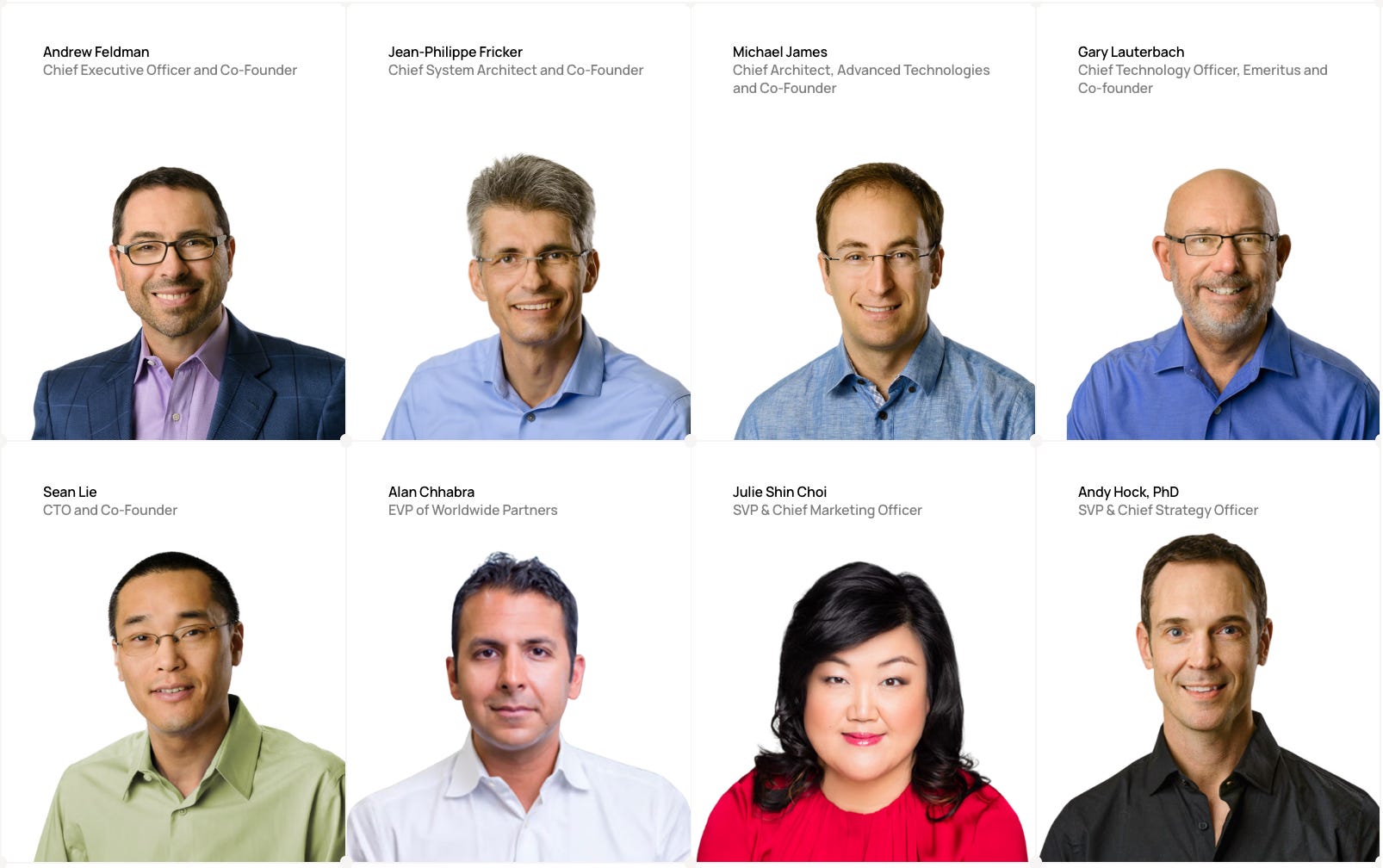
In 2015, the five co-founders founded Cerebras to pursue wafer-scale integration, a problem the semiconductor industry had largely written off due to chip yield constraints. They leveraged their experience building fabric-based computing systems at SeaMicro to develop software based redundancy to route around the yield loss that comes with manufacturing defects across an entire wafer. Over the years, they developed cooling and power systems, as well as custom manufacturing equipment capable of driving dozens of screws into the wafer simultaneously without cracking it.
Feldman has served as CEO since founding the company. Lauterbach and Lie serve as CTO and Fricker as Chief System Architect. James is Chief Architect for Advanced Technologies. All five have played a prominent role in leading Cerebras through three generations of growth for their Wafer-Scale Engine (WSE) processors, with a highly anticipated upcoming release for their fourth generation WSE-4.
Given that the team skews heavily toward the original founders who are serving in technical leadership roles, Cerebras has an experienced leadership group with impressive backgrounds and resumés. In addition to building SeaMicro which was acquired by AMD, Feldman and Lauterbach then spent several years running parts of AMD’s data center business. Feldman served as Corporate Vice President and General Manager, and Lauterbach was CTO of AMD’s data center server business.
Notably, Bob Komin joined as CFO in one of the company’s more recent executive additions. Previously he was CFO of Sunrun, and guided them through their IPO.
Financials and Valuation:
Financials
At the time of writing, CBRS has a Market Cap of $66.95B with Cash & Inv. of $7.92B and Debt of $1.49B. CBRS has Net Cash positive and a Debt to Equity ratio of 0.1.
TTM Performance:
Revenue TTM: $680.67 (M)
Gross Profit TTM: $237.1(M)
Operating Income TTM: ($552.48) (M)
Net Income TTM: ($512.35) (M)
Q2 2026 Highlights:
Record Core Revenue: $209.9 million, representing 103% year-over-year growth.
Cloud Services: Core cloud and other services revenue reached $127.7 million, up 287% year-over-year.
Gross Margin: Core gross margin was 40.6%, with cloud services margins at 41.8%.
Operating Leverage: Core operating margin improved by 2,600 basis points year-over-year to -16%.
Strong Liquidity: The company ended the quarter with over $8.6 billion in cash, cash equivalents, and marketable securities
Valuation:
CBRS trades at:
67 LTM EV/S and 31x NTM EV/S.
5.4x Price to Book
154x NTM EV/EBITDA
Clearly this is not a stock with valuation support.
Revenue Estimates (Nik)
I estimate 2029 revenue of approximately $10B in my base case (Figure 8). Customer-level estimates use a revenue-per-megawatt figure of approximately $9.5M, implied by the OpenAI deployment trajectory, applied to converted capacity.
Valuation and Price Target
The higher-margin hardware path runs mainly through AWS, but that remains a 1,000-system pilot under an unsized framework whose material contribution UBS places closer to 2030. Meanwhile, cloud-heavy OpenAI revenue peaks near $7.1B in 2028 and drops toward $4.1B by 2030 as earlier tranches mature.
Because Cerebras’s cloud-delivery model carries higher capital intensity and lower gross margins than asset-light peers operating in the 60%-plus range, I do not model a return to the low-60s gross margin that consensus projects by 2028–2029. Instead, I reflect this margin pressure by discounting the 11.9x compute peer average to a 9.5x EV/Sales multiple on 2029E revenue. This remains above the 7.0x cloud average to credit Cerebras’s wafer-scale IP and category-leading growth (Figure 9).
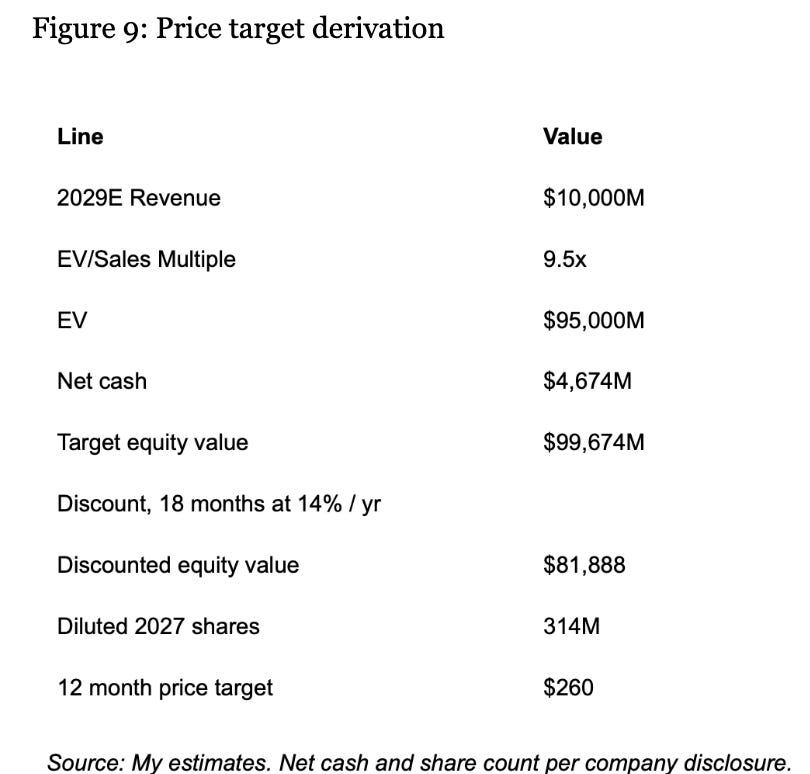
The same $260 results from applying an 8.5x multiple to analyst’s $11.2B revenue which is possible given the shift to lower margin cloud. Figure 10 shows the price target across revenue and multiple assumptions.
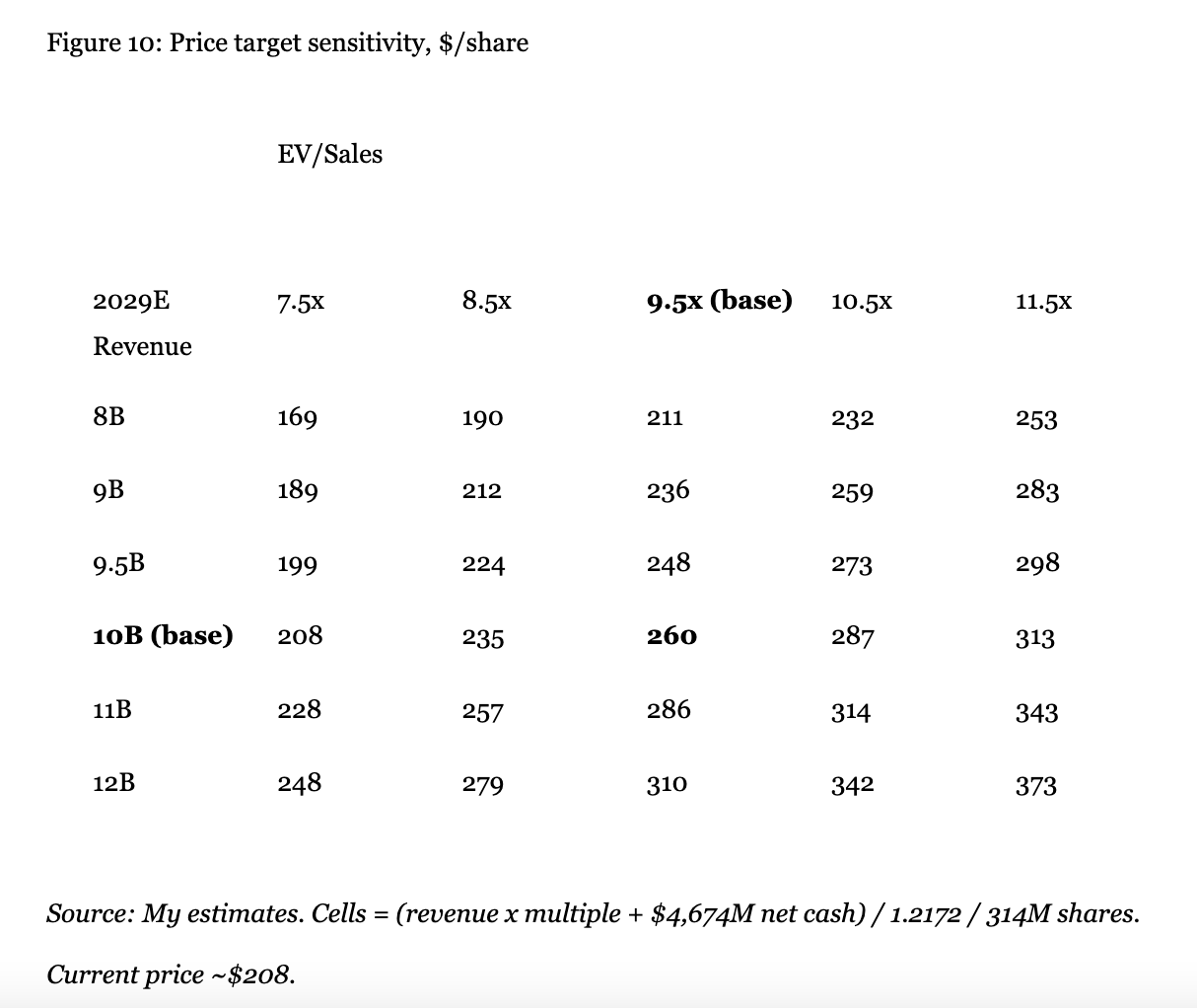
At 9.5x EV/sales and current SP of $218, I believe the market is pricing in 8.28B in 2029 rev which is 19.13% upside.
Does the valuation compensate the buyer for the risks?
Fair value across a range of revenue and multiple assumptions (Figure 10), I believe places the current price in the bottom half of the reasonable range and the risk/reward as positive.
Balance batch. B = (F/BW) x (N_total / N_active). A GPU at F/BW ~300 with a mixture-of-experts activating ~1/8 of parameters gives B* ~2,400; CBRS at F/BW ~10 to 15 balances at a few dozen.
Revenue per MW. OpenAI revenue of $7.1B at approximately 750 MW implies $9.5M per MW-year, used to scale converted capacity to revenue in Figure 8.
Chart and Technicals
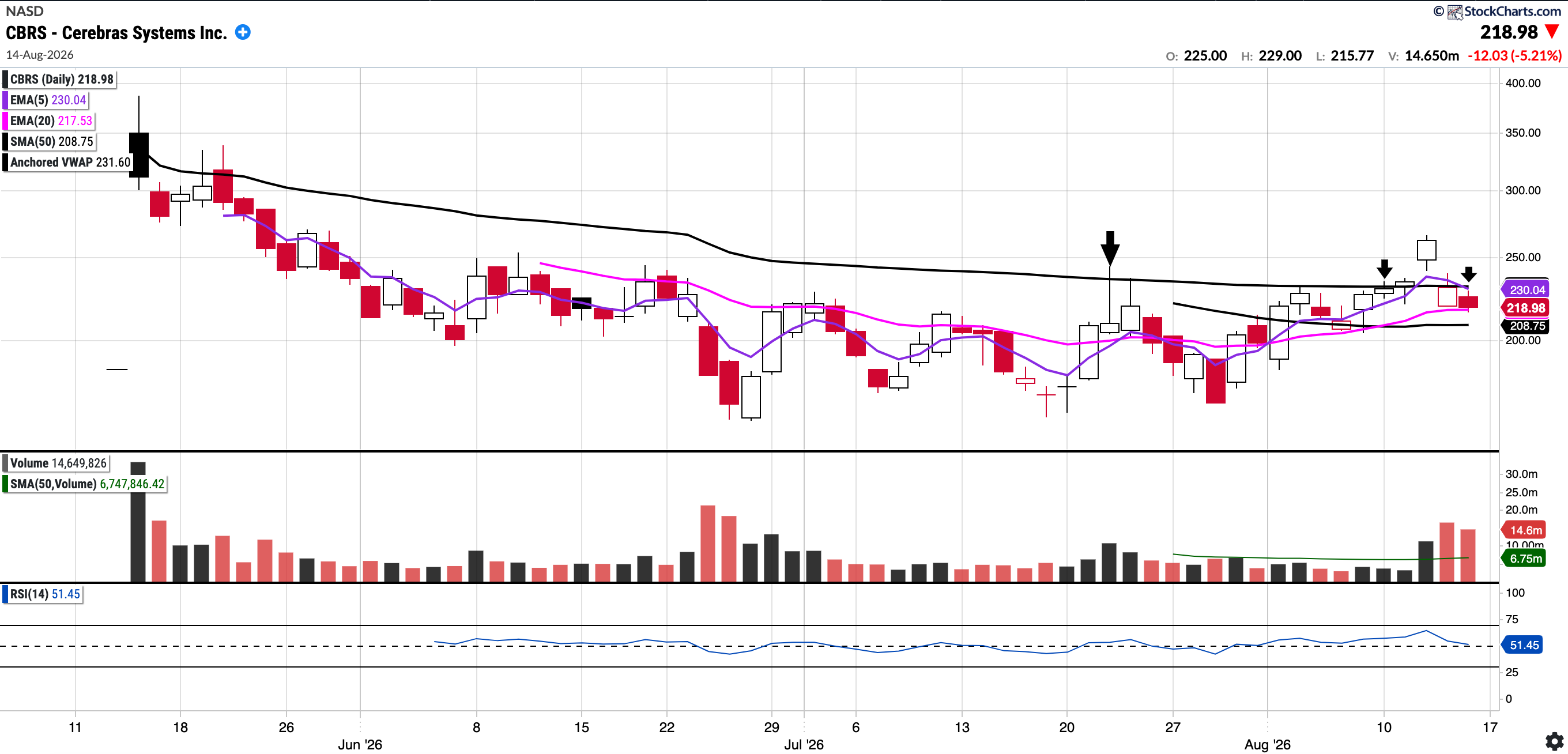
Currently trades at $218.98, 4.9% above the 50SMA
RSI 51.45
-29.6% YTD
CBRS is building its post-IPO base and has, for the most part, traded below its IPO AVWAP. This is relevant because it represents the aggregate cost basis of the entire public market since the stock began trading. The average investor remains underwater, and the IPO AVWAP has consistently served as dynamic resistance, repeatedly attracting sellers (see arrows).
Bulls will want to see that level reclaimed and flipped to support before gaining confidence in a sustained uptrend.
Current position and plans
SixSigmaCapital does not hold a position at the time of writing.
Nik Tirupathi does also not currently hold a position and below are his final thoughts and plans for his position:
I believe that Cerebras does have a truly unique market position and demand is high for low latency disaggregated compute. Given this structural tailwind, I plan on deploying a small amount of capital into Cerebras stock in the near future. To buy at a more attractive valuation, I’m waiting for a compression in share price.
Thank you for reading and if you enjoyed this post, please leave a like and Restack.
Subscribe to the plan that best suits your needs (free or premium), and will see you in the next one!