

In this post, AKS Research and I break down the investment case for CRWV, paying specific attention to the state of its balance sheet.
CoreWeave is in the GPU rental business, and business is accelerating. They design and fill data centres with Nvidia GPUs, wrap their own software layer around them, and sell access by contract or by the hour to some of the biggest names in AI, including Microsoft, Meta, OpenAI, Anthropic, and Nvidia. All the while, they don’t own most of the real estate their data centres sit on, leasing powered shells from data centre landlords, and filling them with GPUs they do own.
That’s the straightforward part of the story. This report will cover the more complex reality of how all of that gets paid for. CoreWeave is primarily funding this buildout with debt spread across more than a dozen separate instruments. These instruments range from investment-grade to speculative, all backed by a $104 billion backlog of contracts.
Layout:
Overview of CoreWeave Inc
Business Model
Contract Backlog
Financials & Valuation
Balance Sheet & Debt
Capital Structure Sustainability & Risks
This post is for informational purposes only and does not constitute financial advice. Please conduct your own due diligence before purchasing any equities or assets discussed herein.
Overview of CoreWeave Inc
CoreWeave Inc. (CRWV) started as Atlantic Crypto in 2017, with a focus on Ethereum mining. Because of the power intensive demands of mining, they had built up a fleet of GPUs, which they pivoted toward general cloud infrastructure and compute rental in 2019. That same year they rebranded as CoreWeave. With the release of ChatGPT the following year, they saw heavy demand for their GPU fleet and positioned themselves as a specialized AI and high-performance computing (HPC) cloud service.
Currently, CoreWeave operates as a cloud infrastructure company that provides GPU compute for artificial intelligence workloads. While CoreWeave officially does not separate their revenue by segment, their income activities can be broken down as follows:
GPU Cloud Infrastructure: The company offers Nvidia GPUs and other essential AI hardware, providing computing resources to support the development and use of AI applications.
Managed Inference Software: CoreWeave runs already-trained AI models to serve live requests like chatbot responses and API calls. They price this dynamically by usage as opposed to having their customers rent blocks of GPUs upfront.
The company’s business model relies heavily on take-or-pay contracts with major hyperscalers and AI giants. These agreements typically span half a decade or longer, with the take-or-pay clause ensuring that CoreWeave receives payments regardless of the client’s actual capacity utilisation. This structure allows them to finance their capital-intensive expansion of data centre capacity.
Business Model
If we were to analyse their business based on the qualitative segmentation of their revenue (above), their primary source of income is through the GPU Cloud Infrastructure segment.
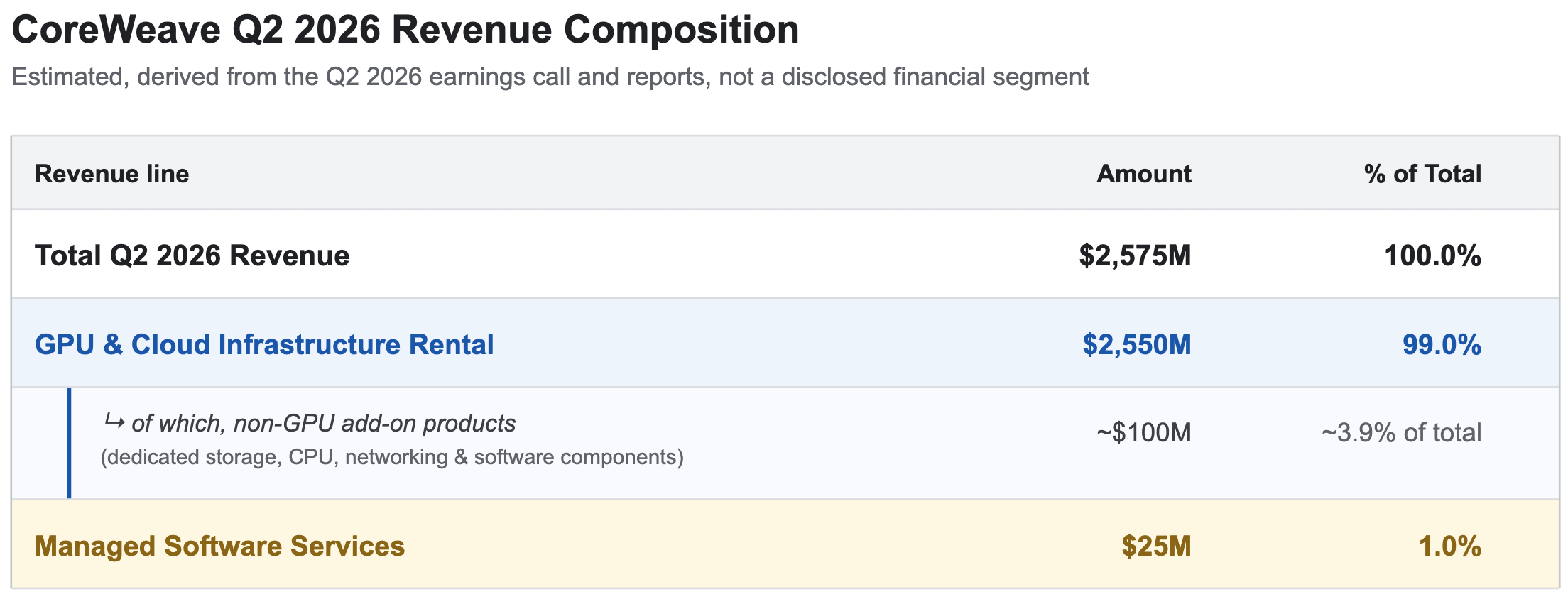
Of CoreWeave’s $2.575B in total revenue for Q2 2026, GPU and cloud infrastructure rentals generated approximately $2.55B (including ~$100M from ancillary storage, networking, and CPU add-ons), while managed inference software contributed $25M.
These figures are estimates derived from the company's Q2 earnings call and financial reports.
GPU Cloud Infrastructure: Accounts for ~99% of their revenue.
CoreWeave rents out GPU compute by designing data centres full of Nvidia’s GPUs. They then wrap their own software layer around them and sell access by contract (or hourly) to large AI customers such as Microsoft, OpenAI, Meta, Nvidia, and Anthropic.
The land and buildings in which the data centres are built are not owned by CoreWeave. Rather, they lease power shells from “data centre landlords” like Core Scientific, Applied Digital, etc. Their largest relationship is with Applied Digital’s Ellendale, North Dakota campus, which includes 15-year leases and up to 400MW. This deal is estimated to generate ~$11 billion for Applied Digital.
Per Fiscal.ai and CoreWeave disclosures, CoreWeave now operates 51 data centres (up from 32 as recently as Q4 2024) with 3.7 gigawatts of contracted power capacity (up from 1.3GW over the same window).
What sets CoreWeave apart from competitors like Nebius (NBIS) and Iren (IREN) is that CoreWeave funds the majority of their buildout with debt. They raise this debt against their pre-existing customer contracts and the pledged cash flows they generate, rather than funding the buildout primarily from cash flow or equity. CoreWeave currently has a revenue backlog of $104 billion (Q2 2026 disclosures) from which they can raise debt.
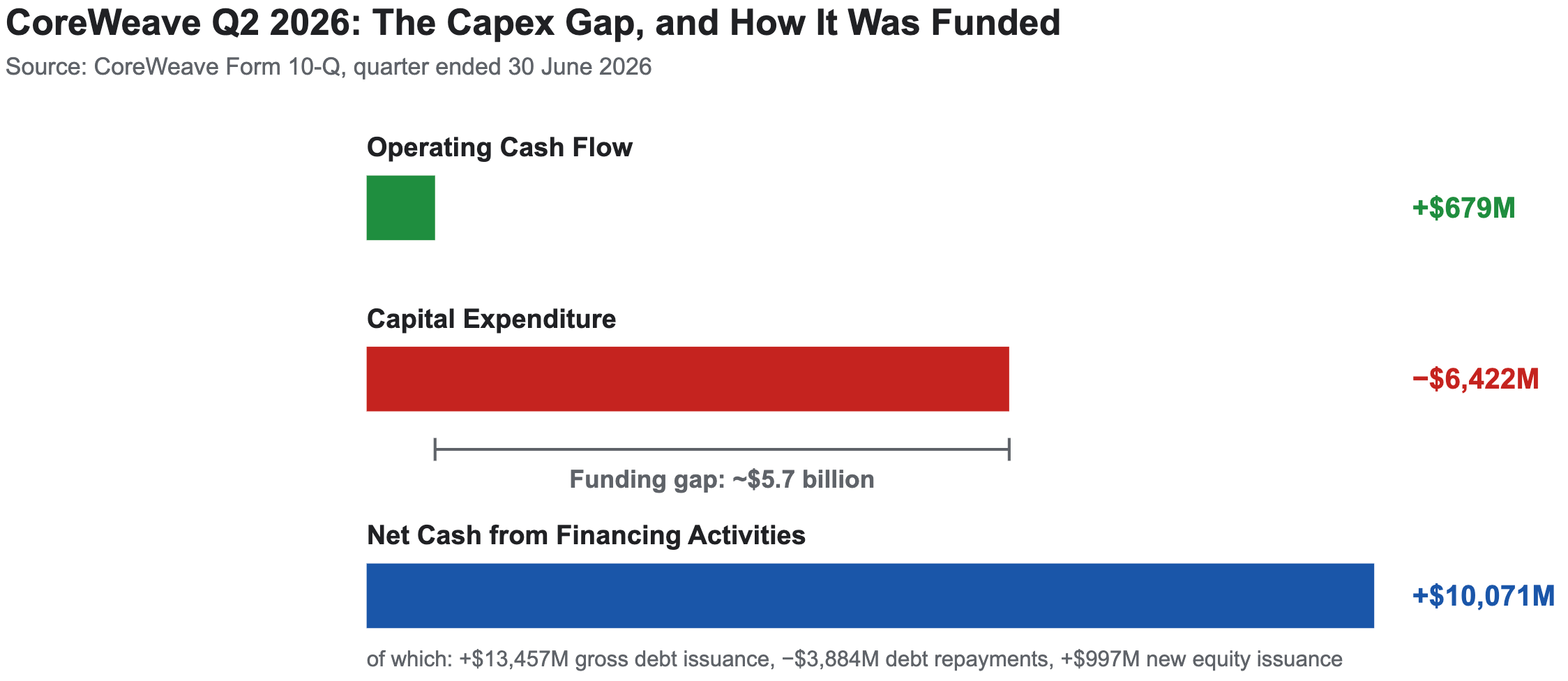
In Q2 2026, operating cash flow was $679M against $6.42B of capital expenditure. Financing activity covered the $5.7B cash flow deficit, generating $10.07B in net financing cash via $13.46B in gross debt issuance against $3.88B in repayments.
Managed Inference Software: Accounts for 1% of revenue.
A newer and much smaller source of revenue saw an ARR increase from ~$1M to $100M+ in one quarter, with $250M+ expected by YE 2026. CoreWeave runs already-trained AI models on a customer’s behalf to serve live requests, chatbot responses, and API calls, rather than renting out raw GPU capacity to the customer. It’s priced dynamically by usage as opposed to the amount of hardware being reserved by a customer. Instead of pre-paying for capacity, customers pay for consumption.
Through this segment, CoreWeave is able to cater to a new customer base since it is a low-commitment product for customers to adopt instead of signing a multi-year contract. It’s an easier initial sale than pre-ordering billions of dollars worth of GPUs.
Additionally, they are able to monetise their hardware without dedicating capex to build a fixed amount of infrastructure. Their existing fleet can be monetised more efficiently as inference volume scales.
Given it does not account for a large portion of their revenue, and it is a relatively new initiative (early 2026), it’s too early to tell how significant this segment will be for CoreWeave. It’s certainly worth watching during the next few earnings cycles.
Contract Backlog
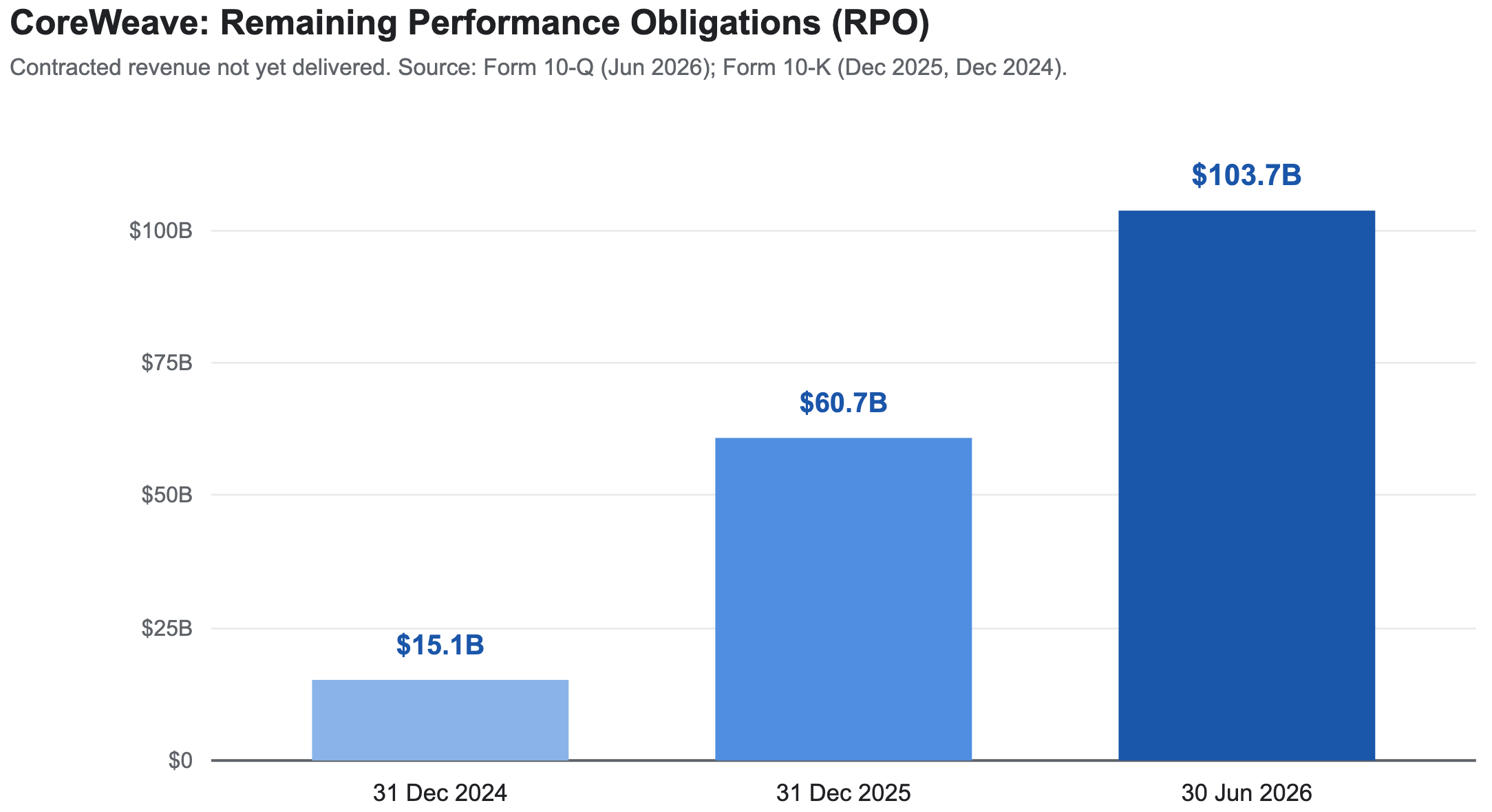
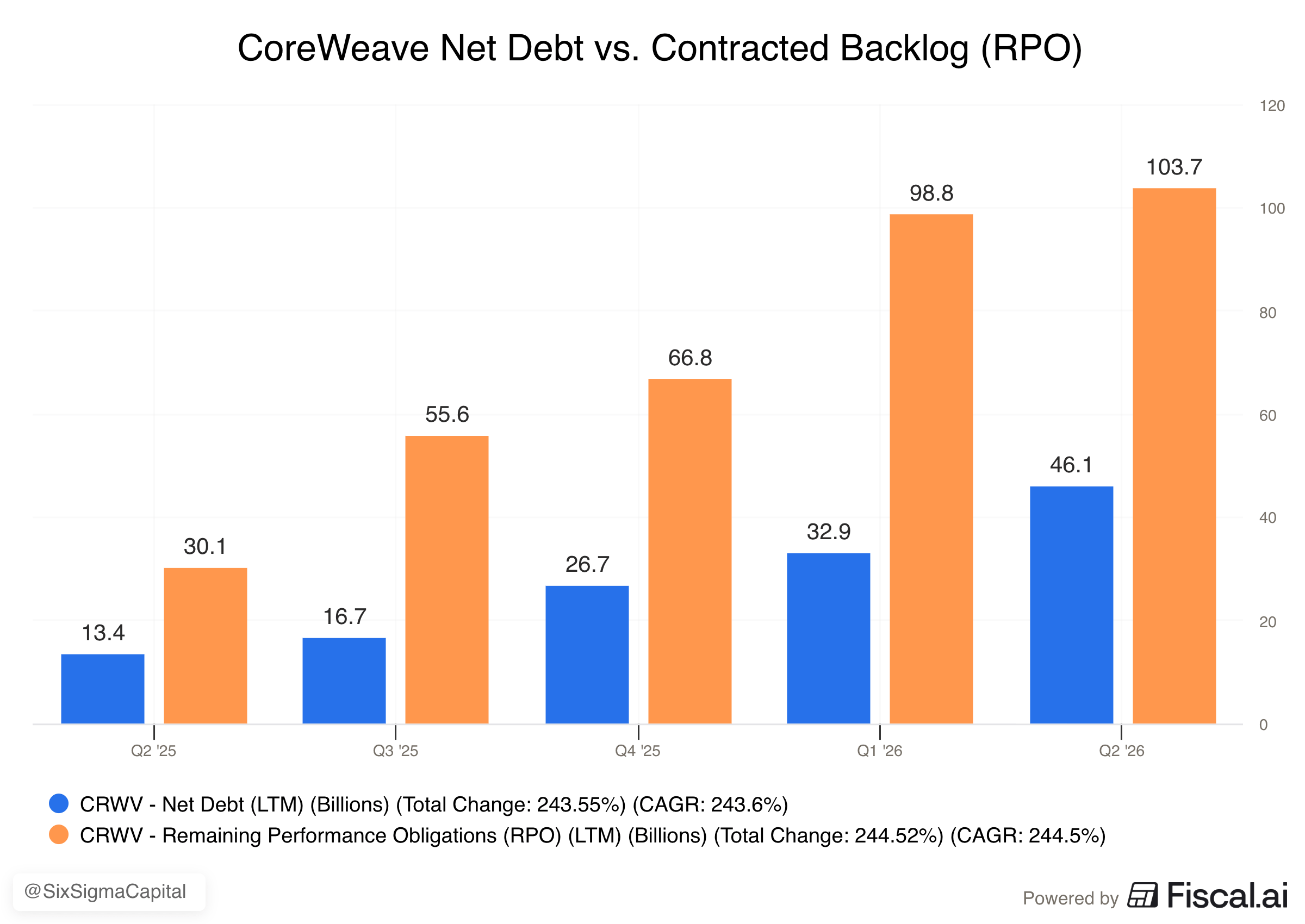
CoreWeave’s Remaining Performance Obligations (RPO), or revenue backlog, stands at ~$104 billion as of 30 June 2026, up from $60.7B from December 2025.
Regarding the nature of the contracts, roughly 98% of recent quarterly revenue has come from take-or-pay contracts spanning multiple years, legally obligating counter-parties to service commitments regardless of capacity utilisation.
CoreWeave does not disclose all of their contracts or how much they are valued at. Of those that are disclosed, Microsoft, OpenAI, Meta and Nvidia are some of their more prominent customers:
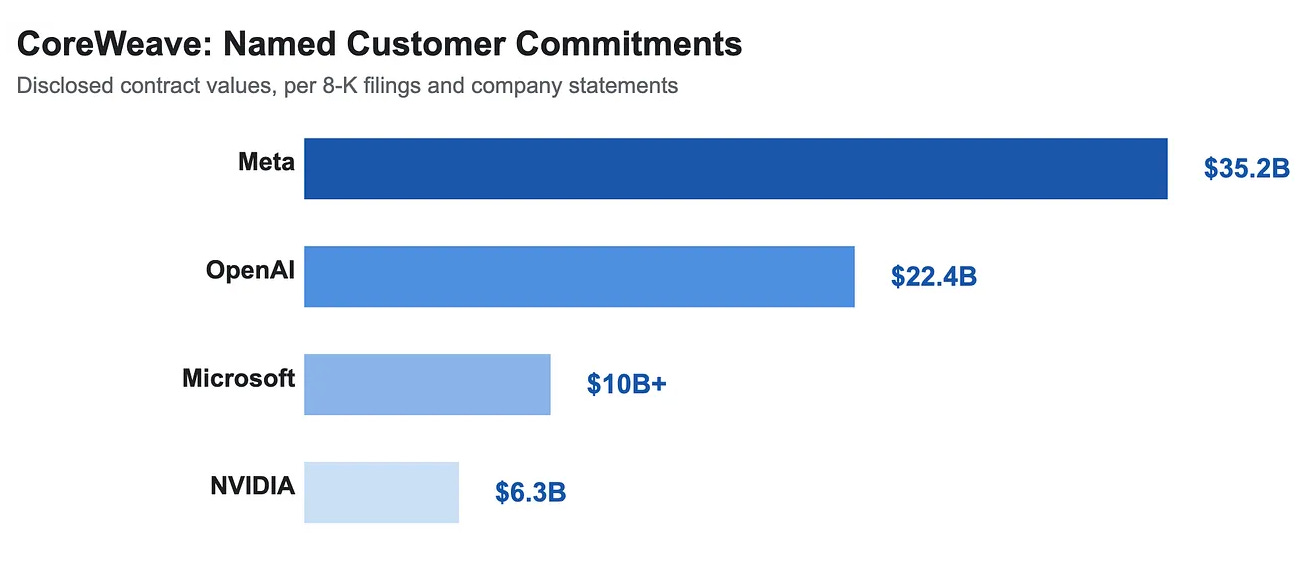
Meta: signed roughly $21 billion of incremental commitments in March 2026, taking its total disclosed contracts to about $35.2 billion through December 2032.
OpenAI: In March 2025, CoreWeave announced an initial agreement with OpenAI with a contract value up to $11.9 billion, followed by an expanded agreement worth up to $4 billion in May 2025, and $6.5 billion in September 2025. The total contract value with OpenAI is at approximately $22.4 billion.
Microsoft: Contractual commitment to spend more than $10 billion with CoreWeave by 2030.
Nvidia: Agreed to buy CoreWeave’s unsold residual capacity through April 2032 under a $6.3 billion order.
Other notable customer commitments include firms like Anthropic, Jane Street, Mistral AI, and Cloudflare.
Financials & Valuation
Financials:
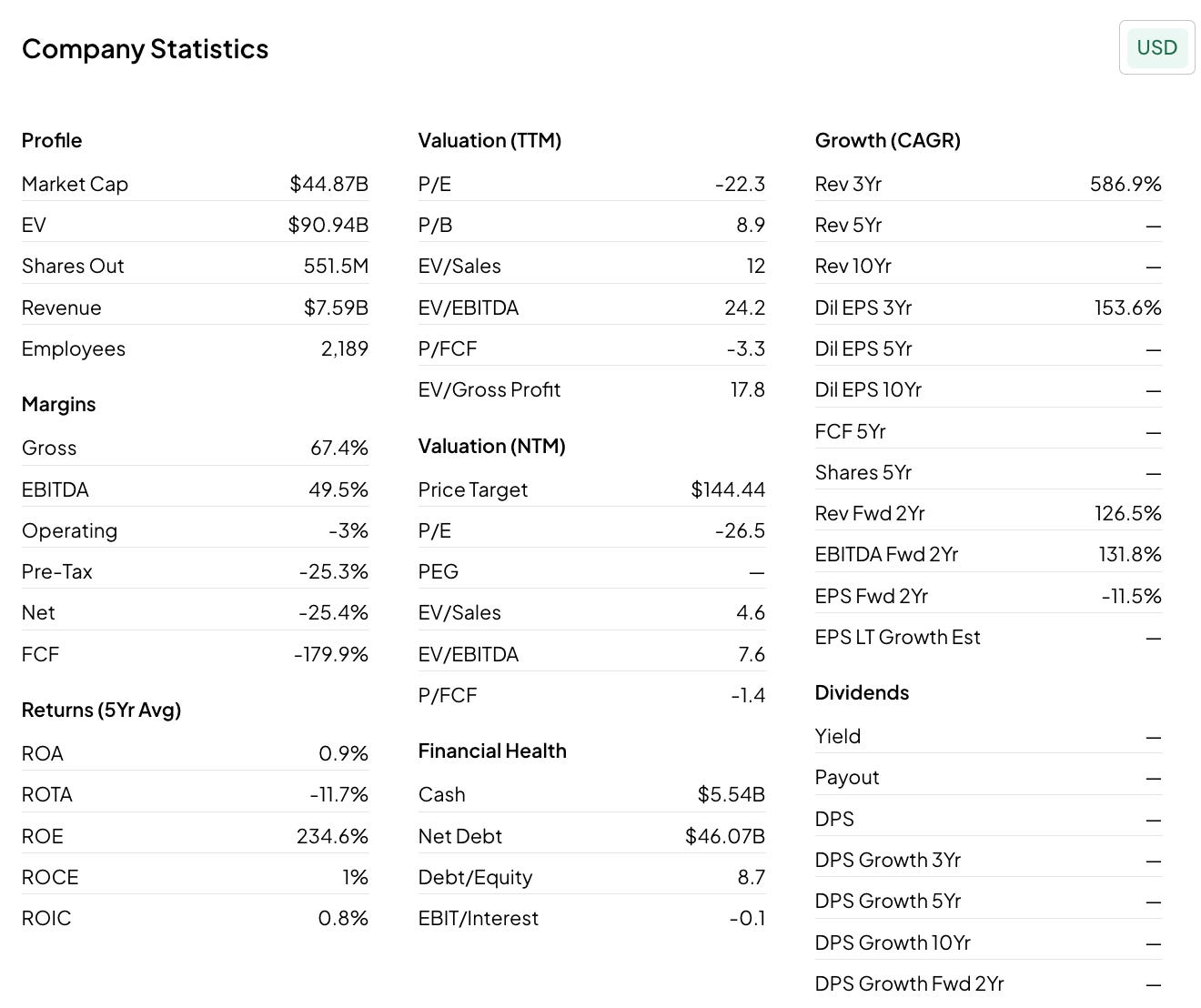
At the time of writing, CoreWeave has a Market Cap of $44.87B with a Net Debt position of $46.07B. Net Debt-to-Equity is ~9.2 (as of Q2 2026).
All financials were taken from the Fiscal AI website. You can access a free trial of the premium offering via the following link, no card required. Fiscal AI
TTM Performance:
Revenue TTM: $7.59 (B)
Gross Profit TTM: $5.11 (B)
Operating Income TTM: -$0.23 (B)
Net Income TTM: -$1.93 (B)
Q2 2026 Highlights:
Revenue of $2,575M, up 112.5% YoY from $1,212M in Q2 2025.
Operating loss of $49M, compared to operating income of $19M in Q2 2025.
Net loss of $626M, compared to a net loss of $290M in Q2 2025.
EBITDA (Fiscal.ai calculated) of $1,344M, up 132% YoY from $579M in Q2 2025.
Data centres grew to 51, up from 33 YoY; contracted power capacity grew to 3.7GW, up from 2.2GW YoY.
Remaining Performance Obligations (RPO) grew to $103.7B, up from $30.1B YoY.
Cash flow from Operations of $679M, compared to -$251M in Q2 2025.
Free Cash Flow of -$5,743M, compared to -$2,704M in Q2 2025, driven by $6.42B of capital expenditure in the quarter.
Valuation:
CoreWeave trades at:
12x LTM EV/S and 4.6x NTM EV/S.
24.2x LTM EV/EBITDA and 7.6x NTM EV/EBITDA
-22.3x LTM PE and -26.5x NTM PE.
-3.3x trailing P/FCF and -1.4x NTM P/FCF.
8.9x P/B and 17.8x EV/Gross Profit (both LTM).
CoreWeave is currently trading at 7.6x NTM EV/EBITDA, against a top line Fiscal.ai model growing at a 126.5% CAGR over the next two years. Morningstar separately models adjusted operating margin reaching the low teens by year-end 2026, building toward a midcycle forecast above 20% around 2030.
If one assumes the 126.5% two-year forward revenue CAGR and a low-teens (~13%) adjusted operating margin by year-end 2026, CoreWeave would reach an estimated $38.9 billion in revenue and roughly $5.1 billion in adjusted operating profit within two years. While the stock currently trades at 24.2x LTM EV/EBITDA, a 10x multiple on that profit base would imply an enterprise value near $51 billion, while a 15x multiple would result in an estimated enterprise value of $76 billion, both measured against today’s $90.94 billion EV.
Forward Guidance:
Per CoreWeave’s Q2 2026 earnings release (11 August 2026), the company raised their full-year 2026 guidance:
Full-year 2026 revenue guided at $12.4 billion to $13.2 billion, raised from the $12 billion to $13 billion range given at the Q4 2025 earnings call in February 2026.
Full-year 2026 adjusted operating income guided at $960 million to $1.15 billion.
Full-year 2026 capital expenditure guided at $35 billion to $39 billion, raised from an earlier $30 billion to $35 billion range.
Year-end annualized revenue run-rate targeted at $18.5 billion to $19.5 billion.
Separately, Fiscal.ai’s own forward estimates:
Revenue Fwd 2Yr CAGR: 126.5%
EBITDA Fwd 2Yr CAGR: 131.8%
EPS Fwd 2Yr CAGR: -11.5%
NTM Price Target: $144.44
The -11.5% 2-year EPS CAGR alongside +126.5%/+131.8% revenue and EBITDA growth implies the Street expects losses to widen in dollar terms even as the top line and EBITDA scale, consistent with a company still in heavy build-out mode.
Financial Health:
Cash: $5.54B
Net Debt: $46.07B
Net Debt/Equity: 9.2
EBIT/Interest: -0.1
Of interest, Morningstar’s equity report carries a Fair Value Estimate of $115.00 (raised from $106.00), a Price/Fair Value of 0.70, potentially implying the stock is undervalued.
Balance Sheet & Debt
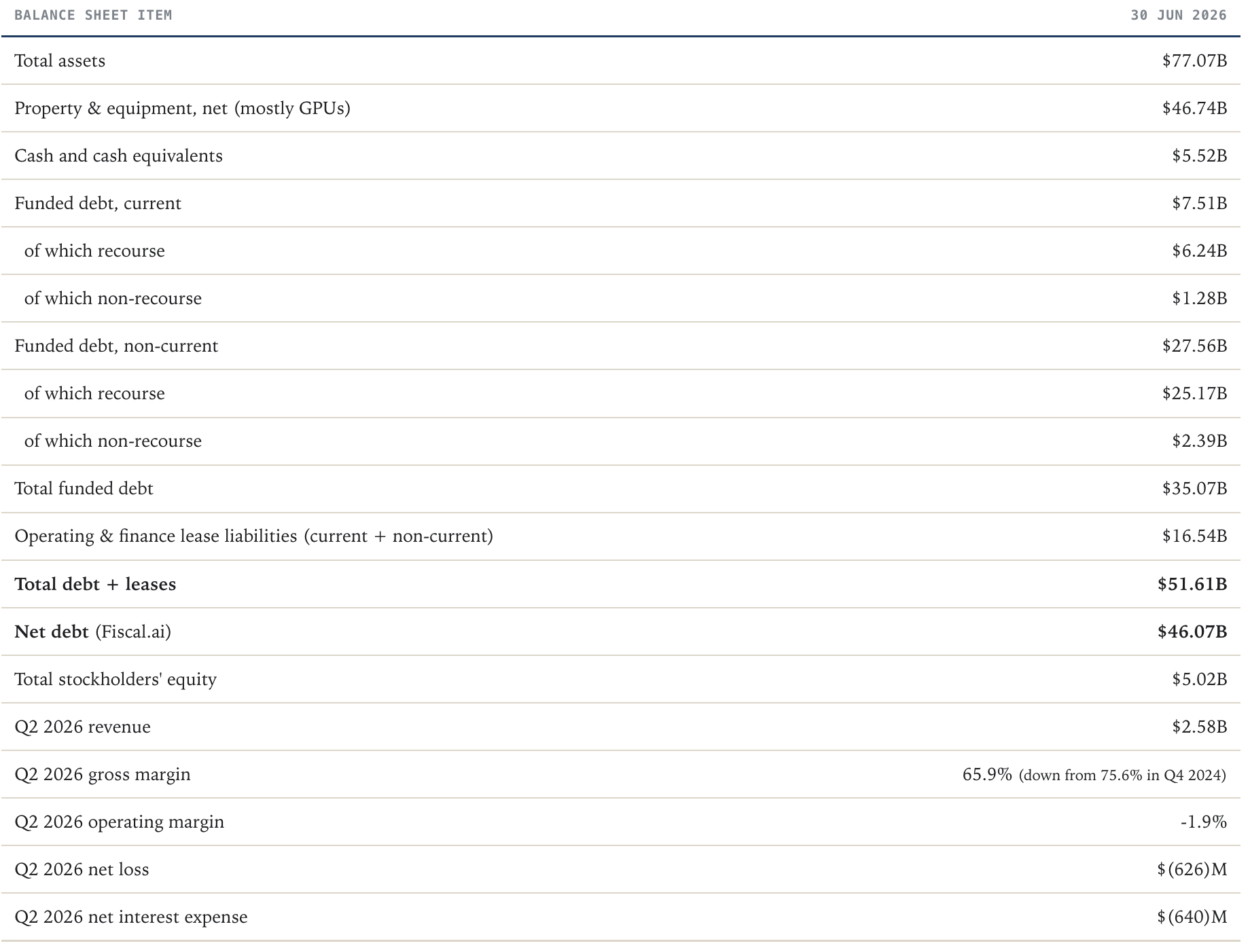
Net debt is roughly 9.2x equity and 8.3x cash on hand. Interest expense of $640 million in a single quarter is about 2.4x what it was a year earlier, and currently equals approximately a quarter of quarterly revenue.
The debt is structured behind a recourse versus non-recourse split. Recourse debt (~$31.4B) would be a claim on CoreWeave (the corporate entity). The non-recourse debt (~$3.7B) is raised against certain data centre project assets. The lender’s claim for the non-recourse debt is on the specific project’s assets, not CoreWeave itself. On top of the $35.07B of funded debt is $16.54 billion of lease liabilities. Fiscal.ai's net-debt figure of $46.07B includes this lease liability.
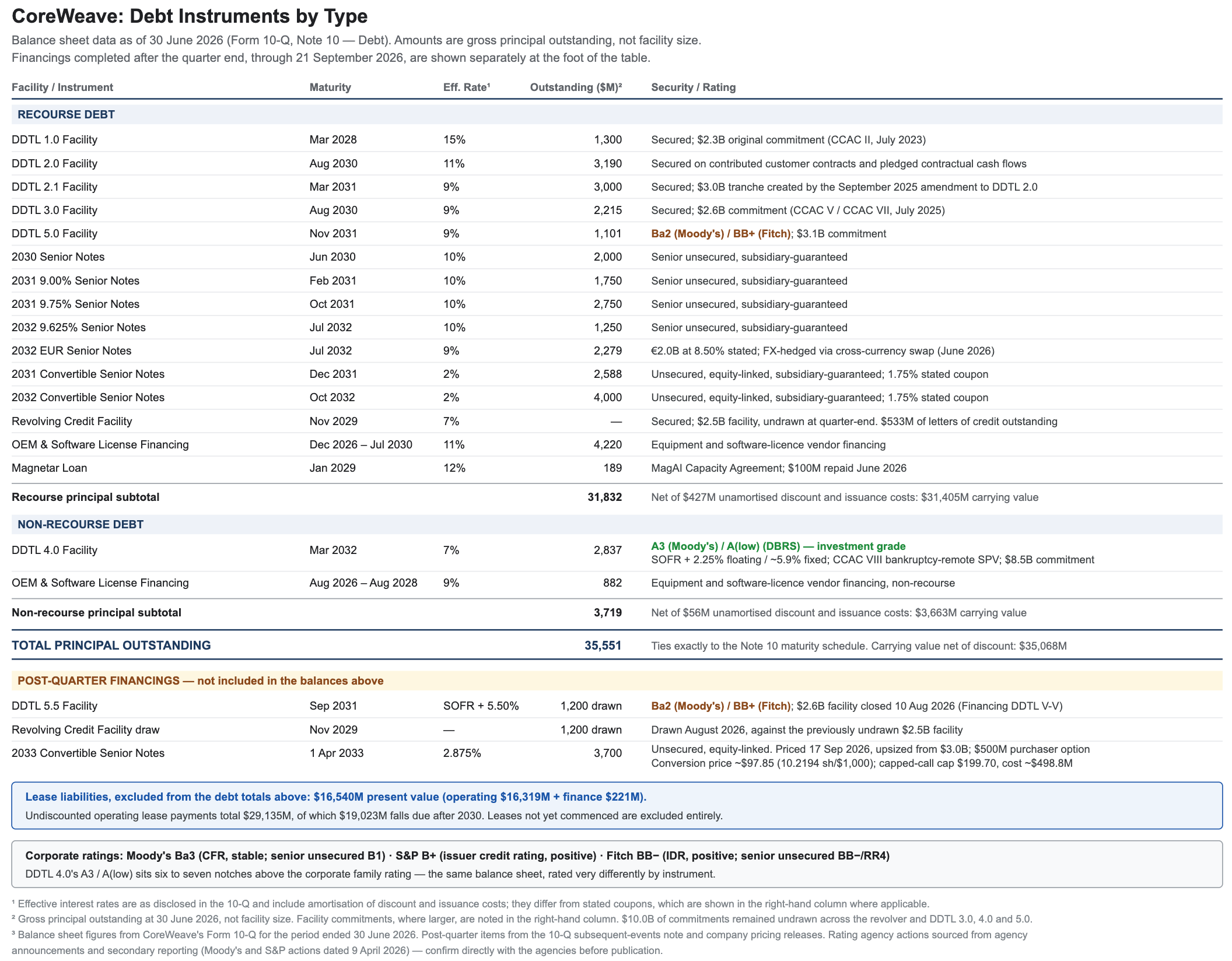
This asset-backed structure is what makes CoreWeave’s borrowing possible at this scale. Rather than relying on corporate credit alone, the Delayed Draw Term Loans (DDTL’s) are secured directly against the physical hardware and the contracted cash flows from CoreWeave’s long term computing agreements.
That structure has evolved to include a duration mismatch lenders would not have accepted early on. DDTL 5.5, closed in August 2026, carries a five-year maturity against customer contracts that average only three years. That lets CoreWeave sell shorter, higher-margin compute contracts rather than just their longer term deals. However, DDTL 5.5 requires stringent lender protections to offset the mismatch and the depreciating nature of GPU collateral, via a cash lockbox structure. This mandates incoming cash flows from customer contracts be used to pay down debt service before CoreWeave can access the capital for operational capex.
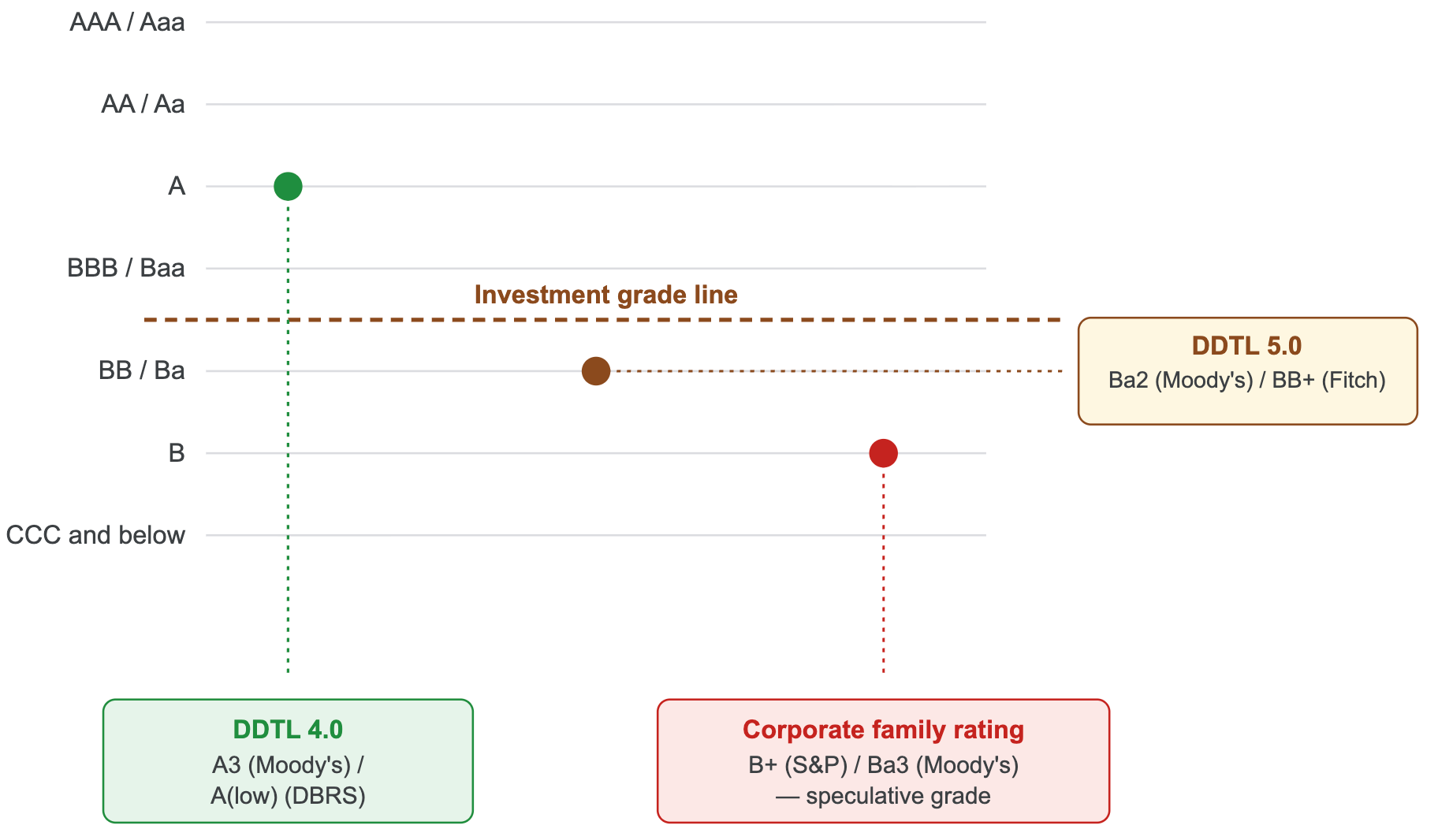
In turn, CoreWeave obtains cheaper debt. DDTL 1.0, priced in 2023, had no operating history behind it so it carried a floating rate near 15%. By March 2026, the $8.5B DDTL 4.0 facility, which was collateralized against a single investment-grade counterparty’s contract was priced at SOFR + 225bps and earned an A3 rating. That gap in cost of capital lets CoreWeave underwrite AI compute at prices that a competitor who relies on high-yield debt cannot match.
Along with the DDTLs, there is a separate stack of senior unsecured notes and convertible notes. The unsecured notes carry high fixed coupons at 8.5%–9.75% because there’s no collateral backing, which would put them in the junk rating category. The convertible notes (2031/2032/2033) are a variant of unsecured debt that gives lenders the option to convert into CoreWeave stock instead of cash repayment, which is why their coupons are relatively lower at 1.75%-2.875%. Rounding it out are the revolving credit facility and $16.54B of lease liabilities (contractual rent obligations to the data centre landlords).
As for debt repayment, the contractual repayment schedule for the funded debt is as follows:
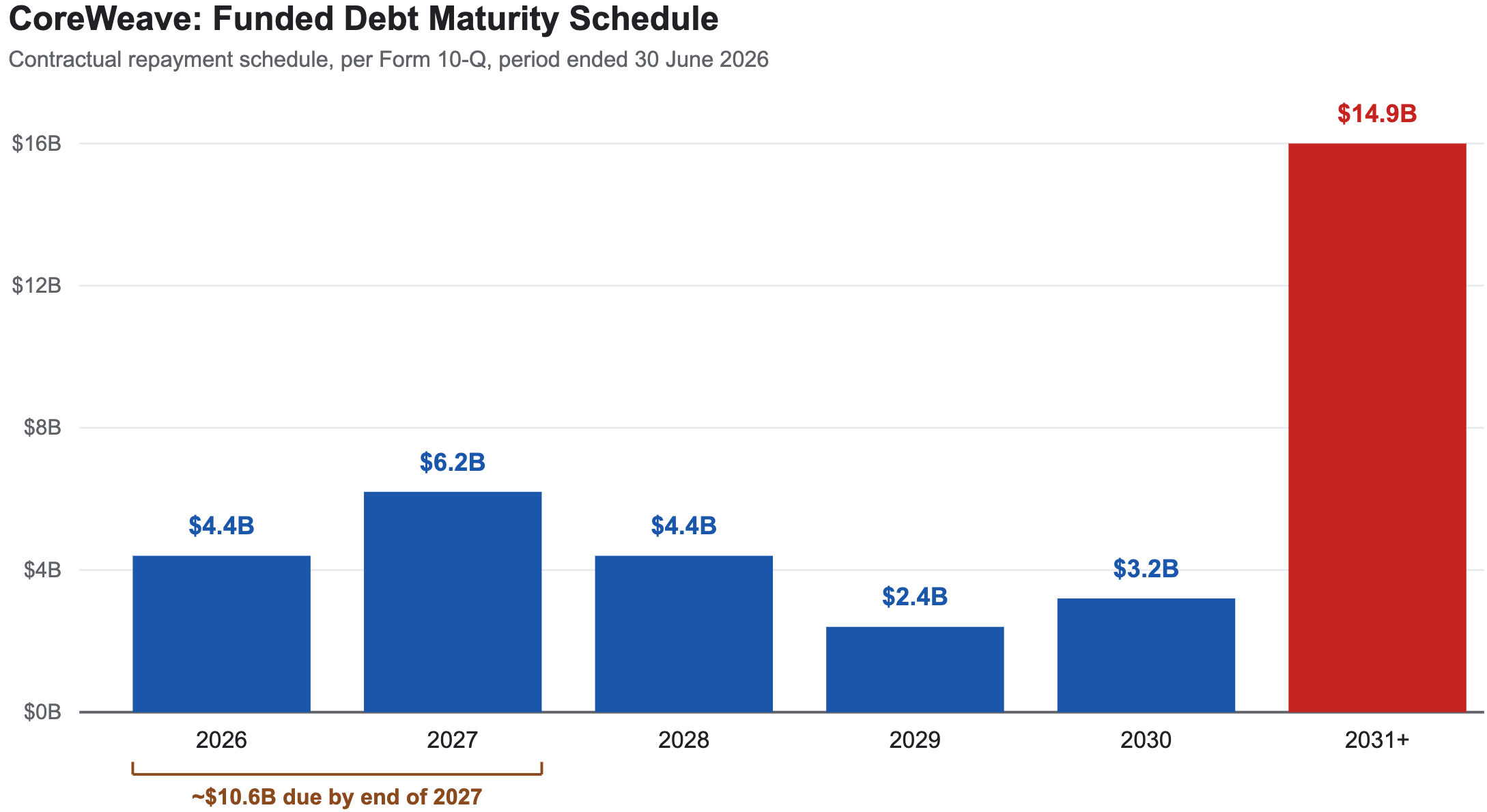
$4.4B remaining in 2026, $6.2B in 2027, $4.4B in 2028, $2.4B in 2029, $3.2B in 2030, and $14.9B thereafter. Roughly $10.6 billion is due between now and the end of 2027, against ~$5.5 billion of cash on hand.
Latest Financing Package:
On September 17, 2026, CoreWeave filed an 8-K disclosing a new financing package, arranged by Goldman Sachs alongside JPMorgan, Morgan Stanley, Citi, Deutsche Bank and others:
A $3.0 billion Convertible Senior Notes offering due 2033, with an option for purchasers to buy an additional $500 million. The total gross size of the private offering was $3.7 billion (upsized from the initial $3.0 billion).
A new Equity Distribution Agreement for up to 35,000,000 shares of Class A common stock, plus associated collared forward sale agreements. At the time of writing, with the current share price of $81.15, we have an estimated $2.84 Billion in financing (distribution has yet to materialize so numbers may vary).
The 8-K states the company intends to use proceeds for general corporate purposes:
“including, without limitation, repayment of indebtedness... and support of its objective of migrating its enterprise credit profile toward investment grade.”
It’s evident management is actively working the capital structure toward a blended cost of capital instead of just piling on more debt. Overall, this package adds another $3.7B minimum of equity raises to the pile (with an additional $2.84 billion based on the share price at the time of writing), and the Equity Distribution Agreement program gives CoreWeave an opportunity to raise equity if they want to. This will allow them to de-lever their debt-to-equity ratio over time while continuing to raise capital.
Financials Versus Neocloud Peers
CoreWeave’s underlying financials look fundamentally different from those of Neocloud peers Nebius and Iren.
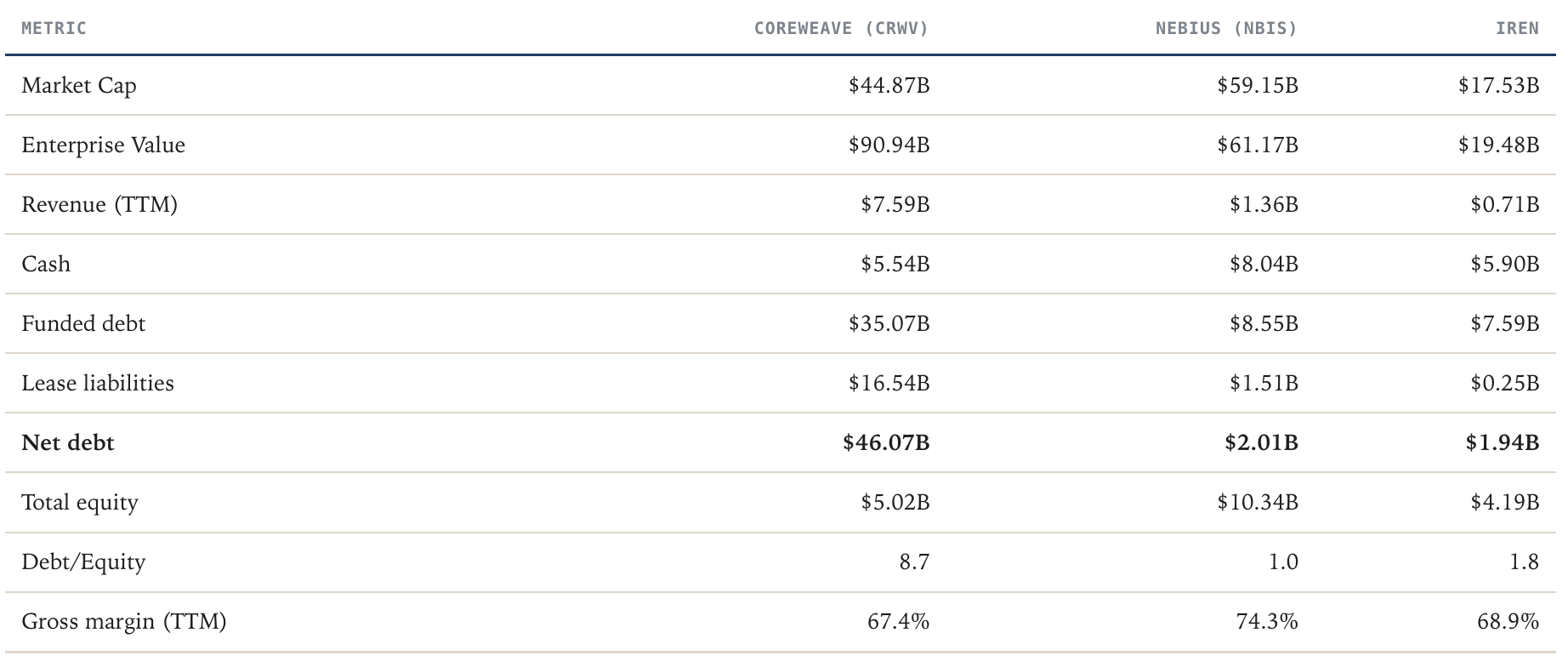
Nebius (NBIS) carries funded debt of $8.55B against $8.04B cash, funded mainly through low-coupon convertible notes. The difference between the two is strikingly apparent when considering that Nebius carries net debt at roughly 0.21x equity, versus CoreWeave’s net debt at 9.2x equity. Nebius also owns some of its data centre development land.
Iren has a similarly moderate structure to Nebius. Iren owns and operates its own GPU infrastructure, with a net debt of $1.94B against $4.19B of equity, and net debt/equity ratio of 0.46, on a much smaller revenue base of $707M TTM.
CoreWeave owns their compute hardware but leases most of their real estate, and funds that hardware overwhelmingly through a stack of separate secured and unsecured debt instruments, rather than equity or heavily relying on customer prepayments. They have a rated capital structure spanning investment grade (DDTL 4.0) to speculative (the unsecured notes). Nebius uses a mix of debt and equity, with their convertible debt stack sitting at $12B. Iren relies the most on equity, as they recently expanded their At-the-Market (ATM) equity offering program to $6 billion in March 2026.
Capital Structure Sustainability
That structure isn’t inherently a problem, especially when considering the $104 billion in revenue backlog. Also, rating agencies have gotten progressively more comfortable extending investment-grade terms to the contract-backed pieces of debt. However, CoreWeave’s path forward depends on the following:
The take-or-pay contracts pay out on schedule
The payouts convert into cash flow before credit conditions tighten
Lenders remain willing to refinance maturing debt on similar or better terms.
Three things point toward this being manageable.
Investment Grade Counterparties and Strategic Scarcity:
A lot of the debt is secured directly by long-term contracts with Microsoft, Meta, OpenAI, and other AI giants. Given severe industry-wide compute constraints, non-payment carries unacceptable reputational and operational risks for hyperscalers, who cannot afford to lose critical infrastructure partners.
Rating agencies recognise this credit quality by rating the SPV facilities collateralised by these contracts as investment grade, allowing CoreWeave to secure favourable borrowing rates (SOFR + 225 btps) despite the high overall leverage.
Positive Operational Cash Flow: Operating Cash Flow (OCF) turned positive at $679M in Q2 2026, up from -$251M in Q2 2025. This is largely on the back of revenue generation from prepayments and expansion. Even though heavy CapEx ($6.42B in Q2 2026) keeps total Free Cash Flow deeply negative, the underlying business is generating cash to support servicing the debt.
Proactive Capital Raising: management is aware of the risks they’re facing. The latest September financing package shows management is actively working the capital structure to rebalance and lower their overall cost of capital, instead of just adding to existing debt.
Risks:
That being said, the following risks present headwinds to their long term growth and financial stability:
Debt Maturity Risk: Roughly $10.6 billion of debt comes due by the end of 2027 against just $5.5 billion of cash on hand currently. They will likely have to pay that off with a mix of cash flow and debt, the latter of which kicks the can down the road.
Customer Concentration Risk: The four disclosed contracts mentioned above account for roughly $74B of the $104B in RPO, which represents a highly concentrated customer base.
Attrition Risk: Microsoft walked away from a $12 billion expansion option to their original deal, despite there being an industry-wide increase in demand for compute and data centre development. Instead, they chose to build their own infrastructure. If major hyperscalers begin insourcing infrastructure rather than renewing multi-year leases upon expiration, CoreWeave faces massive reinvestment and refinancing down the road.
Dilution Risk: Since CoreWeave has refinanced continuously rather than repaying from cash flow, while issuing new debt faster than old tranches mature, there is a risk they will have to continue that pattern for repayment to be manageable without a large equity raise or slowdown in capex. If they pursue an equity raise, there is dilution risk.
Credit Rating Volatility: As previously mentioned, CoreWeave carries a B+ issuer credit rating from S&P and a Ba3 corporate family rating from Moody’s. Some of their specific instruments rated better than the corporate credit overall, and some are worse:
Investment-Grade SPV Debt: DDTL 4.0 ($8.5B) is secured directly against GPUs and a specific customer contract, held in a bankruptcy-remote SPV. Rated A3 (Moody’s) / A(low) (DBRS), investment grade.
Non-Investment Grade Secured Debt: DDTL 5.0 ($3.1B) is rated Ba2 (Moody’s) / BB+ (Fitch), better than the corporate rating but not investment grade.
Unsecured High-Yield Notes: 2032 9.75% senior notes ($2.75B) are senior unsecured and subsidiary guaranteed.
The variation in debt rating creates market uncertainty and abruptly raises borrowing costs. If the AI trade doesn’t play out as expected and companies default on their contracts, CoreWeave will be left severely over-leveraged with billions in rapidly depreciating hardware, alongside insufficient cash flow to service this debt load.
CoreWeave’s story is simple to state but harder to underwrite: it is a GPU rental business backed by a $104 billion contract book, financed almost entirely by a debt stack ranging from investment-grade to speculative. This structure has worked so far because lenders keep pricing against the contracts rather than the corporate credit, and because CoreWeave continues to refinance ahead of each maturity wall instead of repaying from cash flow. Whether this model holds up is less about technology or demand (both of which remain clearly constructive). Rather, it is a question of timing, specifically, whether contracted revenue converts to cash faster than the debt comes due.
Current Position and Plans:
