

On February 24, 2026, Meta (META) and Advanced Micro Devices (AMD) announced an equity-for-compute deal in which Meta will deploy 6 gigawatts of compute. In exchange for this purchase commitment, AMD issued Meta warrants representing nearly 10% of its outstanding shares.
At the time of the agreement, AMD was trading in the $200s, making the warrant’s $600 price hurdle appear distant. However, on September 21, AMD crossed the $600 mark for the first time. This drove the warrant’s illustrative value to roughly $100 billion, effectively mirroring what Meta is expected to spend on the deal itself.
In this write-up, myself and AKS Research break down the terms of the agreement, the conditions Meta must meet to vest its shares, the financial cost to AMD, and the strategic rationale behind the partnership.
The Deal At a Glance
The deal is a commitment from Meta to purchase AMD’s GPUs, CPUs and rack systems. Meta has agreed to purchase 6 gigawatts of compute from AMD over the next 5 years, in exchange for warrants for 160 million AMD shares.
Meta and AMD signed a binding agreement, which is a legally enforceable contract with obligations which parties must fulfill, and legal consequences if they fail to do so. The binding agreement only applies to the initial one gigawatt equivalent of GPU. The publicly disclosed binding purchase commitment covers the initial 1 GW. Gigawatts 2-6 are necessary for the warrant shares to be vested entirely. Based on public filings, here are the basics of the deal:
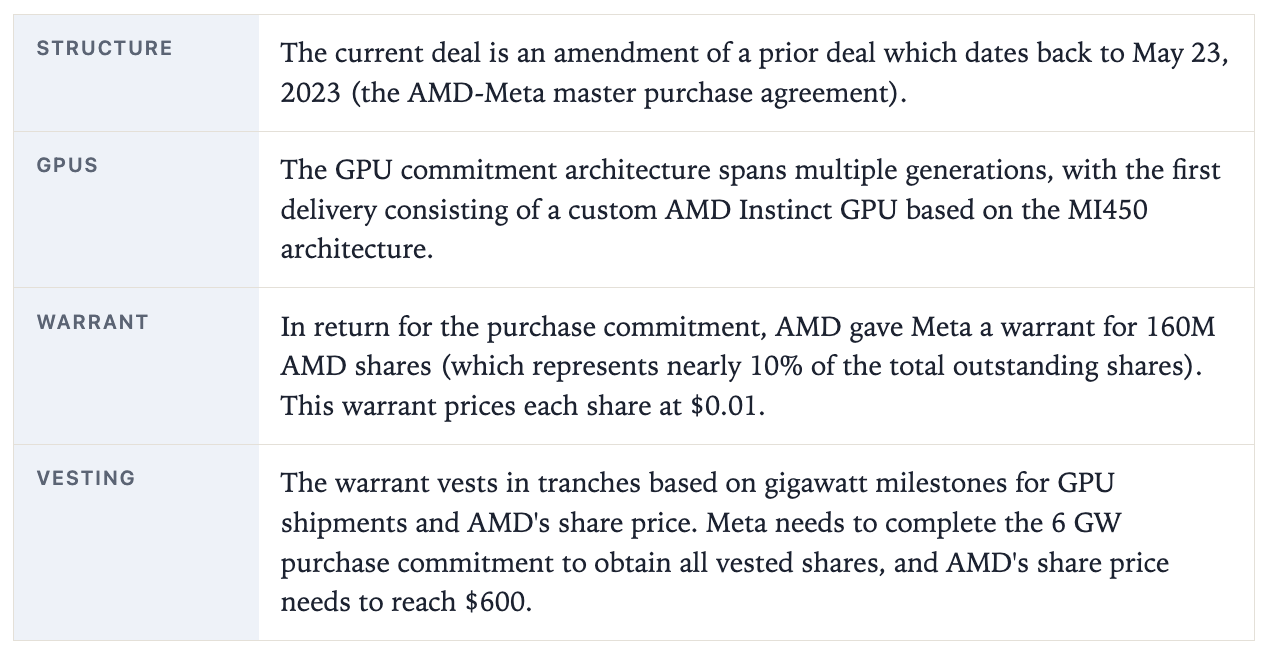
Key Requirements for Share Issuance
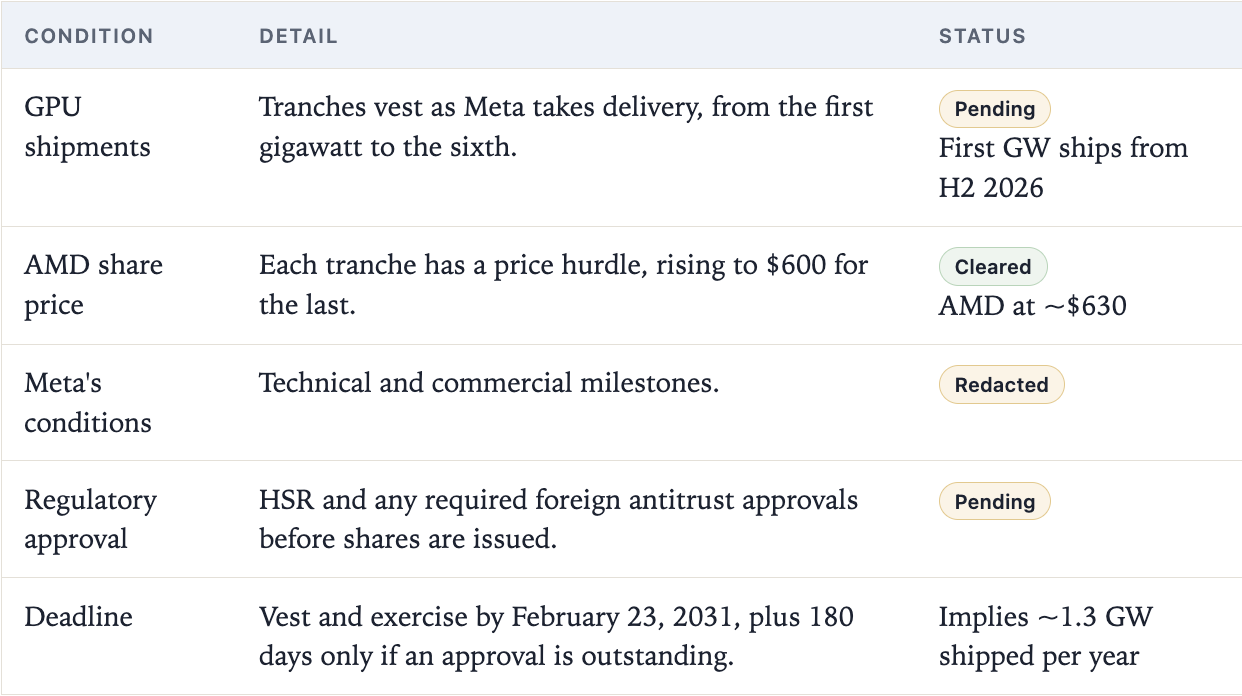
Note: AMD reported that none had vested or become exercisable as of June 27, 2026
Post-Issuance Terms
No lockup. Meta can sell on the open market immediately. The only restriction is on sales to certain AMD competitors.
No rights before issuance. Meta gets votes and dividends once shares are issued. Its share count adjusts for splits and dividends.
No forced remedies. Neither side has to sell assets or accept conditions to obtain antitrust approval.
Amendable. The terms can change if both parties agree, with no shareholder vote required.
Together, these terms let Meta take and sell its shares quickly, with few conditions attached.
AMD’s Deal Economics
AMD has not disclosed the deal’s value, but estimates run from $60-$120B. Bank of America puts each gigawatt at $15–20 billion of revenue (general estimate, not specific to the Meta contract) and about $6 billion of net income (using AMD’s most recently reported operating margin for the data center segment at 31%). This translates to $90–120B of revenue and roughly $36B of net income across 6 GW.
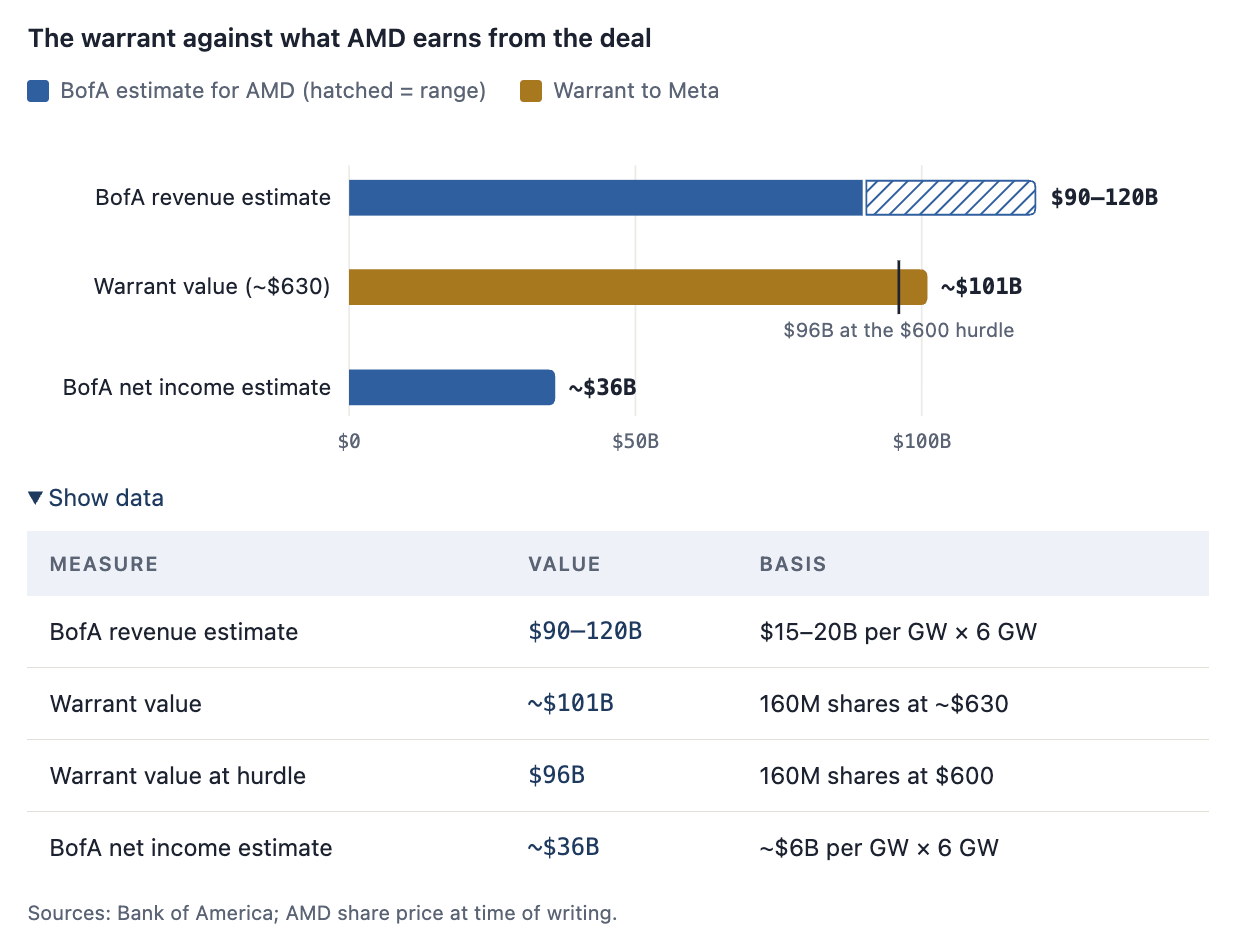
Against those estimates, 160 million shares are worth about $96B at $600/share, and about $101B at the current share price of ~$630. That is approximately equal to BofA’s revenue estimate, and close to three times its net income estimate. On those numbers (which is based on a conditional economic illustration, not verified numbers), AMD hands back more in stock than it expects to earn from the deal.
Given that AMD was trading in the $200s when the deal was announced, it’s likely that neither party expected AMD to reach the $600 per share mark so soon. The maximum potential dilution is tied to share-price appreciation, so shareholders are diluted, but likely in the scenario where they are far richer. Based on that, the question worth considering is: how much of that increase in share price was caused by the Meta and OpenAI deals?
Strategic Rationale for Meta
For Meta, the finances point the other way. At ~$630, the warrant is worth about as much as BofA's estimate of Meta's spend on the deal. If it vests in full and AMD’s share price holds, Meta's AMD compute comes close to paying for itself.
From Meta’s perspective, the deal allows them to lock in supply while reducing their dependence on Nvidia, as Nvidia’s GPU supply remains constrained. Commentary from Meta’s head of infrastructure stresses the importance of the need for multiple chip vendors and distinct architectural approaches in parallel. Locking in AMD as a supplier helps them fulfill that.
Additionally, the first gigawatt delivery consists of a custom MI450, which was co-engineered with Meta for inference. Given AMD’s position as a smaller supplier (relative to Nvidia), they were able to develop custom chips with AMD, a luxury they were not awarded with Nvidia.
The warrant also give Meta potential equity participation in its own supplier. Exercising all 160 million shares would cost Meta about $1.6 million. That gives them a stake in AMD’s success beyond its own orders, since it profits when AMD wins deals with other customers too.
Strategic Rationale for AMD
Meta's upside is AMD's cost. AMD had used this structure once before. On October 6, 2025, it signed a near-identical deal with OpenAI.
6 GW of GPUs, with the first 1 GW binding
A warrant for 160 million shares at $0.01, with exercisable price hurdle of $600.
A five-year life
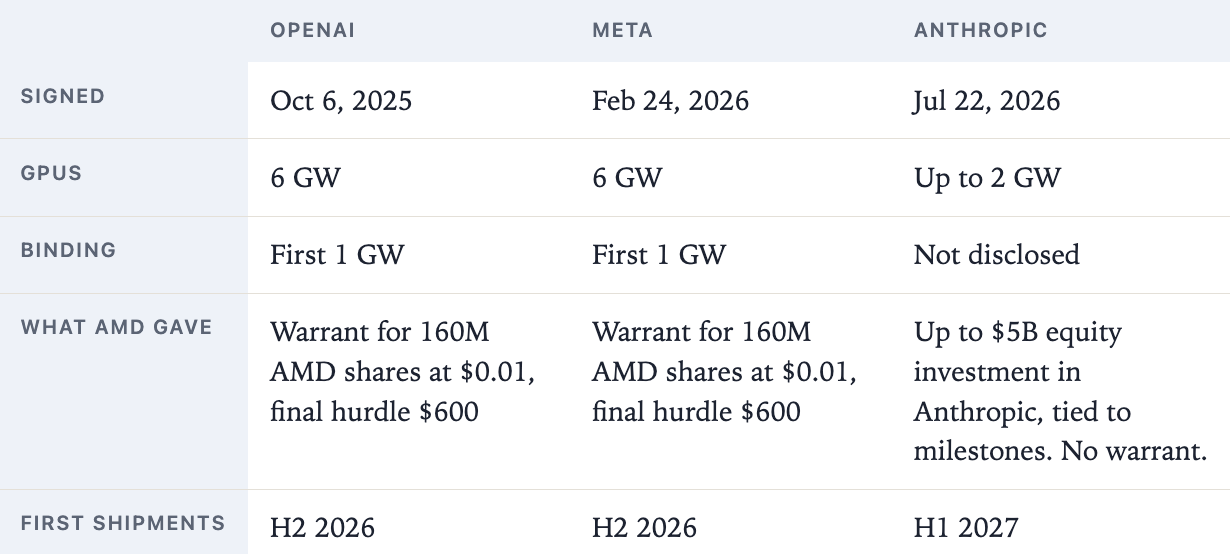
Together, the two warrants cover 320 million shares, about 20% of AMD’s current outstanding shares.
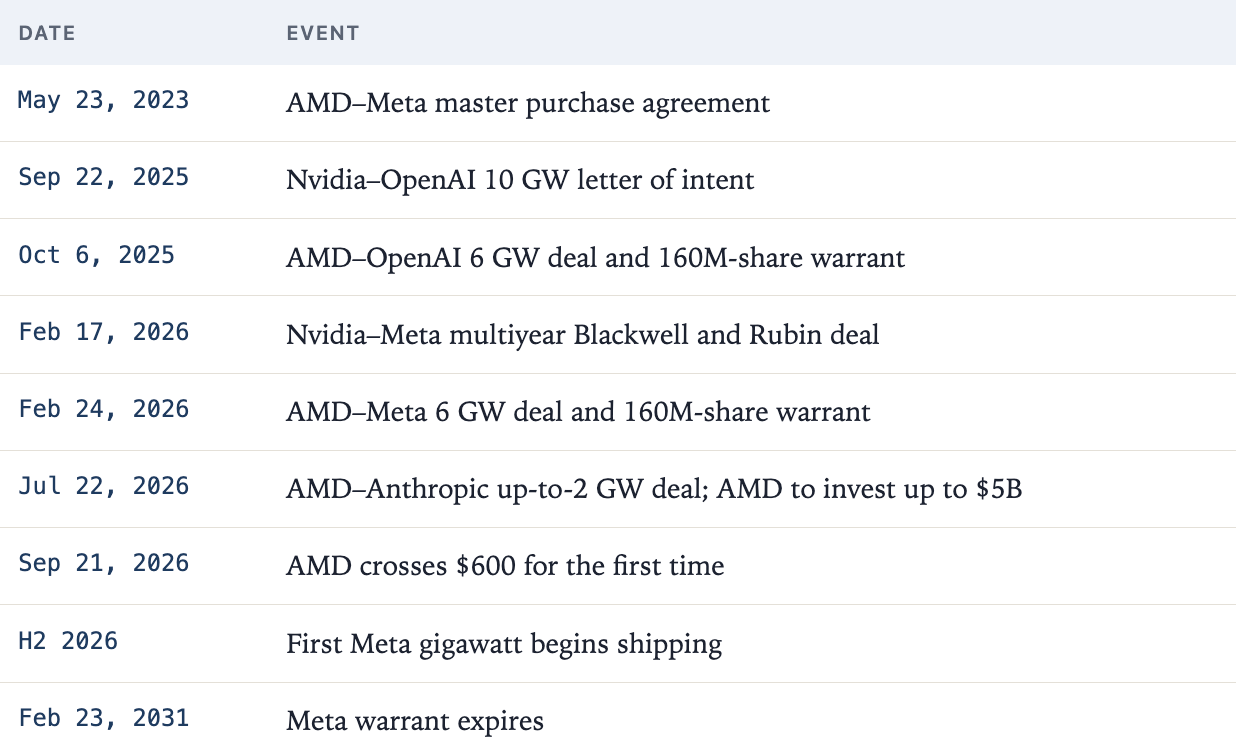
The rationale behind this move was that AMD needed to win anchor customers to compete with Nvidia. Put simply, AMD needed Meta more than Meta needed AMD. The timing of these agreements made this very apparent, as both OpenAI and Meta signed deals with Nvidia shortly before AMD announced its own. Nvidia signed a letter of intent for 10 GW on September 22, 2025, stating it would invest up to $100B in OpenAI as each gigawatt was deployed. AMD announced its OpenAI deal two weeks later. Similarly, Meta signed a multiyear deal with Nvidia for millions of Blackwell and Rubin GPUs on February 17, 2026, and AMD’s Meta deal followed just one week later.
At the time these deals were signed, AMD had less to show buyers, as Helios, built on the MI450, is its first complete rack-scale system. To stay competitive, AMD offered its own stock. This equity incentive allowed AMD to secure two leading AI buyers while locking them in. If Meta or OpenAI shifts spending to Nvidia or any other supplier, they forfeit their unvested shares.
The share price made this offer much easier to stomach. With AMD trading in the $200s, a $600 hurdle made the equity look cheap to give away. It is fair to say that neither Meta nor AMD expected the price to reach $600 so quickly. As the stock climbed, AMD shifted its approach. On July 22, 2026, it signed an up-to-2 GW deal with Anthropic, committing up to $5 billion in equity investment with no AMD warrant disclosed.
Secondary Beneficiaries
Apart from Meta, there are other companies in the AI ecosystem that also benefit their arrangement with AMD.
Samsung: AMD’s primary HBM4 memory supplier for the MI450 series.
TSMC: builds the MI450 on its 2 nm-class process.
Sanmina: assembles Helios racks at the ZT Systems plant it bought from AMD in 2025.
AMD’s EPYC CPUs: Meta is a lead customer for the next two generations, and TrendForce notes agentic workloads raise CPU demand per GPU.
Risks
Most of the risk in this deal sits with AMD.
Circular financing. AMD’s equity incentives (warrants) are now subsidizing a portion of its own demand. That makes it harder to judge how much of the order book is organic. Some investors may interpret that offering a 10% stake implies AMD struggles to win this demand on product alone. Also worth considering that If AI spending slows or the AI trade doesn’t play out as expected, AMD is exposed twice. Once due to a lack of supply contracts, and again due to dilution from warrant shares.
Only 1 GW is binding. Meta can stop after the first gigawatt, and gigawatts 2 to 6 depend on its future capex budgets. Of course, this would mean the warrant is not exercisable.
Customer concentration. A handful of buyers account for a large portion of AMD’s GPU volume, and two of them hold warrants on about 20% of the company.
Share overhang. With no lockup, up to 320 million shares across Meta and OpenAI could reach the market as tranches vest.
Supply and execution. Helios is AMD’s first rack scale system, and it competes with Nvidia for the same HBM4 and TSMC capacity. Shipments are now the main constraint on vesting, and AMD has to have the capacity to deliver.
Looking Ahead
Key catalysts to watch include AMD’s Q3 earnings (which could offer the first read on vested tranches and revenue impact), Meta’s 2027 capex guidance (the best signal on gigawatts 2 through 6), and the Helios ramp through Q4 2026.
AMD won two of the largest AI buyers by offering equity when its stock traded in the $200s. With the share price now above $600, the true cost of acquiring those customers is clear. Nearly 10% of the company goes to each, carrying an illustrative valuation of roughly $100 billion per warrant at current prices. The success of this trade depends on two factors. First, will Meta order gigawatts 2 through 6, given that only the first is binding? If Meta stops at the first gigawatt, it will not earn the full 160 million shares. While this limits AMD’s dilution, it also leaves the company without the crucial anchor customer it set out to win. Second, will this partnership establish AMD as a lasting supplier of AI accelerators? If both scenarios materialize, the equity surrendered will be much easier to justify.
Meta’s side of the trade is far simpler. The company secures a second GPU supplier alongside Nvidia, custom silicon for its inference workloads, and a warrant that could offset most of its AMD hardware spend. By committing to just one binding gigawatt, Meta retains the optionality to scale up or walk away, leaving it with very little downside.
Thank you for reading and if you enjoyed this post, please leave a like and Restack.
Subscribe to the plan that best suits your needs (free or premium), and will see you in the next one!
Very useful analysis. Thanks