

Last night, Meta submitted its third-quarter financial results for the period ending September 30. It was a strong quarter overall, the core business continued its solid performance with revenue up 26% year over year, while Reality Labs losses narrowed. However, two developments stood out to me:
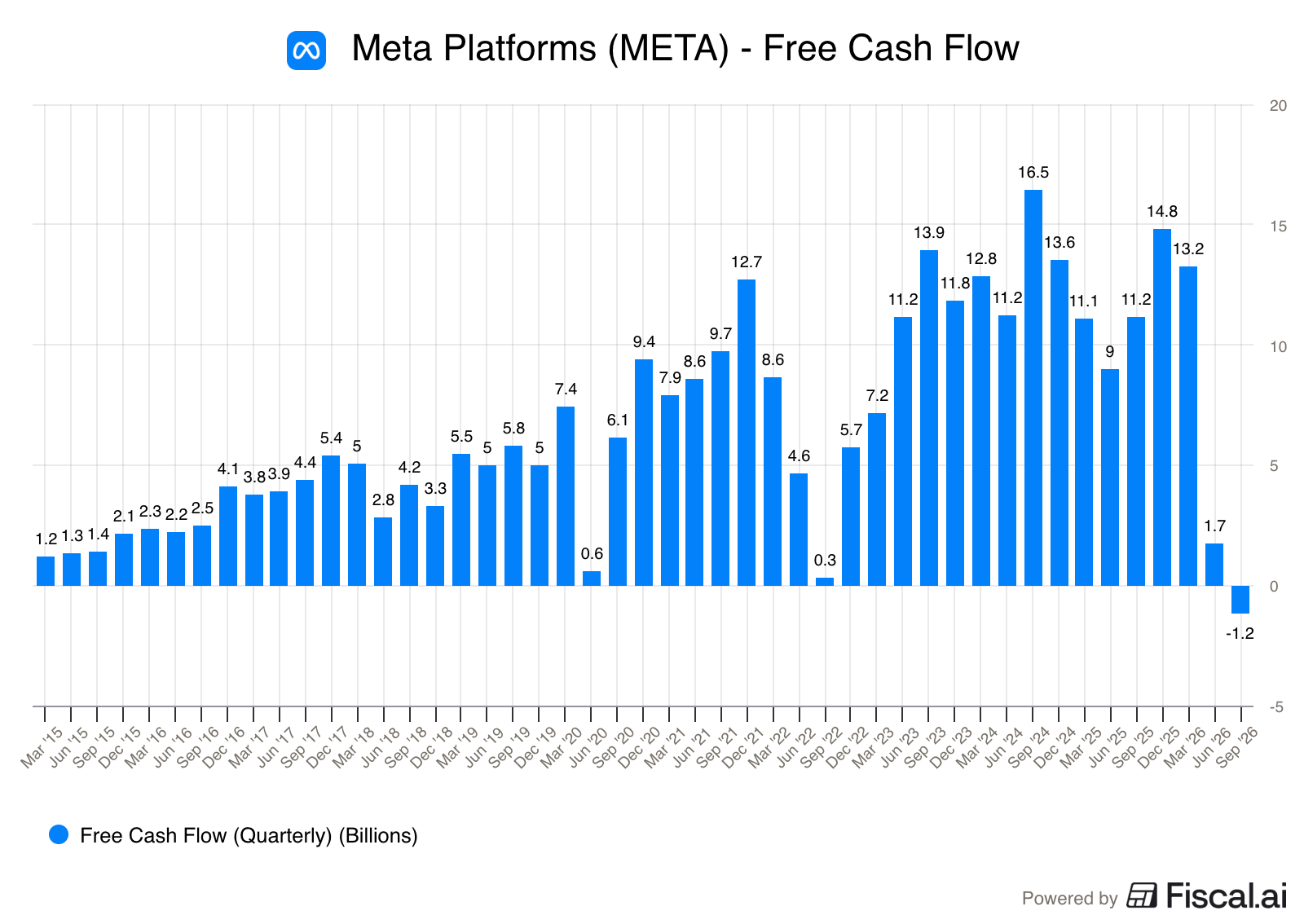
Free cash flow turned negative for the first time since 2012.
Meta announced a new class of non-voting shares.
Below we will take a further look at the quarter.
Overview:
Ad impressions rose 10% while the average price per ad climbed 14%, and Family Daily Active People (DAP) reached 3.64 billion, up 3% year over year. On the earnings call, CFO Susan Li highlighted that partnership ads surpassed a $15 billion annual run rate, noting that the 59% surge in “Other revenue” was powered largely by WhatsApp paid messaging and subscriptions.
The quarter also marked the debut of Muse and Muse Wonder, which Mark Zuckerberg characterised as Meta’s first frontier model. He noted that over 10 million users across the U.S. and Canada set up Muse personal agents within roughly six weeks, with approximately 25% engaging with the tool daily. Global rollout remains paused due to heavy compute requirements, with Zuckerberg citing compute capacity as “one of the limiting factors over the next year.”
Headline profitability was distorted by a $9.89 billion charge stemming from Meta’s August settlement framework with 52 U.S. state attorneys general regarding youth mental health litigation, which outlines potential payments of up to roughly $18.59 billion. Backing out this charge, operating income came in at $22.88 billion (up 11% year over year), while diluted EPS stood at $7.40.
Key Financial Highlights
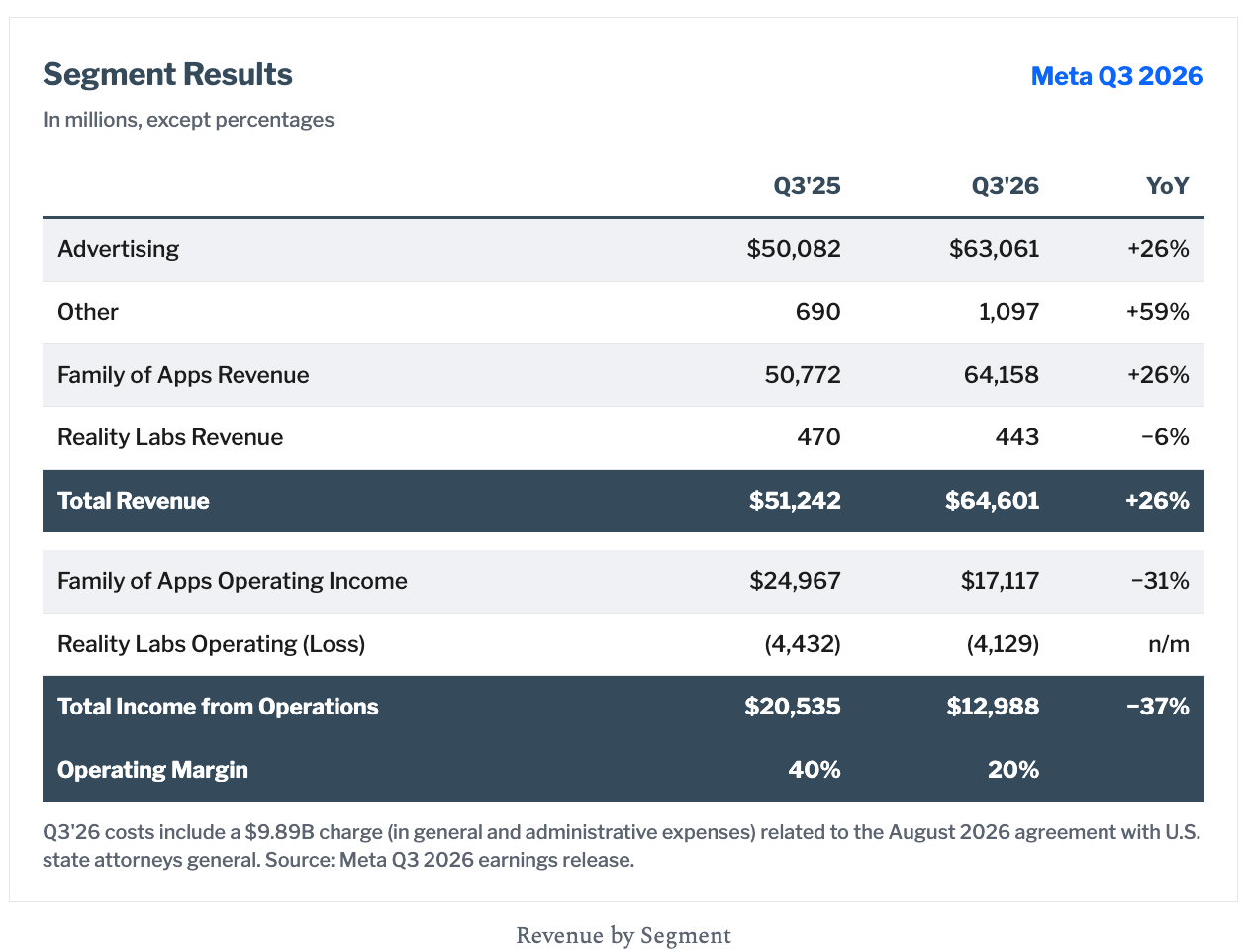
Total Revenue: $64.6 billion, up 26% year-over-year (26% constant currency).
Family of Apps Ad Revenue: $63.1 billion, up 26% year-over-year (26% constant currency).
Reality Labs Revenue: $443 million, down 6% year-over-year.
Family of Apps Other Revenue: $1.1 billion, up 59% year-over-year, driven primarily by WhatsApp paid messaging and subscriptions.
Ad Impressions: Increased 10% year-over-year.
Average Price Per Ad: Increased 14% year-over-year.
Family Daily Active People: 3.64 billion, up 3% year-over-year.
Headcount – Headcount was 66,775 as of September 30, 2026, a decrease of 15% year-over-year.
Operating Income: $13.0 billion, a 20% operating margin. Excluding the legal charge, $22.9 billion, a 35% operating margin (vs. 40% a year ago).
Net Income: $9.9 billion or $3.83 per share (up from $2.7 billion YOY, which included a one-time $15.93 billion tax charge). Excluding this quarter’s legal charge, EPS would have been $7.40, vs. $7.25 in Q3 2025 excluding that tax charge.
Cash and Marketable Securities: $82.45 billion.
Long-Term Debt: $80.9 billion, up from $58.7 billion at the end of 2025.
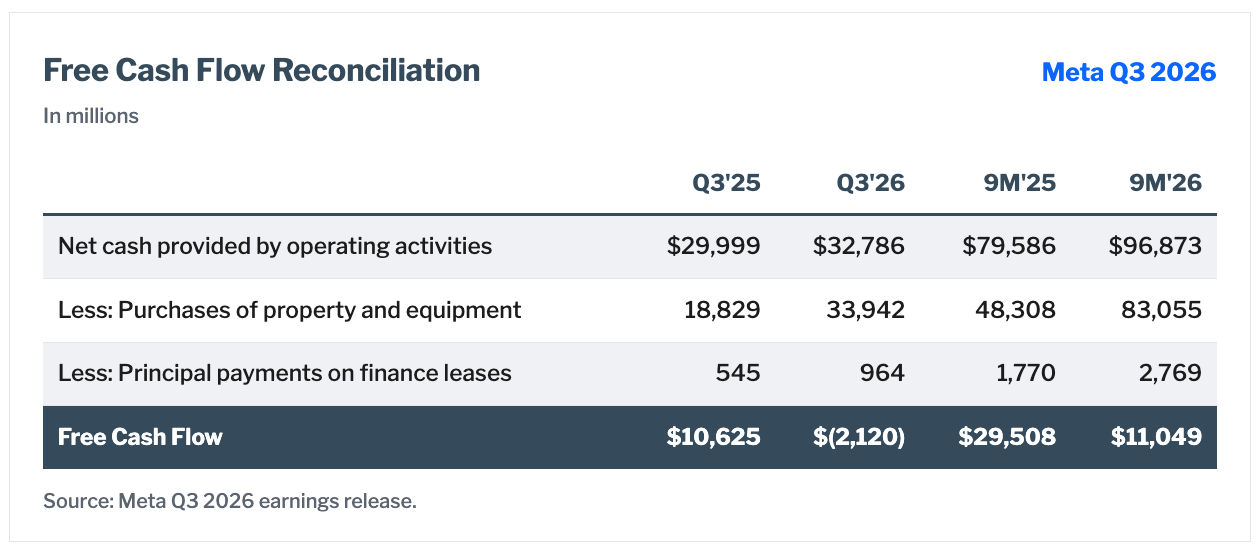
Capital Expenditures: $34.9 billion including principal payments on finance leases, up ~80% year-over-year.
Free Cash Flow: Negative $2.1 billion, the first negative quarter since 2012 (vs. $10.6 billion in Q3 2025).
Key Takeaways
Muse Ecosystem Momentum:
Muse has reached over 10 million users in the U.S. and Canada in just six weeks . The product is seeing strong early retention, with 25% of users engaging daily .
Strategic Shift to Agentic Commerce:
Shopping is the primary use case for Muse, with over 25% of users engaging in commerce activities .
Meta is actively building a “Personal Agent Protocol” to standardise how AI agents interact with businesses, moving away from human-like navigation toward authenticated, structured API interactions .
Operational Efficiency:
While Muse is currently compute-intensive, Meta expects to improve cost efficiency by more than 10x over the next year.
The company is also transitioning its internal content understanding models to the Muse family, which has reduced per-unit processing costs by over 80% .
Capital Structure Update:
Meta’s board approved the creation of publicly listed, non-voting Class C capital stock, structured effectively as a two-for-one stock split scheduled for January 19, 2027. Under the plan, holders of existing Class A and Class B shares will receive one Class C share for each share owned. This will adjust trading prices proportionally while leaving current voting power entirely unchanged, closely mirroring the recapitalisation Alphabet executed in 2014. As part of the move, Meta signed a Founder Alignment Agreement with Mark Zuckerberg governing his future sales of the new shares.
Strategically, the move provides Meta with a non-dilutive equity currency for employee compensation, strategic acquisitions, and potential capital raising. While CFO Susan Li noted that Meta has no immediate financing plans to announce, the timing is telling. In the context of negative free cash flow, paused share repurchases, and an escalating AI infrastructure build-out, Class C stock gives management the flexibility to issue equity and fund capital expenditures without eroding Zuckerberg’s voting control.
Reality Labs Outlook:
The company is narrowing its focus in Reality Labs, with operating losses expected to decline to approximately $15 billion in 2027 as investment is reallocated toward AI priorities
Guidance
For the fourth quarter of 2026, Meta expects total revenue to be in the range of $73 billion to $76 billion, with foreign currency anticipated to be an approximately 1% headwind to year-over-year growth. This is ~24% YOY growth at the midpoint.
Full-year 2026 total expenses are now projected to be between $175 billion and $179 billion, raised to include the $9.9 billion legal charge. Excluding that charge, Meta still expects 2026 operating income to be above 2025.
Reality Labs’ operating losses are expected to decline to $18-19 billion.
Capital expenditures for 2026, including principal payments on finance leases, are forecast to be in the range of $135 billion to $145 billion, narrowed from $130-145 billion. For reference, January’s guide was $115-135 billion.
The fourth quarter tax rate is expected to be 15%-17%.
For 2027, Meta isn’t providing a revenue outlook yet, but expects to continue investing aggressively in both the core business and AI, and believes it is positioned to sustain strong revenue growth throughout 2027. Reality Labs losses are expected to narrow to around $15 billion.
Current position and final thoughts:
I am currently long META, which represents a ~6% position with a cost basis in the mid-500s. On the run-up, I reduced the position by around 30%, with the last trims executed at 765 on October 13.

All transactions shared live here: Portfolio live Updates
The business remains strong and Q4 is likely to be another strong quarter.
A few things to pick at are the first FCF-negative quarter in years, alongside the overhang of a potential capital raise. Capex has outrun operating cash flow, buybacks have halted, long-term debt is up $22 billion this year, and the board has created a share class with capital raising listed first among its intended uses. Muse’s early numbers are encouraging, but I would like to see a clearer path to monetisation before Meta lays out its 2027 budget.
I rate META as a Hold at current levels. For investors seeking a fresh entry point, waiting for a pullback toward technical support (such as the 50-day moving average near 661) would be prudent. For now, I will continue to monitor the story quarter by quarter.
Thank you for reading, leave a like and see you for the next one!