

Microsoft submitted its first-quarter fiscal 2027 financial results for the period ending September 30. It was a strong quarter overall as revenue rose 19% year over year, Azure growth picked up to 48% from 42% last quarter, and operating margin edged up to nearly 50%. However, two developments stood out:
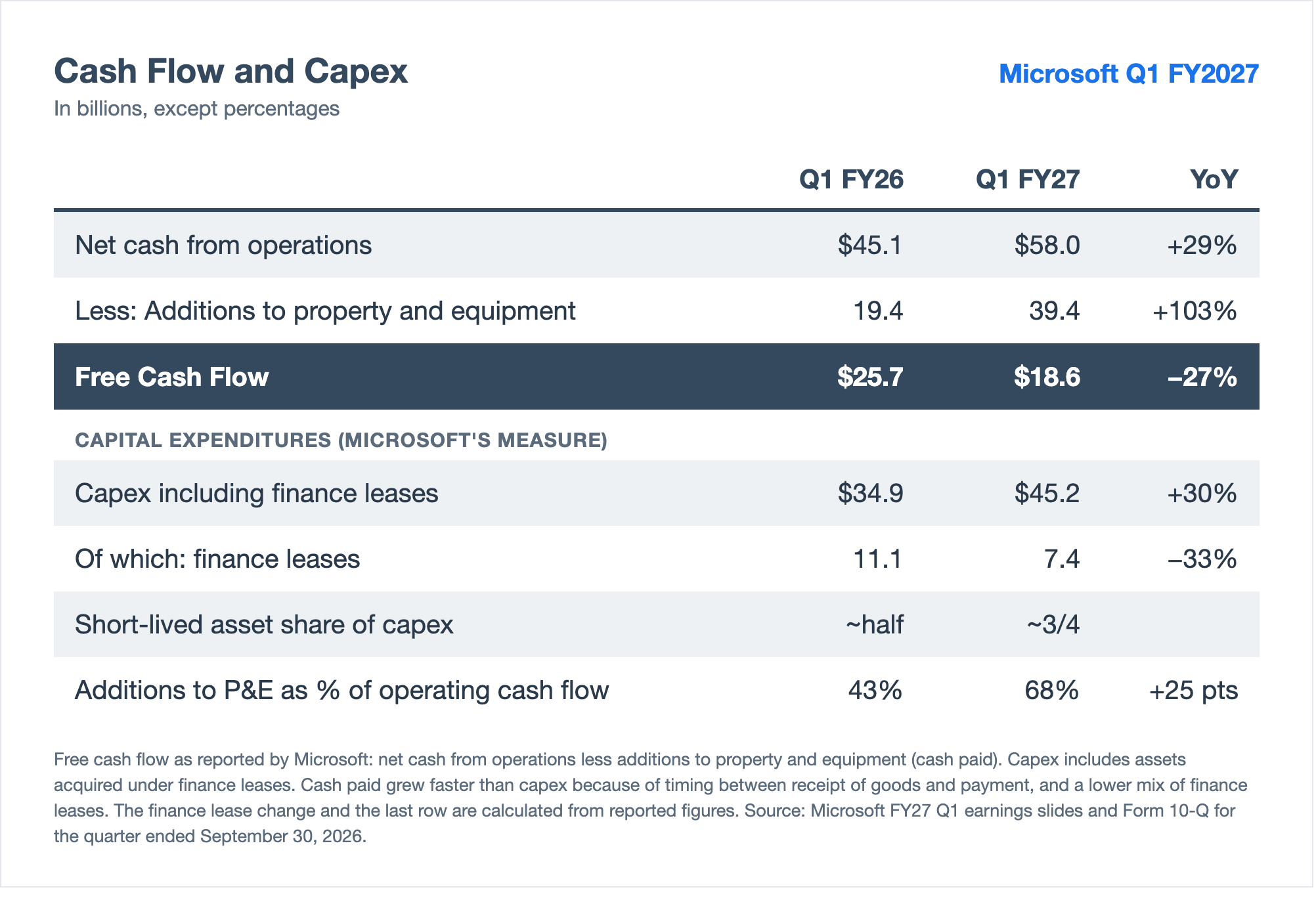
Free cash flow fell 27% to $18.6 billion as cash paid for property and equipment doubled to $39.4 billion. Capex including finance leases rose a more modest 30%, to $45.2 billion.
OpenAI accounted for $10.0 billion of revenue, roughly 11% of the total.
Below we will take a further look at the quarter.
Overview
Microsoft Cloud revenue grew 30% to $63.9 billion. Azure was the primary driver, adding $10.8 billion in revenue year over year, with growth across all workloads.
Microsoft 365 commercial cloud revenue rose 17%, helped by higher revenue per user as customers moved to Copilot, E5, and E7 plans. Meanwhile, paid seats grew a modest 5%.
Commercial remaining performance obligation (RPO) reached $677 billion, up 73% from a year ago, with a weighted average duration of about 2.3 years.
The quarter was also the first reported under Microsoft’s new segment structure: Results are now split into Agents and Infra (applications, agents, the multi-model system, and Azure infrastructure) and Devices and Consumer, with prior periods recast.
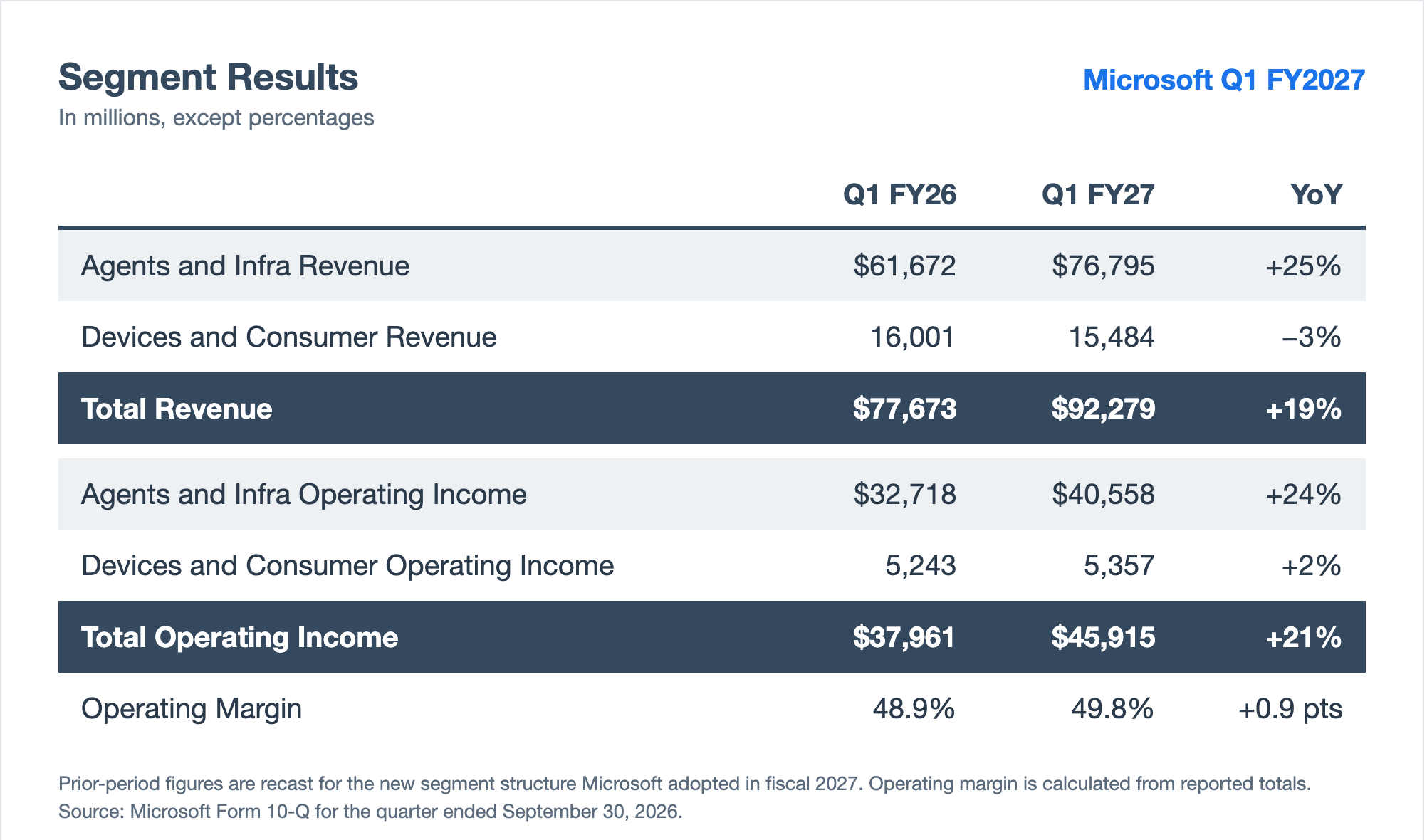
The two segments moved in opposite directions: Agents and Infra revenue grew 25%, while Devices and Consumer fell 3%, dragged down by a 22% drop in Windows OEM and devices revenue.
Headline earnings were helped by OpenAI. Microsoft booked a $272 million net gain on its OpenAI investment this quarter, compared to a $4.1 billion loss in the same quarter last year. That is why GAAP EPS of $4.92 was up 32%, while EPS excluding the OpenAI impact was $4.89, up 18% from $4.13.
Key Financial Highlights
Total Revenue: $92.3 billion, up 19% year-over-year.
Agents and Infra: $76.8 billion, up 25%.
Devices and Consumer: $15.5 billion, down 3%.
Microsoft Cloud Revenue: $63.9 billion, up 30%.
Azure Revenue: up 48%.
Microsoft 365 Commercial Cloud Revenue: up 17%, with commercial seats up 5%.
Microsoft 365 Consumer Cloud Revenue: up 17%.
Industry Solutions Cloud Revenue: up 10%.
Search and Advertising (ex-TAC): up 12%.
Xbox Content and Services: down 2%.
Windows OEM and Devices: down 22%.
Commercial RPO: $677 billion, up 73% year-over-year.
Gross Profit: $62.6 billion, a 67.8% gross margin (vs. 69.0% a year ago). Microsoft Cloud gross margin was 66%, down from 68% a year ago and up from 65% last quarter.
Operating Income: $45.9 billion, up 21%, a 49.8% operating margin (vs. 48.9% a year ago).
Net Income: $36.6 billion or $4.92 per diluted share, up 32%. Excluding OpenAI, EPS was $4.89, up 18%.
Cash and Short-Term Investments: $64.5 billion, down from $76.8 billion at the end of June.
Debt: $35.5 billion (current and long-term), down from $40.3 billion at the end of June. Finance lease liabilities of a further $71.0 billion are not included.
Operating Cash Flow: $58.0 billion, up 29%.
Capital Expenditures (including finance leases): $45.2 billion, up 30%, with roughly three-quarters going to short-lived assets, mainly CPUs and GPUs.”
Cash Paid for Property and Equipment: $39.4 billion, up 103% from $19.4 billion a year ago.
Free Cash Flow: $18.6 billion, down 27% (vs. $25.7 billion a year ago).
Headcount: down 2% year over year.
Key Takeaways
Azure Keeps Accelerating, With Some Margin Cost:
Azure grew 48%, up from 43% last quarter. Microsoft attributes it to demand across the platform, with continued growth across all workloads.
The cost is visible in the margin. Microsoft Cloud gross margin fell to 66%, which Microsoft attributes to Azure making up a larger portion, partly offset by product-level improvements. Total company gross margin slipped about 1.2 points to 67.8%. Operating margin still rose, because operating expenses grew only 6% against 19% revenue growth.
On backlog, commercial RPO of $677 billion is up 73% year over year, but is roughly flat against the $678 billion reported in June. About 30% of it is expected to be recognised over the next 12 months.
The Spending Ramp:
Net property and equipment rose by about $34 billion in a single quarter, to $346.8 billion. On top of that, Microsoft recognised $7.4 billion of finance leases during the quarter, against $11.1 billion a year ago.
Leases that have been signed but not yet started (mostly datacenters), total $364.6 billion, commencing between fiscal 2027 and fiscal 2034.
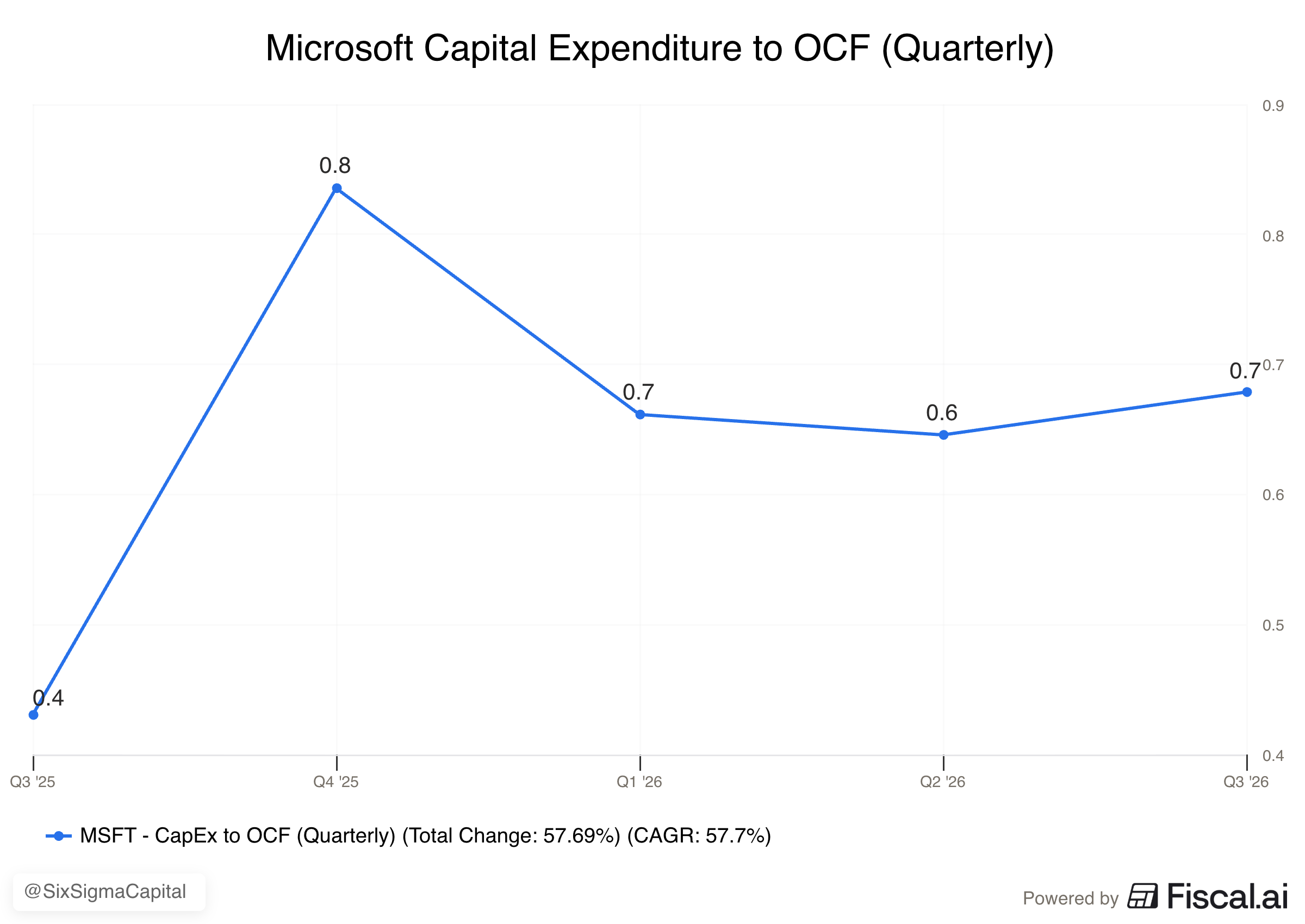
Operating cash flow grew 29%, but cash paid for property and equipment grew 103%, so it took 68% of operating cash flow this quarter, against 43% a year ago. Microsoft says cash paid grew faster than capex because of payment timing and fewer finance leases. Its capex including finance leases rose 30% to $45.2 billion.
Cash and short-term investments fell $12.3 billion over the quarter. This is partly because Microsoft repaid $4.9 billion of debt.
OpenAI:
Microsoft holds an equity method investment that represents about 24% of OpenAI on an as-converted basis. It and has funded $12.0 billion of its $13.0 billion commitment.
OpenAI is also a customer. Revenue from commercial arrangements with OpenAI, including revenue-sharing payments, was $10.0 billion this quarter. This accounts for about 11% of Microsoft’s total revenue. Receivables from OpenAI rose to $7.2 billion from $6.0 billion in June. Microsoft does not say how much of the $677 billion RPO relates to OpenAI.
Devices and Consumer:
Windows OEM and devices revenue fell $1.0 billion, or 22%. Microsoft points to the benefit of Windows 10 end of support in the prior year, inventory drawdowns at OEM and channel partners, and weaker PC demand.
Xbox hardware fell 14% on lower console volumes, while search and advertising excluding traffic acquisition costs grew 12%, led by LinkedIn, Edge and Bing.
The segment’s operating income still rose 2%, helped by lower amortisation of Activision Blizzard intangibles.
Capital Returns:
The board declared a quarterly dividend of $0.98 per share, up about 8% from $0.91, payable December 10 to holders of record on November 19.
Buybacks were smaller than a year ago at $2.9 billion against $4.0 billion, and $37.7 billion remains on the $60 billion authorisation.
In total, Microsoft returned $10.2 billion to shareholders in dividends and repurchases.
Guidance
For the second quarter of fiscal 2027, Microsoft expects total revenue of $96.0 billion to $97.1 billion, growth of 18% to 19%, with FX having no meaningful impact. Operating margins should be down slightly year over year.
Agents and Infra: revenue of $80.1 billion to $80.7 billion, growth of 24% to 25%.
Azure: growth of 49% to 50% in constant currency. Some third-party GPU capacity contracts have slipped into the second half. Customer demand continues to exceed available supply.
Microsoft 365 Commercial Cloud: about 19% growth in constant currency, with revenue growth expected to accelerate through the year.
Microsoft 365 Consumer Cloud: growth in the low teens.
Productivity and Server Licensing: a decline in the mid to high single digits.
Industry Solutions Cloud: growth in the mid to high single digits.
Frontier and Support Services: growth in the low to mid single digits.
Microsoft Cloud gross margin: roughly 65%, down year over year on the mix shift to Azure.
Commercial bookings: will again be affected by large Azure commitments signed in the prior year.
Devices and Consumer: revenue of $15.9 billion to $16.4 billion.
Search and advertising (ex-TAC): growth in the low double digits.
Xbox content and services: growth in the mid to high single digits, the strongest quarter of the year. Xbox hardware is expected to decline.
Windows OEM and devices: a decline in the mid-30s, with elevated inventory, weak PC demand and a prior-year Windows 10 comparison.
Costs: COGS of $32.7 billion to $32.9 billion (up 26% to 27%) and operating expenses of $18.5 billion to $18.6 billion (up 9%). Both include an estimate for the recently announced employee voluntary exit offer.
Other income and expense: roughly negative $300 million excluding OpenAI. Effective tax rate of about 20%.
Capex: over $50 billion in Q2, and about $170 billion for calendar 2026 because of the third-party capacity delays. Capex should accelerate in the second half of the fiscal year.
Free cash flow: Microsoft expects to stay free cash flow positive in fiscal 2027. Hood also said Microsoft “will access additional sources of funding when we believe it is attractive to do so”. On the call she added that it has not yet tapped the debt markets.
Current position and final thoughts
SixSigmaCapital is currently long MSFT, with a cost basis of $241. We have owned it for many years, but we have been trimming shares in the mid-$500s, especially the ones acquired in 2026 in the $360–$370 range.
All transactions shared live here: Portfolio live Updates
The business remains strong. Azure is growing faster, margins held up, and the backlog is large and long-dated.
A few things to pick at are the cost of getting there and how concentrated the demand is. Free cash flow fell 27% in a quarter where operating cash flow grew 29%, because cash paid for property and equipment doubled, and Microsoft’s own capex measure is still growing 30%. Microsoft Cloud gross margin is two points lower than a year ago as Azure grows, commercial bookings fell 12%, commercial RPO was flat against June, and OpenAI is now roughly 11% of revenue while also being a 24% investee. With $364.6 billion of datacenter leases still to commence, I would like to see free cash flow stabilise before the spending gets bigger.
We rate MSFT as a Hold at current levels. For investors seeking a fresh entry point, waiting for a pullback toward technical support such as the SMA 50 would be prudent.
Thank you for reading, leave a like and see you for the next one!