


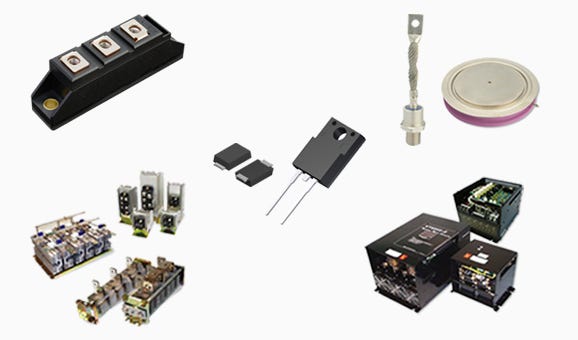
Power semiconductors are the parts inside an electronic device that switch, convert, and regulate current as it moves from the power source down to whatever it’s powering. They do so by stepping voltage up or down and turning AC into DC (and back) along the way. Every piece of electronics that plugs into a wall relies on a power semiconductor.
They are highly relevant to the AI infrastructure boom. The buildout of AI data centres is pushing power demand increasingly higher. As the power requirements in a data centre increase, so does the need for managing it efficiently across the entire rack. Every watt lost in conversion is a watt that isn’t being used for compute, and it gets wasted twice due to the “double penalty” of data centre efficiency (once as lost electricity, and again in the cooling needed to balance the heat it created). Power semiconductors help ensure efficient conversion to make the most out of all the power flowing through data centres.
Beyond AI, these chips perform a similar function in electric vehicles and industrial applications, and right now, these two major demand sources are pulling the industry in different directions. Electric vehicles, the longtime largest end market, are still working through a 2019-2024 capacity overbuild and remain in a downturn. Meanwhile, AI data centres, moving towards a new 800VDC power delivery standard, are growing fast and running short on supply. NVIDIA is racing to lock down components across that AI power chain, building out the 800VDC standard itself and pulling 14 power semiconductor companies into its ecosystem, while suppliers race to expand capacity to meet the new orders. A handful of names are taking a different path, most notably Texas Instruments (TXN), which has raised prices three times in the past year while cutting its forward capex intensity from above 30 per cent of revenue to about 13 per cent.
The remainder of this post walks through the chain from the grid to the chip, sizes the demand behind it, shows where supply is constrained, and points out the associated risks. The companies listed in this post will get a closer look in a follow-up.
This post is for informational purposes only and does not constitute financial advice. Please conduct your own due diligence before purchasing any equities or assets discussed herein.
Power Semiconductors
Power semiconductors help control large amounts of electrical power. When electricity is delivered to the chip, it needs that electricity delivered at a specific voltage and current. The electricity that comes from a power source, such as a wall outlet or a battery is rarely the right amount of voltage and current. A power semiconductor is a chip that helps convert and regulate the electricity to the correct voltage and current, allowing the connected device to get the exact amount of power it needs. Power semiconductors are used in almost all modern electronics, including phone chargers, washing machines, industrial robotics, and electric vehicles.
Two Major Themes In The Industry:
The power semiconductors industry consists of two major themes:
EV and Industrial - silicon carbide (SiC)
Data Centers - Gallium Nitride (GaN) and SiC
The legacy side is EV traction and industrial equipment, running mostly on SiC and IGBT devices (an IGBT is an electronic switch for high voltages and large currents). Yole Group’s reported that the power SiC market is an overcapacity downturn, with utilisation around 50% for upstream SiC processes and 70% for device lines as of 2025.
Independent of that legacy business is the emergence of power delivery for data centers, which is supply constrained. GaN semiconductors are experiencing accelerating adoption, largely due to Nvidia’s 2025 initiative towards an 800-volt DC (800 VDC) rack architecture. This business did not start from scratch. The high voltage devices, the SiC supply base, and the DC conversion technology were all scaled first for electric vehicles, which the AI build is inheriting.
The reason the architecture is changing is power density. Modern AI data centers need way more power than they used to. A single server rack today draws over 100 kilowatts, and the next generation of racks is expected to need up to 600 kilowatts. The existing infrastructure is unable to handle the power conversion and distribution needs, and pushing that much electricity through a low voltage system wastes energy and requires heavy cabling just to manage it. As such, power semiconductor companies need to find methods to handle higher voltages and power levels more efficiently than what the current infrastructure is used to. This is where 800VDC is emerging to become the standard architecture for how power gets distributed through the data centre. Power semiconductor demand is built on providing the chips that help this architecture run.
The Four Stages
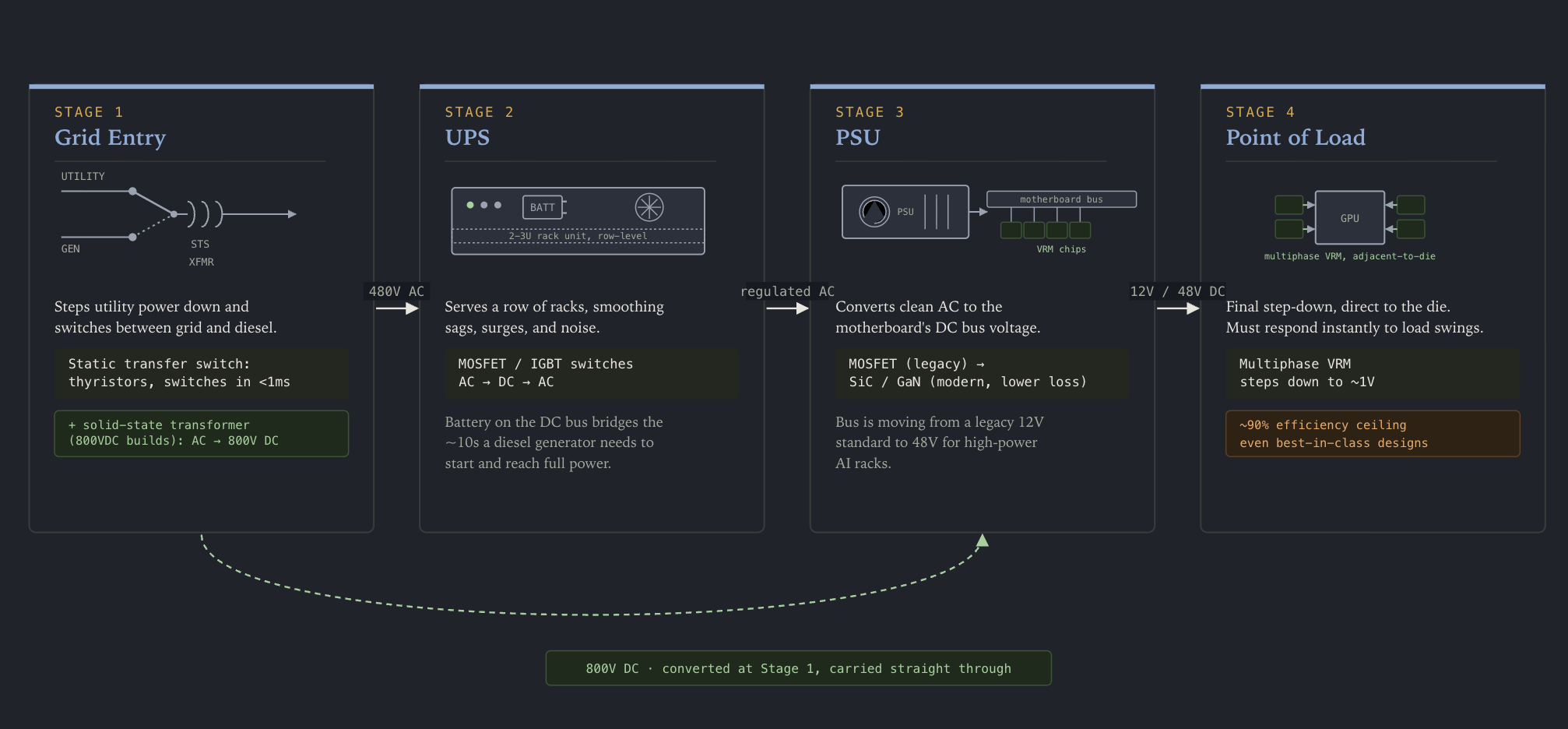
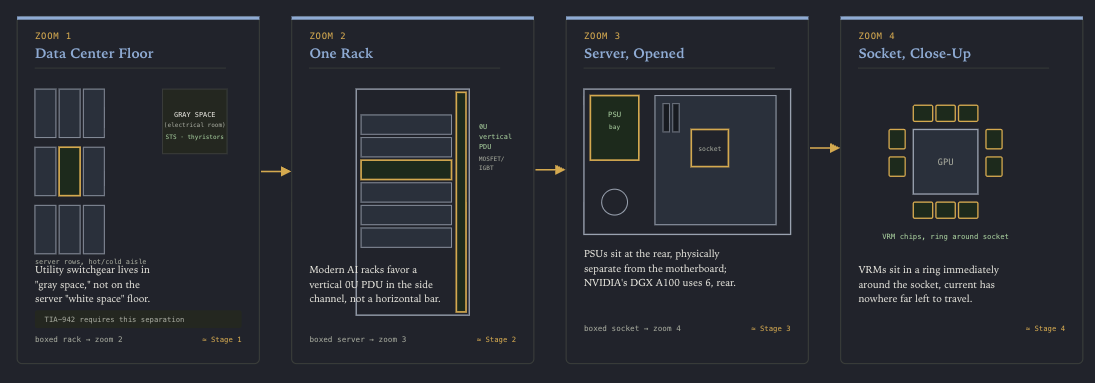
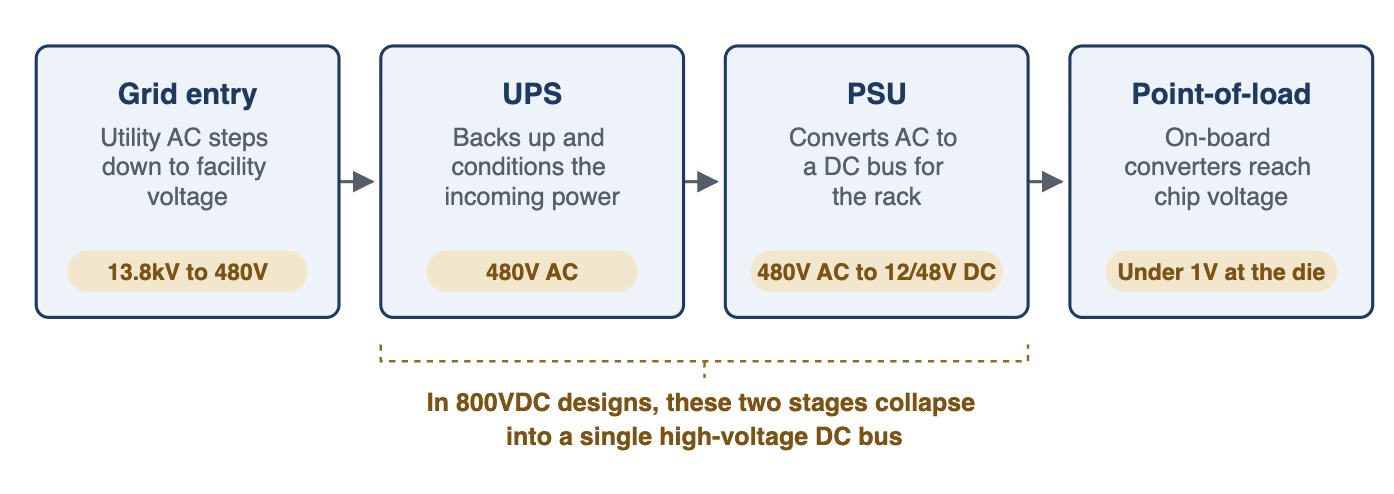
Power Semiconductors are primarily used in four stages inside the data centre.
Stage 1: Grid Entry
Utility power enters here, gets stepped down by transformers, and is switched between sources. The switch that matters for semiconductors is the static transfer switch, which selects between the utility feed and the backup diesel generator using thyristors instead of mechanical contacts, so it can transfer in milliseconds. It only changes sources during a utility disturbance, but its thyristors carry the load current continuously. In newer 800VDC builds, a solid-state transformer also sits at this stage and converts AC to 800V DC on every watt that comes in.
Stage 2: UPS (uninterruptible power supply)
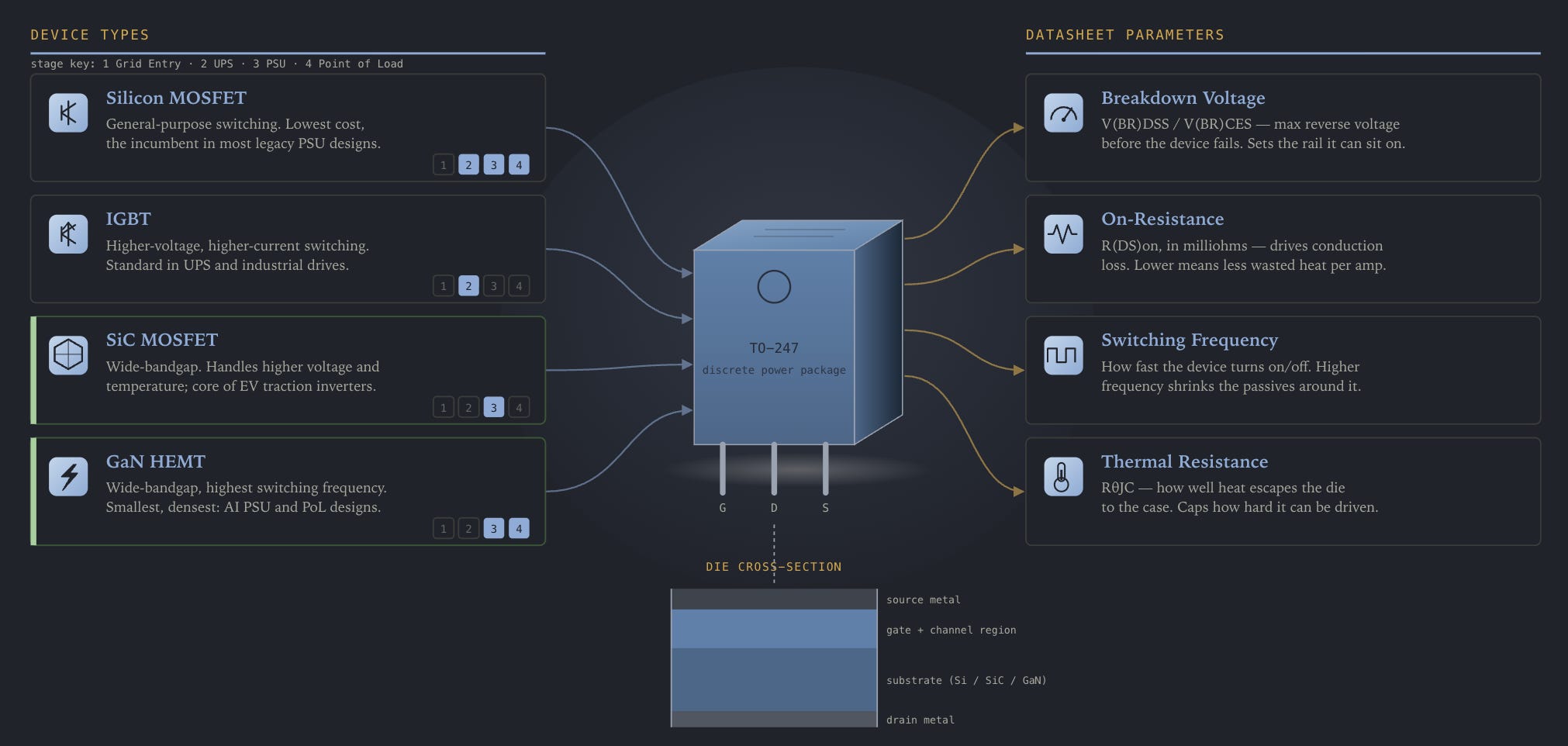
The UPS stage sits right after grid entry and before the PSU, and it typically serves a whole row of racks or a section of the data center. This stage uses either MOSFET (Metal-Oxide-Semiconductor Field-Effect Transistor) or IGBT power semiconductor switches to convert incoming AC to DC and vice versa. This allows the servers to always receive a clean and stable supply of electricity, preventing voltage sags, surges, and electrical noise.
It also provides power during the event of a failure. the A diesel generator takes a few seconds to start up and reach full power before responding to a grid failure. The UPS uses a battery (attached to a DC source), to supply power so the servers do not lose power while the generator spins up.
Stage 3: PSU (Power Supply Unit)
Inside each individual server, there is a PSU. It takes the clean AC power from the UPS and converts it to a DC bus voltage for the motherboard. Historically, this main bus uses 12 volts, but it is being increased to 48 volts for high power data centers. The Voltage Regulator Modules (VRMs) on the motherboard then step down the volts further to the tiny voltages needed by the chips. This is done by MOSFETs in older designs and SiC or GaN devices in modern PSUs, because the newer materials waste less energy in the form of heat.
Stage 4: Point of Load (PoL) Conversion
This stage takes the PSU’s output voltage and steps it down one final time (usually to 1 volt) to the CPU or GPU. Given that the demand for a chip’s power can increase suddenly, the PoL conversion has to be done instantly and efficiently to keep the voltage stable. Otherwise, the chip could misbehave.
According to an IEEE survey of data-centre power delivery (Chen et al., 2023) article, there is an efficiency bottleneck in this stage of the chain, since even the best designed conversion mechanisms typically reach around 90% efficiency.
The AI Power Build
Industry Catalysts
The major catalyst for the industry is the increasing data centre power demand. According to Goldman Sachs Research (GS):
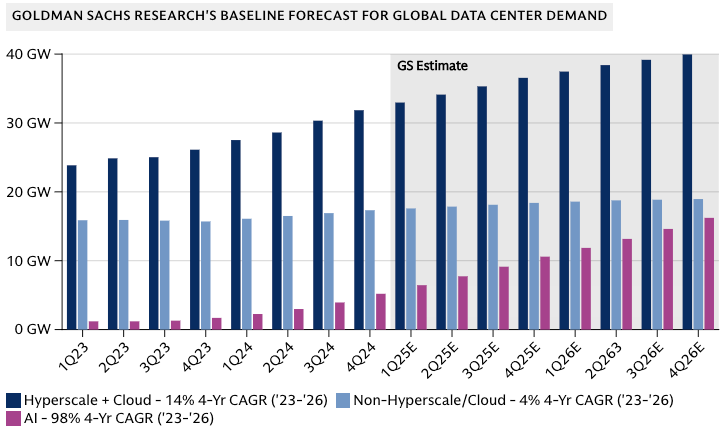
Demand across hyperscale, cloud, and AI is set to grow into 2027, while non-hyperscale/cloud demand remains relatively stagnant. Their analysts estimate current demand to be approximately 62 gigawatts (GW), composed of cloud workloads (58%), traditional workloads (29%), and AI workloads (13%). According to their projections, AI is expected to grow to 28% of the overall market by 2027, while cloud drops to 50% and traditional workloads fall to 21%. They also foresee increasing processing power requirements for modern AI workloads, highlighting a significant jump between 2026 and 2027.
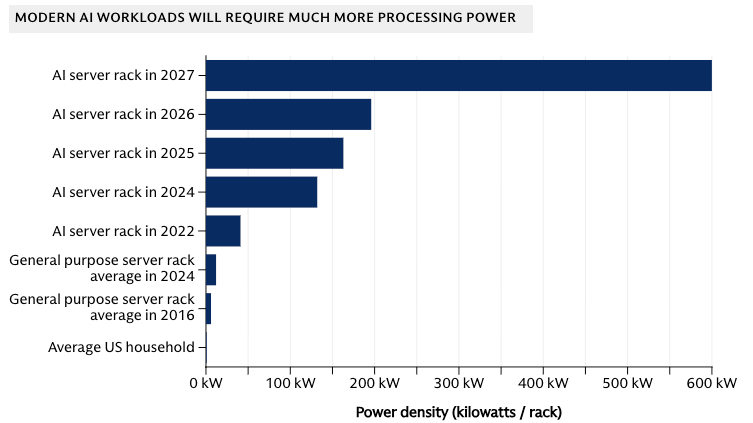
GS forecasts that “data centre power demand will increase from 1%-2% of overall global power demand in 2023 to 3%-4% by the end of the decade. In the US, the weighting of power demand from data centres will increase even more, likely more than doubling by 2030 from 4% in 2023.”
The growth in AI is substantial for power semis. The majority of current demand comes from legacy business in automotive and industrial applications, which are sectors that have recently seen slowing growth. Surging demand from the AI and data centre sector is a new source of revenue from a fast-growing industry.
The growing demand for AI data centres shows up in the projected market size for 800VDC equipment. SemiAnalysis estimates that the market for power racks and sidecars (equipment that handles power conversion at the rack level) will peak around $11 billion in 2028, while the market for solid-state transformers (which handle the earlier medium-voltage-to-800VDC conversion step) will reach about $13 billion by 2030. Nvidia has responded by naming 14 silicon partners to its 800VDC ecosystem, and revenue is already showing up across those companies:
Infineon’s fiscal 2026 AI data centre revenue is guided above €1.6 billion, more than doubling from over €700 million in fiscal 2025 and representing a more than 6x increase from €250 million in fiscal 2024.
Analog Devices’ data centre business grew more than 100% YoY in its fiscal Q3 2026.
Murata is spending ¥250 billion (US$1.56B) in fiscal 2026 capex, including ¥80 billion (~$499 million) specifically to expand server-grade MLCC capacity.
While these numbers signal bullish sentiment, and rightfully so, there is something to note about Murata’s expenditure on capacity expansion, which serves as a potential signal of an overarching constraint. Demand is currently outpacing supply across several areas of the power semis chain.
Industry Shortages
While the focus of this report is power semiconductors, it is worth analysing the entire power build chain. Citrini Research bundles capacitors, inductors, and power semiconductors into one basket, and that framing is relevant here as well. Capacitors and inductors are passive components, while power semiconductors are active chips, but they are part of the same circuit. A shortage or price increase in one directly affects the others, so it is worth discussing them as a whole.
The main shortage in this transition is in multilayer ceramic capacitors, or MLCCs, which store and release electrical energy using stacked layers of ceramic and metal. A single Nvidia GB200 server uses roughly 6,500 MLCCs, and the Rubin board is expected to need around 12,000.
Murata, Samsung Electro-Mechanics, and Taiyo Yuden control about 77% of global high-end MLCC capacity, and all three are running at 90-95% capacity as lead times have stretched to 20-24 weeks. Murata’s own guidance says capacity expansion over the next two years will slightly exceed 20%, but this will fall short of AI-driven demand growth.
Focusing on the power semiconductors, the shortage is concentrated in high-voltage capacity built for 800VDC. There exists a supply chain bottleneck for electrical components that can handle 800VDC, and the SiC manufacturing capacity sitting idle from the EV downturn cannot simply be redirected to 800V data centre parts because these need higher blocking voltages. This shortage is impacting prices as TXN, a company that makes the required electrical components, has raised prices for the third time in a year.
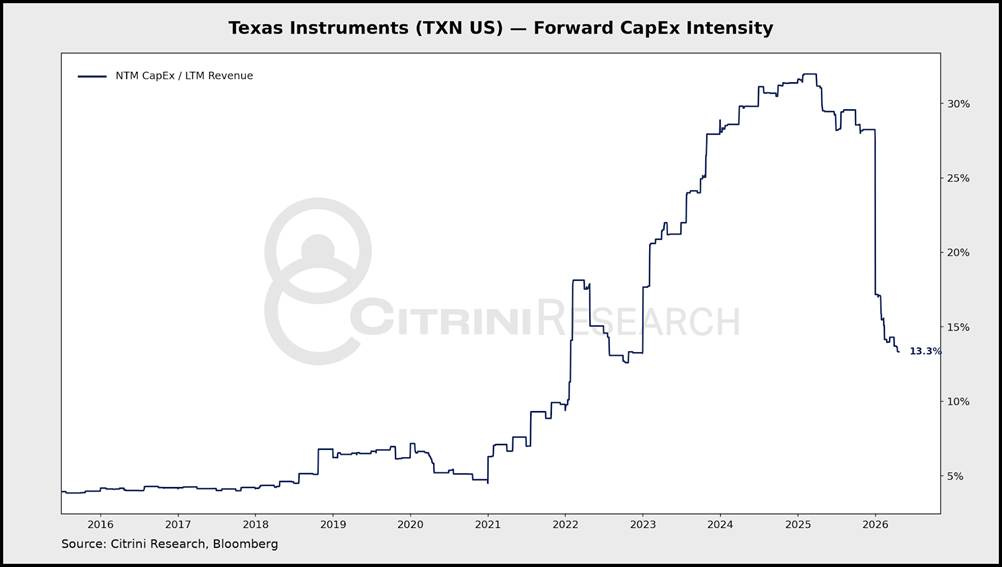
It is worth noting, though, that according to Citrini Research, TXN has seen a decrease in Forward CapEx Intensity, which suggests their approach is to avoid repeating the mistake many companies made with the EV cycle: building capacity for demand which then sat idle. TXN already spent heavily ahead of demand. Now, rather than start a new expansion for AI, it’s letting price absorb the shortage.
Risks & Uncertainties
The industry has not settled on a single voltage for data centre power. Nvidia is building out 800VDC, while Google, Meta, and Microsoft are building Mt Diablo, which allows either 800VDC or a bipolar 400VDC. The 400V path reuses the SiC devices already made in volume for electric vehicles, while the 800V path depends on higher-voltage devices that are still being made in volume. If the market leans toward 400V, it is possible that the excess EV supply is used and the component shortage eases sooner than expected. Currently, with 800VDC gaining traction, the shortage likely remains until capacity finishes ramping up.
Another major risk is the lack of diversified revenue sources for power semiconductor companies. Microsoft, Alphabet, Amazon, and Meta account for the bulk of the AI infrastructure spend for the data centre buildout, and materialised revenue must follow Nvidia’s buildout timeline. Despite bullish revenue guidance from the majority of power semiconductor companies, much of the basis for those projections is built on a successful rollout of the Rubin architecture (which uses an 800VDC power architecture). A slip in Nvidia’s execution would be worrisome for many major names in the power semiconductor industry.
Power Semiconductor Companies
Below is a list of some power semiconductor names worth watching. Some of these companies will be covered more in depth in future posts. For now, this is just a breakdown of where each one sits in the chain.
On Semiconductor (ON) - Stage 3 (PSU)
$74.38 (+31.18% YTD) · Market Cap $28.96B
onsemi converts grid power into stable, usable power for AI compute, minimizing energy loss and heat at each conversion stage using its SiC and GaN chips. This lets hyperscalers run more compute within the same power budget and reduces cooling needs.
STMicroelectronics (STM) — Stage 3 (PSU)
$52.24 (+90.87% YTD) · Market Cap $47.36B
STMicroelectronics operates as a mass producer of highly efficient power semiconductors, dominating the EV market with its SiC chips while aggressively scaling GaN tech for AI data centers. They have approx. ~33% global market share in the SiC power device market.
Navitas Semiconductor (NVTS) — Stage 3 (PSU)
$11.80 (+40.81% YTD) · Market Cap $3.08B
As another stage 3 producer, Navitas Semiconductor designs GaN and SiC chips. They are one of the smaller names here, and offer a lot of exposure to the 800VDC buildout. They were named as Nvidia’s GaN collaborator for the next gen rack architecture.
Texas Instruments (TXN) — Stage 4 (Point-of-Load)
$258.44 (+45.58% YTD) · Market Cap $236.08B
One of the largest analog chipmakers in the world, with products specifically targeting point-of-load conversion for 800V AI data center power. TXN makes the vital electrical plumbing that regulates, converts, monitors, and distributes electricity across hardware architecture like 800VDC.
Wolfspeed (WOLF) — Material supplier, used across Stages 2-3
$28.35 · Market Cap ~$1.50B
Wolfspeed grows pure silicon carbide crystals and slices them into wafers and substrates. They also manufacture SiC MOSFETs, and package multiple semiconductor chips together for heavy-duty usage.
Conclusion:
The demand for power semiconductors is clearly growing. The supply side is mixed, but it also points in a reasonable direction. Suppliers are increasing capacity, even if it’s not to the extent that is expected from companies, like TXN.
There are still open questions. The main one is which voltage standard the industry shifts towards. Right now, 800VDC is the likely standard, but that’s not settled. If it ends up being bipolar 400VDC, a portion of the existing EV supply can be reused, which would ease the shortage sooner. If it ends up being 800VDC, more of the demand requires capacity that is still being built.
For the companies with exposure to this industry, demand and volume are going up, and so is pricing, so the outlook remains bullish.
We will take a closer look at some of the companies listed in this post in a follow-up.
Thank you for reading and if you enjoyed this post, please leave a like and Restack.
Subscribe to the plan that best suits your needs and will see you in the next one!
Sources
Financial Data (Stock price, market cap, etc.) from Google Finance
Goldman Sachs Research — data center power demand by workload type (hyperscale/cloud/AI GW breakdown) and share of global power demand
SemiAnalysis — 800VDC equipment market sizing ($11B racks/sidecars by 2028, $13B solid-state transformers by 2030)
Trendforce - MLCC numbers for Rubin and GB200 Boards
Yole Group — power SiC market utilization and overcapacity data (2025)
Citrini Research — Semi Memo: Supply Chain Inheritance
Chen, Y., Shi, K., Chen, M., and Xu, D., “Data Center Power Supply Systems: From Grid Edge to Point-of-Load,” IEEE Journal of Emerging and Selected Topics in Power Electronics, Vol. 11, No. 3, June 2023
Nvidia — 800VDC ecosystem partner announcement, October 2025 OCP Global Summit
Earnings releases and investor materials: Infineon, onsemi, STMicroelectronics, Wolfspeed, Navitas Semiconductor, Texas Instruments, Murata Manufacturing