

In this post, Akshath S and I break down the investment case for QXO Inc (QXO).
This post is for informational purposes only and does not constitute financial advice. Please conduct your own due diligence before purchasing any equities or assets discussed herein.
Layout:
Overview of QXO Inc
Bull and Bear Case
Management
Financials and Valuation
Chart
Current position and plans
Overview of QXO Inc
QXO, Inc. is a building products distributor that trades on the NYSE. QXO buys roofing, waterproofing, siding, lumber, trusses, insulation, and related construction supplies in bulk and sells them to contractors, homebuilders, and other trade professionals. It operates as a B2B distribution business, as opposed to a traditional retailer.
QXO was relaunched in early 2024 with a $1 billion equity investment (~$900 million from Brad Jacobs) into SilverSun Technologies, a publicly traded ERP software company. SilverSun Technologies was then rebranded as QXO and repositioned as a consolidator and distributor of building products.
Jacobs, who is chairman and CEO, has applied the same business strategy of entering fragmented industries and buying smaller operators to consolidate them into a larger business multiple times. Through this specific process, he has turned his last three business ventures into multibillion-dollar companies. His plan for QXO remains the same, as he stated in a press release: “to become a preferred supplier serving the full project lifecycle of large, multisite developments and master-planned communities.”
QXO has explained its rationale for entering the building products industry: “We chose building products distribution because it fits our playbook perfectly and offers the right combination of size, growth, and acquisition opportunity... We also like the structure of the industry. There are attractive assets to buy, and the acquisition landscape is less crowded than it is in many other industries we’ve operated in. Most importantly, this is a sector where better execution matters. As we improve pricing, procurement, availability, service, technology, and inventory management at scale, we can unlock considerable value independent of market growth.”
Key Segments
QXO operates across three markets, each established through acquisitions:
Roofing & Waterproofing (via Beacon Roofing Supply, $11B, closed April 2025): The merger established QXO as the largest publicly traded distributor of roofing, waterproofing, and complementary building products in North America.
Lumber, Trusses & Gypsum (via Kodiak Building Partners, $2.25B, closed ~April 2026): added fabrication, assembly, and installation capability alongside core lumber/gypsum/trusses distribution, plus construction supplies. This acquisition expanded QXO’s addressable market to more than $200 billion.
Insulation (via TopBuild Corp, ~$17B, closed July 1, 2026): Their latest acquisition of TopBuild Corp positions QXO as a leader in the following building product categories in North America:
#1 in insulation
#2 in roofing
#1 in waterproofing
#1 or #2 in the lumber and building materials sector, in key geographies served
Following the completion of the TopBuild acquisition on July 1, 2026, QXO became the second-largest publicly traded building products distributor in North America. Combined, the three businesses generate roughly $18.1 billion in revenue and $2.1 billion in adjusted EBITDA (2025A, pre-synergies). They operate from approximately 1,150 branches across all 50 U.S. states and seven Canadian provinces. Their current headcount stands at about 28,000 employees.
Strategic Rationale
Despite operating in the building materials industry, QXO has repeatedly highlighted the importance of technology as the backbone of its operations. Management believes that the implementation of technology and AI systems will play a significant role in moving from a collection of acquired businesses to a single, highly connected network. Its recent appointment of Ashwin Rao (former head of AI at Target) as Chief Artificial Intelligence Officer further reiterates this belief.
It aims to use technology to solve the gaps that exist in the distribution of building materials and products, particularly in ERP, warehouse management, CRM, pricing tools, route optimization, inventory, and eCommerce. By consolidating these fragmented sectors, QXO hopes to increase economies of scale while capitalizing on projected infrastructure spending increases over the coming years.
Bull case
Industry Tailwinds
A major tailwind for QXO is the underlying industry, which consists of an enormous, fragmented, and barely digitised building products market. Building products distribution generates roughly $800 billion in annual revenue across North America and Western Europe, spread across a mix of national, multi-regional, and local distributors, with a fragmented customer base.
The two categories that matter most for QXO over the next several years are housing and repair on one side, and the AI data centre buildout on the other.
The industry benefits from a housing shortage, as White House economists estimate the United States has a shortage of 10 million units (Bloomberg). Additionally, there are strong tailwinds for residential repair and re-roofing activity, as the average age of an existing single-family home in the U.S. is 42 to 44 years. In Massachusetts, Pennsylvania, and Ohio, the combined median home age is above 60 years (William Blair Thinking). In the non-residential space, the average age of a structure in the U.S. is 53 years old (Rothiams). On housing, the NAHB estimates single-family starts rising 5% to a 984,000-unit pace in 2027, up from a 940,000-unit pace in 2026. Meanwhile, remodelling activity, the spending category most relevant to Beacon’s roofing and waterproofing business and TopBuild’s insulation business, is forecast to grow another 2% in 2027 on top of 3% growth in 2026 (NAHB).
As for non-residential spending, the AIA Consensus Construction Forecast sits at 3.0% growth, with the majority of it driven by data centres.
McKinsey estimates about $800 billion of the $5.2 trillion spending on data centres (2030 Forecast) will fall toward the builder bucket. This includes land, materials, construction companies, etc. (McKinsey). While it is difficult to break down the exact figures regarding QXO’s role in the data centre buildout, Turner & Townsend puts the average global shell and core cost (the structural shell, which consists of roofing, waterproofing, and insulation) at $11.3 million per MW.
It is worth noting that Jacobs stated the acquisition of TopBuild will benefit QXO due to increased business from data centre development. As of April 2026, TopBuild only has single-digit percentage exposure to data centres, but it is a “fast-growing” segment of its revenue (SEC Filing Pursuant to Rule 425 under the Securities Act of 1933).
Business Model & Economies of Scale
Regarding its business model, QXO is a material distributor. It buys roofing, insulation, and building materials from suppliers and sells them to contractors and builders. It generates revenue without having to own factories or machinery to produce raw materials. It also does not operate any retail stores like Home Depot or Lowe’s.
Building products distribution is an industry where economies of scale offer key competitive advantages. Naturally, larger distributors have greater purchasing power, allowing them to pass on cost savings to customers. Despite the clear advantages, the building products distribution industry is highly fragmented, with over 7,000 distributors in North America and approximately 13,000 in Europe. This fragmentation presents an attractive opportunity for consolidation in the industry, and QXO has already taken advantage of it. Three acquisitions in about eighteen months have already taken combined revenue past $18 billion, as it targets $50 billion in annual revenue by the mid-2030s.
QXO and TopBuild buy from many of the same suppliers, such as Saint-Gobain, Johns Manville, and Owens Corning. Combined, they negotiate as one larger buyer instead of two smaller ones, which typically allows for better pricing. Sixteen of Kodiak’s top 20 vendors already overlap with Beacon’s, representing $5.3 billion of combined spending. As a result of these acquisitions and increasing scale, management expects $300 million of run-rate savings a year by 2030.
Brad Jacobs
Brad Jacobs has built and sold multiple companies from scratch, out of which three in unrelated industries (waste collection, equipment rental, and freight logistics) became multibillion-dollar businesses using the same formula each time. In each case, he used the same approach of finding a large, fragmented market with underinvested and technologically lagging operators. He then consolidated those fragments through mergers and acquisitions and let scale allow for pricing power and margin.
Combined, those three ventures alone represent roughly $90 billion in value today.
United Rentals: $65.83 billion
XPO: $22.53 billion
United Waste: sold for $2.5 billion in 1997.
A more in-depth analysis follows in the management section below, but in short, QXO is that same approach applied to a fourth industry. Jacobs has already invested $900 million of his own money alongside other shareholders, and his track record is impressive, to say the least. As such, a bet on QXO is also a bet on Jacobs himself.
Bear case
The risks for QXO stem from balance sheet concerns, dilution from repeated acquisitions, a well-capitalised competitor, and execution risk under a potentially complex market cycle.
Balance Sheet Concerns
After the TopBuild acquisition, leverage is elevated as QXO’s funded debt totals roughly $10.5 billion, of which $3.0 billion is in new unsecured notes carrying a BB- rating from S&P, below investment grade.
Another issue brought about by repeated acquisitions is share dilution. QXO issued 312.5 million new shares for TopBuild alone, on top of prior Beacon and Kodiak issuances. Shares outstanding now sit at roughly 1.04 billion, up from 725.4 million as of June 30, 2026. This puts downward pressure on the share price, as share dilution is generally not viewed fondly by investors.
Competition From the Largest Home Improvement Retailer
An external threat to its business exists in the form of a far larger and better-capitalized competitor, Home Depot, which outbid QXO for its acquisition of GMS. Along with GMS, it also acquired SRS, which positions Home Depot as a direct competitor in the building products distributor space. This is uncharted territory for Jacobs, as he has not had to compete with a company of Home Depot’s size in his previous ventures.
Execution Risk
QXO’s valuation also depends on flawless execution across three concurrent acquisitions. Beacon, Kodiak, and TopBuild were acquired within roughly fifteen months of each other. Q3 2026 will be the first opportunity to determine whether results resemble the $18 billion revenue and roughly $2 billion EBITDA story management has cited. Much of QXO’s current valuation reflects the outcome of this integration and the $300 million in targeted savings, rather than its current performance. There is execution risk here, which could be worrying if the company does not report earnings as expected.
QXO’s business also remains tied to housing and construction cycles to some extent. Most mortgage rate forecasts have 30-year fixed rates staying above 6% through 2027 (Reuters). A prolonged housing or non-residential construction slowdown would certainly add downward pressure to demand for roofing, insulation, and lumber. On top of that, QXO would be absorbing that pressure with a leveraged balance sheet.
Management
The Chairman & CEO of QXO, Brad Jacobs, has founded eight companies, growing each into billion-dollar-plus enterprises, six of which went public. He has an exceptional track record:
United Rentals — founded 1997, Jacobs served as chairman for 10 years and CEO for six. United Rentals is the world’s largest equipment rental company.
XPO Logistics — Since 2011 Jacobs along with other investors acquired and integrated approximately 500 companies and opened 250 greenfield locations, XPO is now positioned as a leader in freight and logistics providers.
United Waste Systems — went public 1992 and sold to Waste Management for $2.5B in 1997. Earnings grew at ~55% CAGR during his tenure.
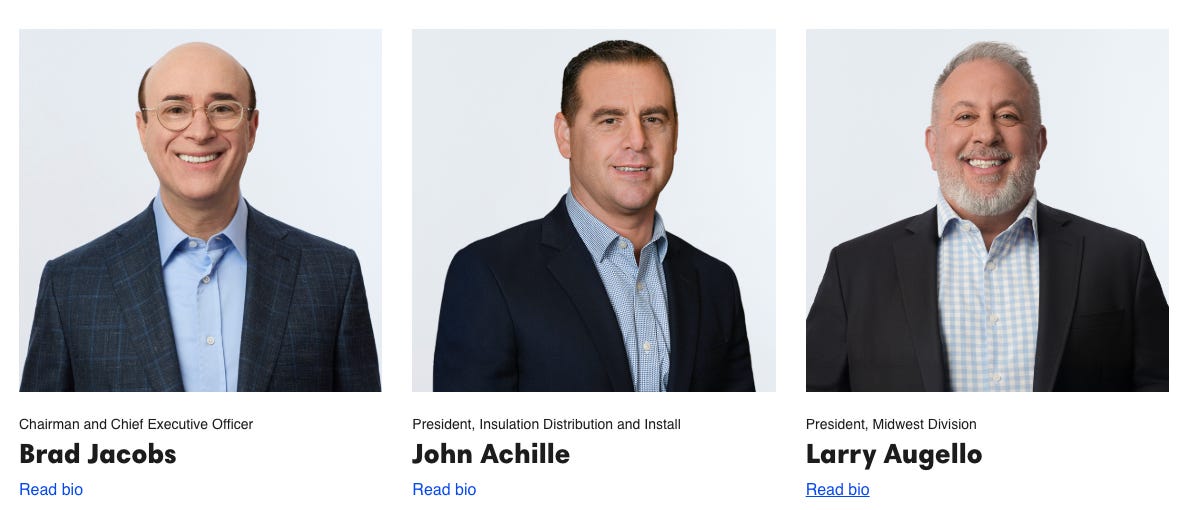
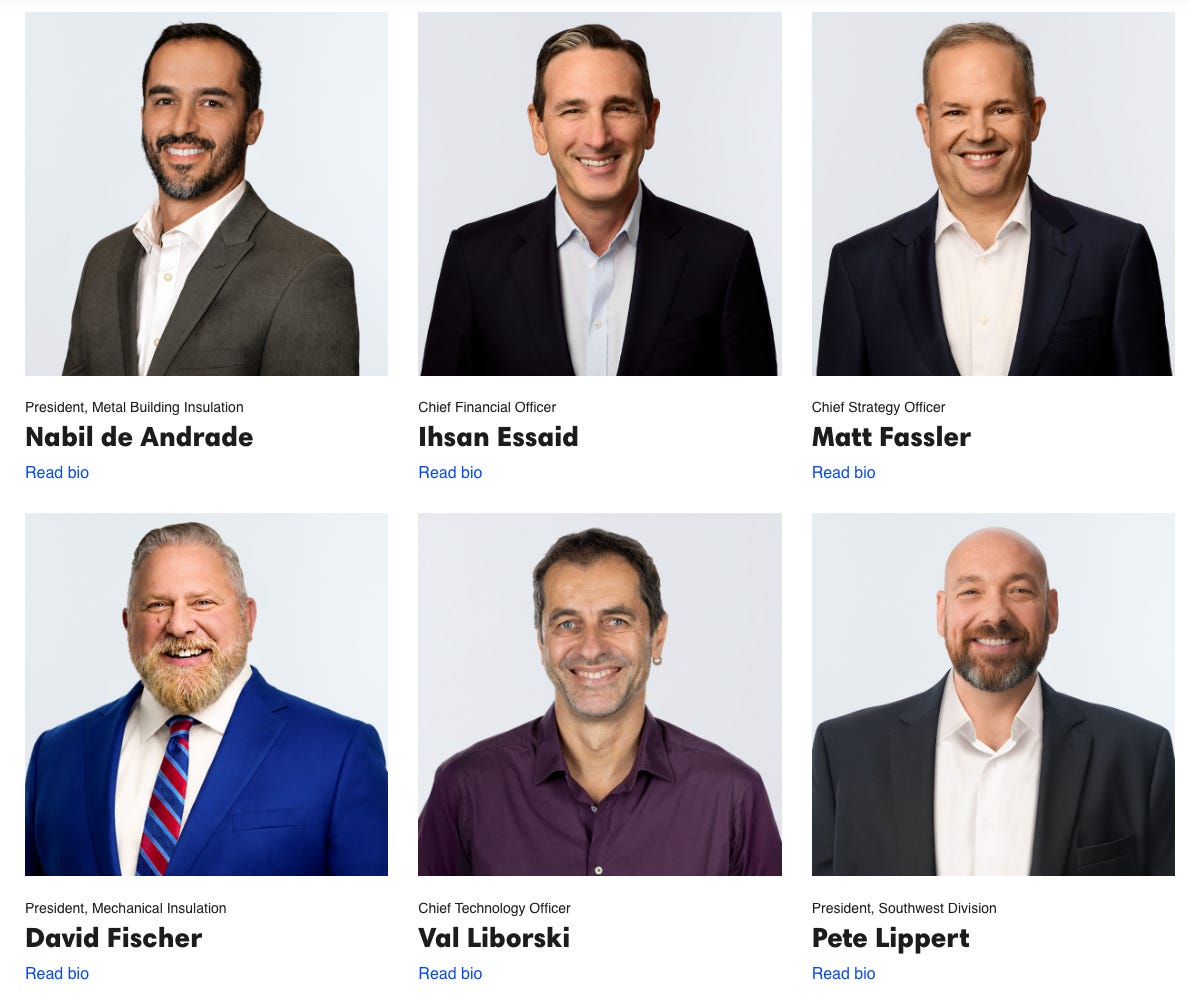
Matt Fassler, Chief Strategy Officer, served in the same role under Brad Jacobs at XPO from 2018 to 2022, where he oversaw the company’s strategy, capital structure, investor relations, and growth opportunities. He has direct and relevant experience in the exact position he is now performing at QXO.
Ken West will become President and COO effective September 1, 2026. Previously, he worked at Honeywell, where he most recently served as President and CEO of Honeywell Process Technology.
Its recent appointment of Ashwin Rao as Chief Artificial Intelligence Officer is significant, as he was previously head of AI at Target, where he led a team that developed models for pricing, merchandising, customer experience, supply chain, and logistics. It also appointed Val Liborski, who most recently served as CTO of Yahoo and as a product manager at Amazon Web Services. Their combined experience is significant, as technology and AI are a core part of QXO’s strategy to consolidate the fragmented sectors in building products distribution.
Financials and Valuation
Financials
At the time of writing, QXO has a Market Cap of $14.56B with Net Debt of $4.26B. The Debt to Equity ratio is 0.7.
Debt to TTM EBITDA sits at 20.7x on a trailing GAAP basis. (TTM EBITDA of $340.5M does not entirely include Kodiak or TopBuild. Kodiak has only been part of QXO for one of the four trailing quarters, and TopBuild closed on July 1st, after the TTM window ends)
Leverage (Gross Debt ÷ EBITDA) is at 5 using management’s $2.1B combined 2025A adjusted EBITDA.
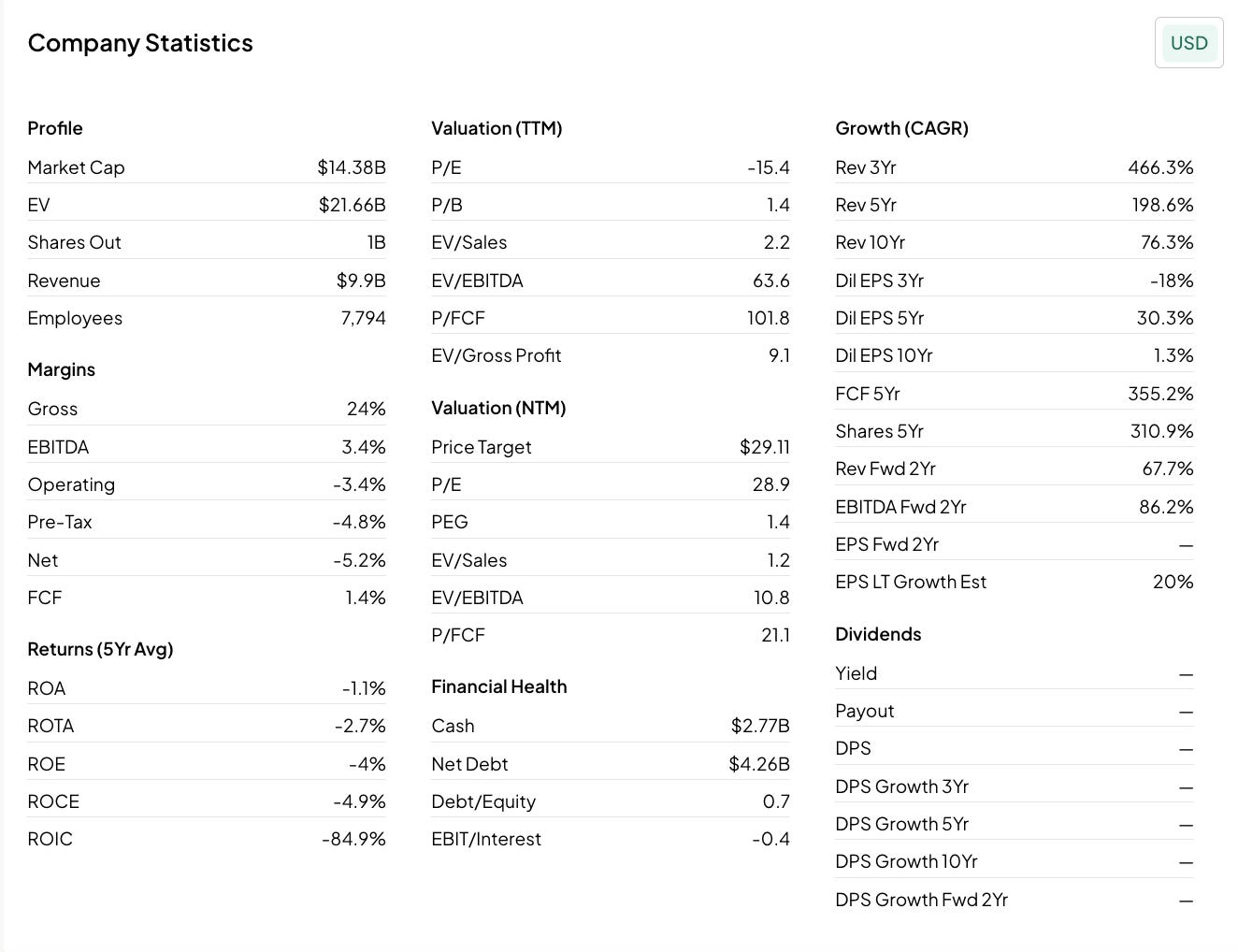
All financials were taken from Fiscal AI’s website. You can access a free trial of the premium offering via the following link, no card required. Fiscal AI
TTM Performance:
Revenue TTM: $9.90B
Gross Profit TTM: $2.38B
Operating Income TTM: $(337.6)M
Consolidated Net Income TTM: $(511.7)M
Q2 2026 Highlights:
Revenue of $3.25B, up 70.3% YoY, including $595M from Kodiak
Adjusted EBITDA of $272M, up from $204M YoY
GAAP Net Loss of $(55)M, narrowing from $(59)M YoY
Gross Margin of 24.7%, up from 21.1% YoY
Six month operating cash flow is at $(146)M, and free cash flow is ~$(200)M, which was driven by Kodiak integration costs and working capital build. However, TTM free cash flow is positive at $141.2M.

The sales mix is shifting with the integration of Kodiak’s business. Complementary building products grew from 22.4% to 37.9% of net sales year-over-year, while residential and non-residential roofing both shrank as a share of the total (48.7% → 39.0% and 28.1% → 22.7%, respectively). Roofing is not shrinking in dollar terms, but rather revenue is more diversified with Kodiak’s contribution.
Management remains optimistic as they committed to more than doubling EBITDA and reaching $50 billion in revenue by 2030.
Valuation:
QXO trades at:
2.2x LTM EV/S and 1.2x NTM EV/S
64.1x LTM EV/EBITDA and 10.9x NTM EV/EBITDA
P/E LTM -15.4 and 28.9x NTM P/E
103.1x LTM P/FCF and 21.4x NTM P/FCF
This premium reflects the market pricing in Jacobs’ ability to efficiently deploy capital, given his track record at United Rentals and XPO. The wide gap between LTM and NTM multiples shows QXO’s valuation depends more on the successful integration of these businesses than its current performance.
Chart
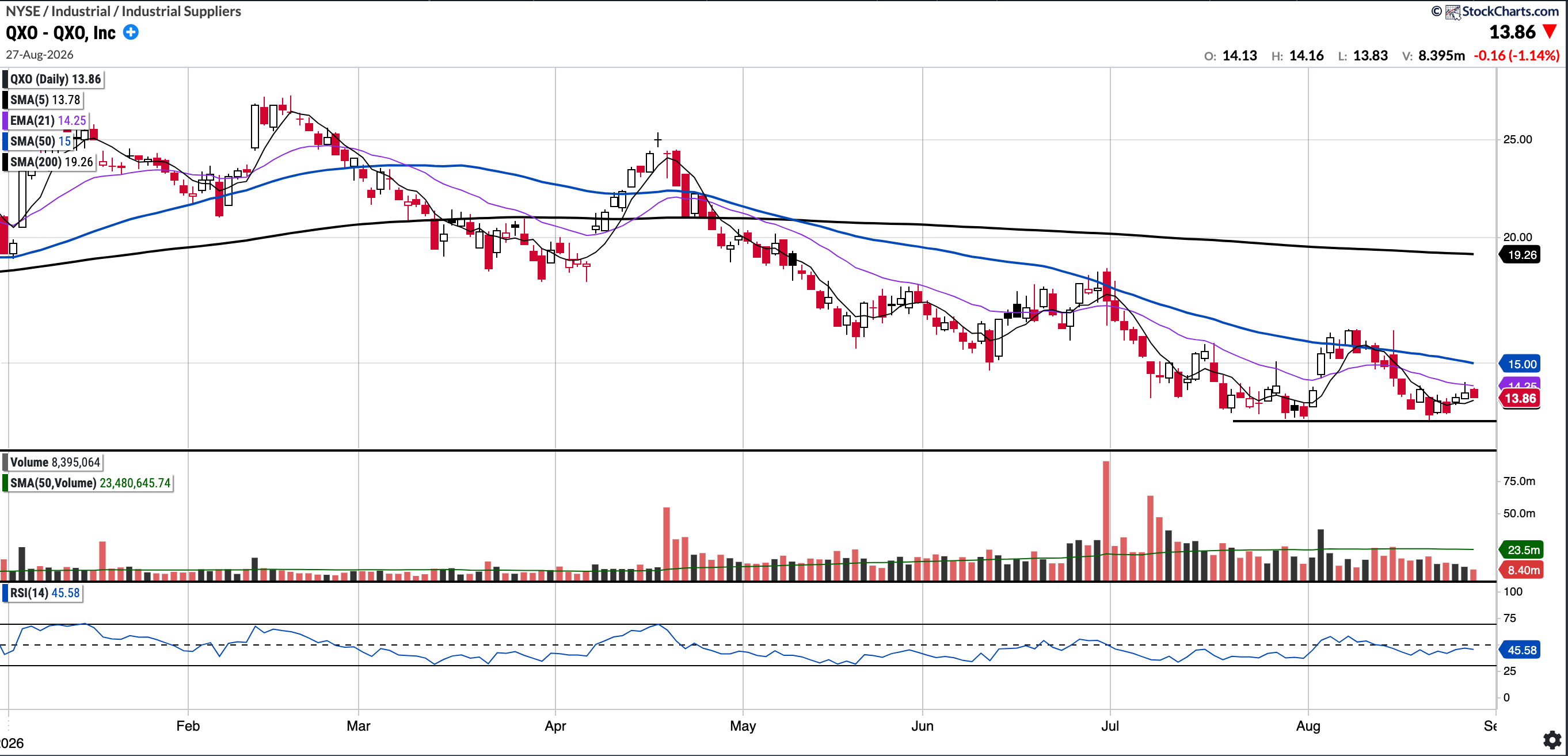
Currently trades at $13.86, 7.58% below the 50SMA and 28.02% below the 200SMA.
RSI 45.58
-29.72% YTD
QXO remains in a clear downtrend, trading below all major moving averages, with the 50-day SMA sitting well below the 200-day SMA.
The stock found resistance at the overhead 21 EMA recently and prior to that the SMA 50 has served as resistance. Bulls would want the support in the low 13’s to hold and then for overhead moving averages to be reclaimed.
Final Thoughts
The bet is on Brad Jacobs to execute his proven M&A roll-up strategy in a fragmented industry, using technology to expand margins and capture resilient repair-and-remodel demand. Any acceleration in new home construction or a drop in interest rates would also serve as tailwinds.
Thank you for reading and if you enjoyed this post, please leave a like and Restack.
Subscribe to the plan that best suits your needs and will see you in the next one!
References
Primary / Company Sources:
QXO, Inc. Annual Report (Form 10-K), fiscal year 2025 — SEC EDGAR
QXO to Buy Kodiak Building Partners for $2.25 Billion Press Release — QXO Investor Relations
QXO Investor Q&A, July 9, 2026 — PDF
QXO Investor Presentation, “QXO to Acquire TopBuild,” April 2026 — PDF
QXO Reports Second Quarter 2026 Results (Earnings Release) — PDF
TopBuild Corp, SEC Filing Pursuant to Rule 425 under the Securities Act of 1933 — SEC EDGAR
Secondary / Institutional Sources:
Bloomberg, “Housing Shortage Is at Least 10 Million Homes, White House Says” — link
William Blair, “Why the Roofing Industry Is the Next Frontier in Essential Services” — link
Rothiams, “Growing Old: Six Risks of Aging Facilities” — link
NAHB, “2026 Housing Outlook: Ongoing Challenges, Cautious Optimism and Incremental Gains” — link
McKinsey, “The Cost of Compute: A $7 Trillion Race to Scale Data Centers” — link
Turner & Townsend, “Data Centre Construction Cost Index 2025-2026” — link
S&P Global Ratings, QXO credit rating action — link
Reuters, “US Home Prices Crawl Higher, 30-Year Mortgage Rates Stick Near 6%” — link
Data:
Fiscal.ai — financial statement data, TTM performance, valuation multiples, and technical/chart data throughout the Financials and Valuation and Chart sections
Due to it's leveraged nature, I believe $QXO is a great play on real estate rebound. However, hard to see it do well when long end rates are this high.
Great write-up - not much to add except: This stock is not for kids, nor for the impatient. Built a position at 12.3 avg entry point, decent size. Would double it at 8. Would double that again at 5-6.