

Earlier today, SK hynix submitted its third-quarter financial results for the period ending September 30. It was an exceptional quarter across the board, with quarterly revenue surpassing KRW 100 trillion (~$75.1 billion) for the first time and operating margin reaching a record 80%. Two developments stood out to me:
Operating profit hit a record for the sixth consecutive quarter, at KRW 83.33 trillion (~$62.6 billion).
Shareholder returns stepped up materially, with a KRW 14 trillion (~$10.5 billion) third-quarter dividend and approximately KRW 10 trillion (~$7.5 billion) in share buybacks and cancellations.
Below we will take a further look at the quarter.
Overview
DRAM bit shipments grew approximately 10% quarter over quarter while average selling prices climbed at a high-20% rate, and NAND prices rose at a mid-20% rate despite a slight decline in bit shipments. DRAM now makes up 75% of revenue, with NAND at 24%. Management attributed the margin expansion to rising prices and increased sales of high-value-added products, which more than offset a decline in exchange rates.
On the product side, SK hynix expects HBM4 to surpass HBM3E in both HBM shipment and revenue share in the fourth quarter, with the M15X fab on track to reach full capacity by the end of 2026. Notably, negotiations for 2027 HBM supply have already been finalised.
Headline net profit was weighed down by a KRW 32.63 trillion (~$24.5 billion) non-operating loss, driven by KRW 11.63 trillion (~$8.7 billion) foreign exchange loss from the fall in exchange rates and a KRW 22.92 trillion (~$17.2 billion) investment asset-related loss.
As a result, net profit came in at KRW 39.78 trillion (~$29.9 billion), down 58% quarter over quarter against a second quarter that included large investment gains, but still up 216% year over year.
Key Financial Highlights
Revenue: KRW 104.62 trillion (~$78.6 billion), up 32% quarter-over-quarter and 328% year-over-year.
DRAM: 75% of revenue. Bit shipments up approximately 10% QoQ, with ASPs up a high-20% rate.
NAND: 24% of revenue. Bit shipments slightly down QoQ, with ASPs up a mid-20% rate.
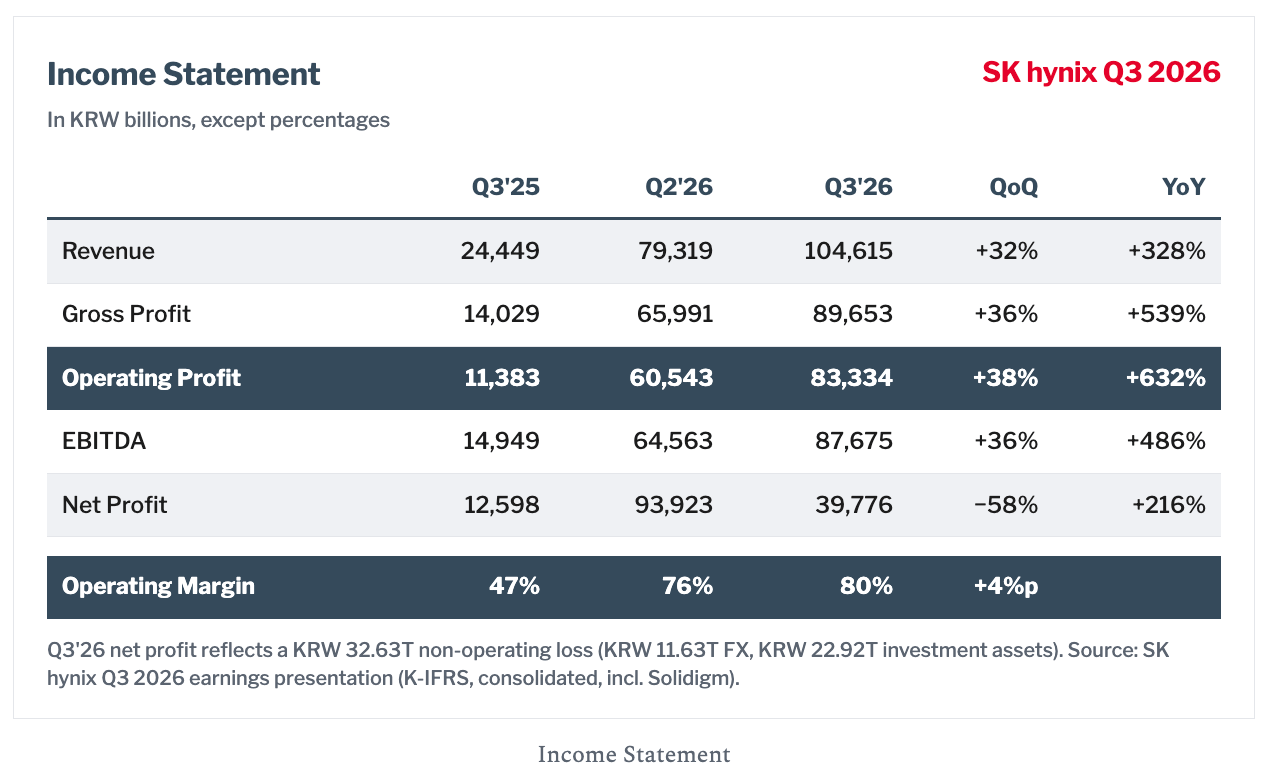
Gross Profit: KRW 89.65 trillion (~$67.3 billion), an 86% gross margin (vs. 57% a year ago).
Operating Profit: KRW 83.33 trillion (~$62.6 billion), a record 80% operating margin, up 632% year-over-year and the sixth consecutive record quarter.
EBITDA: KRW 87.68 trillion (~$65.9 billion), an 84% EBITDA margin.
Net Profit: KRW 39.78 trillion (~$29.9 billion) or KRW 54,454 (~$40.90) per diluted share (up from KRW 12.60 trillion YOY), after the KRW 32.63 trillion non-operating loss.
Cash: KRW 114.46 trillion (~$86.0 billion), up from KRW 87.96 trillion last quarter and KRW 27.85 trillion a year ago.
Debt: KRW 15.80 trillion (~$11.9 billion), down from KRW 24.08 trillion a year ago, leaving a net debt-to-equity ratio of −32% (i.e. a net cash position).
Operating Cash Flow: KRW 54.78 trillion (~$41.1 billion), against KRW 12.67 trillion (~$9.5 billion) of property, plant and equipment purchases.
Key Takeaways
Shareholder Returns:
This was the part of the release I was watching most closely, and SK hynix delivered on both fronts. The board declared a third-quarter dividend of approximately KRW 14 trillion (~$10.5 billion), or KRW 20,000 (~$15.02) per share, made up of a KRW 10,000 earnings-based dividend and a KRW 10,000 special dividend funded largely by realised gains on its Kioxia investment. The record date is November 30, with payment expected in December.
Alongside the dividend, the company will acquire and cancel approximately KRW 10 trillion (~$7.5 billion) of shares for shareholder return, and confirmed buybacks will continue each quarter, with the scale set by the board based on the share price, market conditions and cash flow. For the full year, SK hynix plans to return approximately KRW 100 trillion (~$75.1 billion): at least KRW 30 trillion (~$22.5 billion) in cash dividends and at least KRW 60 trillion (~$45.1 billion) in share acquisitions and cancellations.
The dividend is good to see, but we would have preferred buybacks, so it is encouraging that buybacks make up the larger share of the full-year plan.
One thing to note: total share acquisition for the quarter was approved at KRW 20 trillion (~$15.0 billion), but roughly half of that is set aside for executive and employee compensation and is not counted as shareholder return.
Long-Term Agreements:
LTAs have now been signed with 14 key customers, including major global CSPs, on a standard five-year term, with extensions under discussion with some customers.
Pricing sits within customer-agreed ranges that reflect market conditions, and the contracts include safeguards such as deposits. SK hynix has secured LTA volumes covering over 50% of total capacity for both 2027 and 2028, which gives considerably more visibility into earnings than a memory company has typically had.
HBM and Product Roadmap:
With 2027 HBM negotiations finalised, management expects the profitability gap between HBM and conventional DRAM to narrow meaningfully.
In DRAM, the company is rapidly increasing the share of 1cnm server products, including DDR5 and LPDDR5 SOCAMM for AI servers. In NAND, 321-layer products are set to exceed 50% of domestic capacity in Q4, with high-density eSSD supply expanding for KV cache tiering.
Market Outlook and CapEx:
SK hynix expects memory demand to outpace supply through 2030, with supply growth constrained by leading-edge process complexity and fab construction lead times. Citing market research estimates, it expects global CSP capex to grow over 60% in 2027. To meet that demand, 2027 capex is expected to increase significantly compared with 2026, covering advanced node equipment, the Y1 fab ramp-up and infrastructure investment in Korea and overseas.
Guidance
For the fourth quarter of 2026, SK hynix expects DRAM bit shipments to grow by a mid-20% rate quarter over quarter, driven by the expansion of 1cnm and the M15X ramp-up.
Fourth-quarter NAND bit shipments are expected to grow by a mid-single-digit rate quarter over quarter (including Solidigm), driven by increased sales of 321-layer eSSDs.
For 2027, the company expects DRAM demand bit growth of mid-20% year over year and NAND demand bit growth in the high teens.
2027 capex is expected to increase significantly compared with 2026.
Current position and final thoughts:
SixSigmaCapital has a long position with a $131 nominal average cost, with the original cost basis fully recovered.
All transactions shared live here: Portfolio live Updates
This was an outstanding quarter. Record margins, a cash balance of over KRW 114 trillion (~$86.0 billion), and LTAs locking in over half of capacity for 2027 and 2028 point to a much more durable earnings base than memory has historically offered, and the step-up in shareholder returns shows management is willing to share that with shareholders.
A few things to keep an eye on are the size of the 2027 capex budget, the share of buybacks directed to employee compensation, and how quickly HBM’s profitability premium over conventional DRAM narrows.
Thank you for reading, leave a like and see you for the next one!
Operating margin at 80% and LTAs covering over 50% of 2027 and 2028 capacity make memory earnings far more visible than the old cycle. The buyback share of the KRW 100 trillion return plan is the detail to track.