


On September 8, Meta launched Muse, a personal AI agent that lives in its own app and gets things done on behalf of the user.
A major selling point is its simplicity, which lies in the basic everyday tasks it is designed to handle. The tasks that no one wants to spend time on. Instead of opening a calendar app, users can simply tell Muse to add a reminder to a calendar, or rather, have it send a notification itself. Instead of spending half an hour attempting to coordinate a weekly schedule, users can have Muse can do it in minutes. If a user wants to buy a new pair of Reebok Club C 85 Vintage shoes, they don’t have to visit ten different websites only to find out the shoes are out of stock or their size isn’t available. Muse will do it for them.
While Muse is capable of handling many of these everyday tasks, it operates in an expanding market alongside other highly capable products like OpenClaw. Following the September 8 launch, Meta’s stock has climbed ~20% (at the time of writing), driven by Muse reaching #1 in the App Store within ten days. The app has generated a level of consumer excitement and adoption rarely seen since the debut of ChatGPT. SixSigmaCapital believes this stock rise is deserved given Meta has a real chance to be a major winner in the B2C space.

Furthermore, we note they are now actively entering the enterprise market, as Mark Zuckerberg announced: “Today we are starting the next major pillar of our business, Meta Enterprise Platform, to help businesses use AI to grow and transform in new ways as well”. To lead this push, Chirantan “CJ” Desai has joined Meta as Chief Enterprise Platform Officer.
However, analysing Meta’s success in isolation misses the broader industry implications. As more companies build and deploy their own agentic AI assistants, the companies supplying the essential underlying components stand to win.
In this post, AKS Research and I, will take a further look at the potential winners and losers from the widespread adoption and rise of agentic AI assistants.
Layout:
Preface
Shifting to a Per-User Model
Market Opportunities in Agentic AI
Potential Winners
Potential Losers
Industry Tailwinds
Conclusion
This post is for informational purposes only and does not constitute financial advice. Please conduct your own due diligence before purchasing any equities or assets discussed herein.
Shifting to a Per-User Model
Chatbots consume compute resources only when a user asks a question. In contrast, agents utilise compute for the entire duration of a task, whether that takes an hour, a day, or continues indefinitely. The fundamental shift driving the agentic AI market is that compute demand is transitioning from a per-question basis to a per-user basis.
When a user assigns a task to an AI agent, the agent breaks it down into actionable steps. It then leverages tools such as a browser, email, calendar, or payment methods to execute them. The agent continues operating even after the user closes the application, returning later for updates or approval.
This architecture is precisely what makes agents so computationally intensive. To execute a task from start to finish, an agent relies on multiple resources over an extended timeframe. Because some agents perform recurring tasks indefinitely, Muse provides every user with a dedicated cloud computer and a private browser: Muse Secure VM (a virtual machine simulated in software on a server). This computer maintains a persistent state between interactions, allowing Muse to operate continuously in the background and follow up with the user as needed.
When a person books a flight, they run a few searches, complete a couple of forms, and submit payment. When an AI agent books that same flight, it executes identical steps while making repeated calls to its underlying model. As Nvidia CEO Jensen Huang noted during the company's August 26 earnings call: “The amount of compute necessary for an agent versus a human using it is probably 15 to 100 times depending on the type of problem you’re trying to solve.”
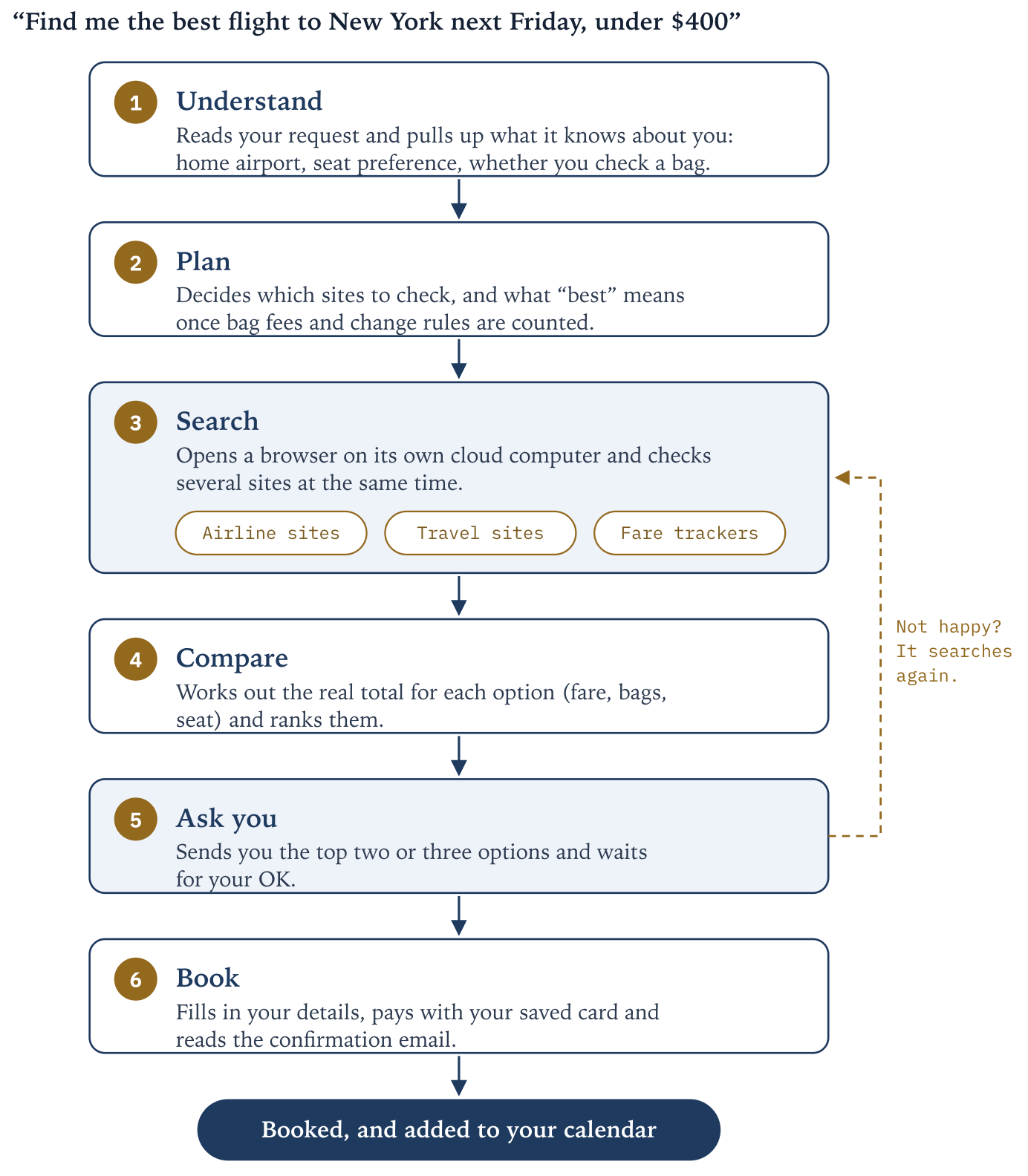
Now, if the agent keeps running after booking the flight, continuously watching the fare for cheaper deals, checking them in, and handling any changes to the trip, then the usage significantly increases.
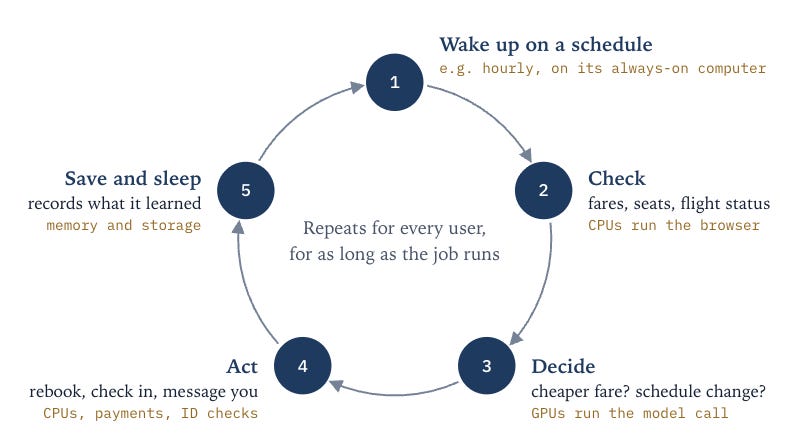
To handle this usage, agents lean on three basic pieces of hardware: GPUs to think, CPUs to act, and memory to keep track of the task.
GPUs do the same job they do for a chatbot: deciding what to do next. The difference is that an agent needs GPU power throughout different steps, such as deciding which airline to check, whether a fare is good enough, when to ask the user to confirm details, etc.
CPUs help carry out the tasks. Opening the airline’s website, loading each page, filling in the user’s details, and reading the confirmation email are standard computing tasks that run on the CPUs inside the agent’s cloud computer. Unlike a chatbot, an agent heavily relies on a CPU while it is executing tasks.
Memory holds the context of the task while the agent works on it. A lot of what the model processes, including fares and seat preferences, is stored in what’s called the Key-Value (KV) cache. This way the model doesn’t have to reread it all at every step. For a sense of scale, a model the size of Meta’s Llama 3.1 70B needs an estimated 40GB of KV cache for a single 128,000 token task, on top of about 140GB to hold the model itself. Now consider how much memory is needed to support many users with an agent running in the background.
Market Opportunities in Agentic AI
Since the launch of ChatGPT, the AI trade has generated tremendous wealth, particularly for companies at the forefront of AI development. More recently, however, as use cases continue to expand, many companies have seen their market caps reduced.
Companies that manufacture the chips and memory supporting AI agents, the data centers where they reside, and the tools tracking their performance are positioned to grow alongside the rising adoption of agentic AI. Competing agents draw upon overlapping categories of infrastructure, and the market is increasingly recognizing this shift.
Conversely, businesses that depend on human behavior to drive decision-making face a less certain future. As agents assume control over more decisions, the behavioral patterns these companies have historically relied upon may begin to fracture. For some, this transition could result in a gradual loss of revenue. For others, the decline could be far more sudden.
Potential Winners
CPUs
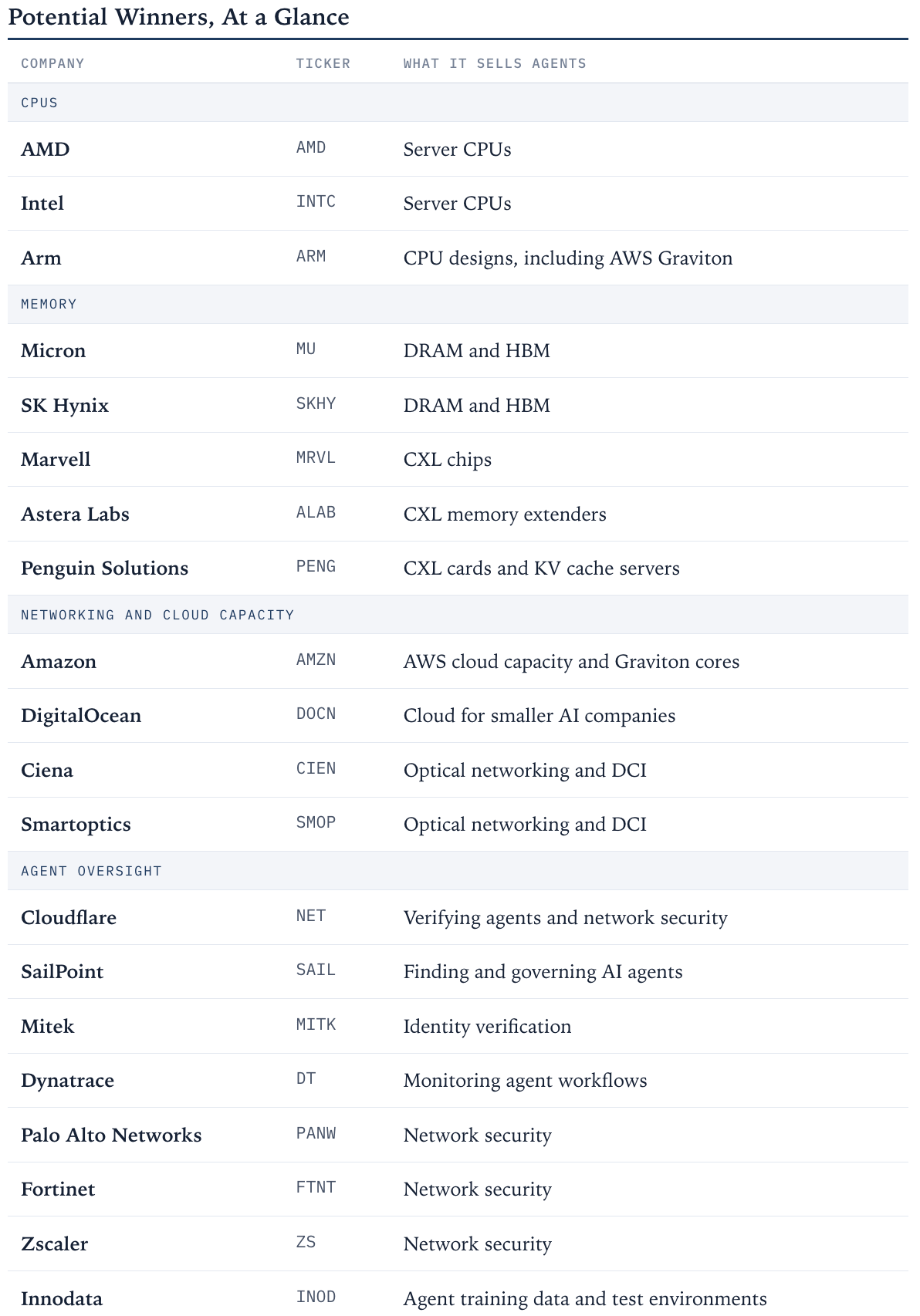
Every agent requires a computer to operate, and every computer relies on CPUs. Meta CEO Mark Zuckerberg stated that Muse was built to serve billions of users worldwide, meaning that achieving this goal will require enough CPUs to support billions of virtual machines (assuming one VM per user). Micron projects agentic architectures will shift from a 1:4 CPU-to-GPU ratio toward 1:1 or 1:2, representing a twofold to fourfold increase in CPU demand. Based on these projections, this infrastructure buildout requires significantly more CPUs than traditional chatbots ever demanded.
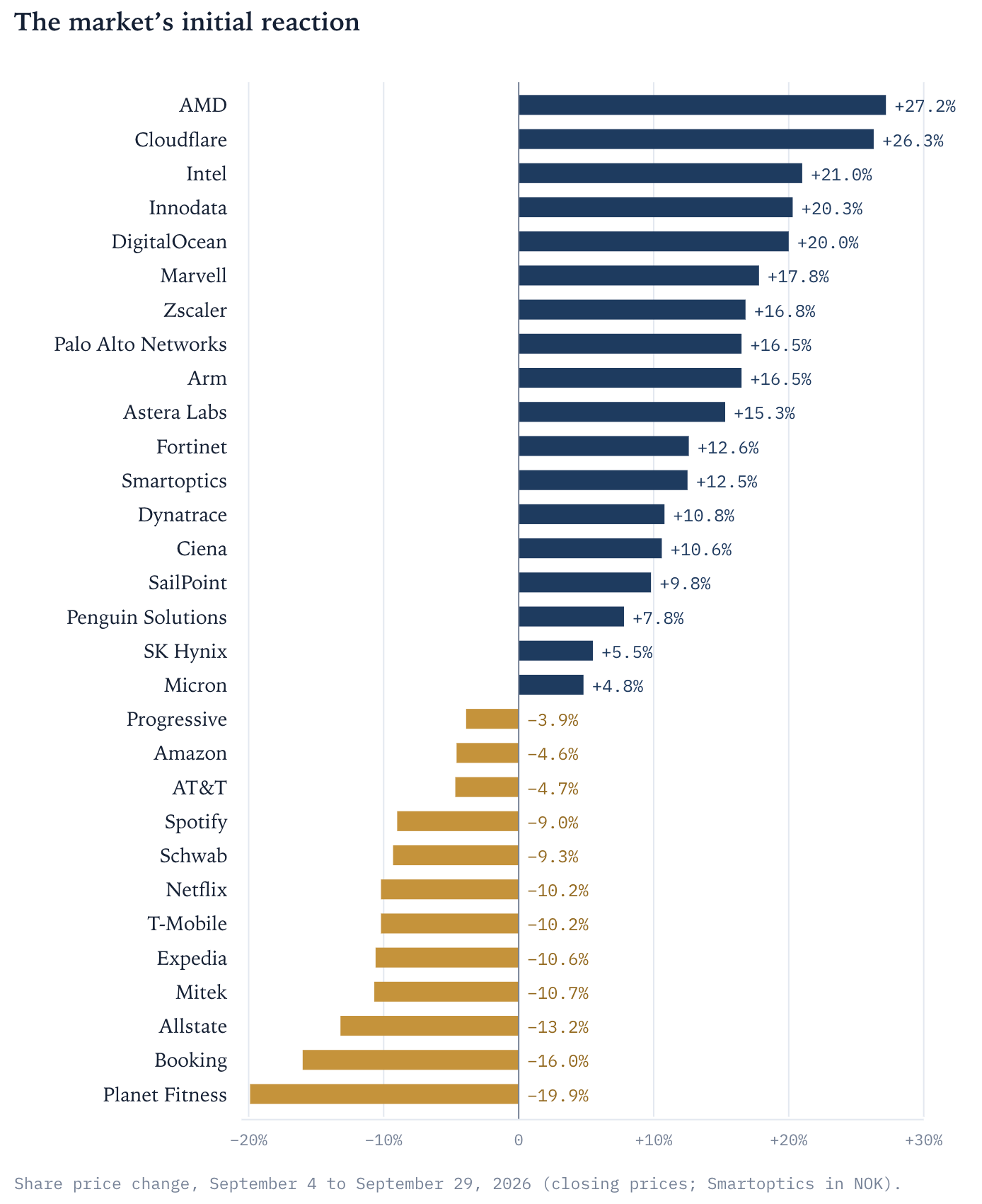
It is therefore no surprise that the three companies supplying these CPUs and their underlying architectures stand to benefit from broader AI adoption. Intel and AMD manufacture x86 server processors, while Arm designs the architecture utilized by Muse and competing agents. Reflecting this momentum, all three stocks have rallied since the September 4 close.
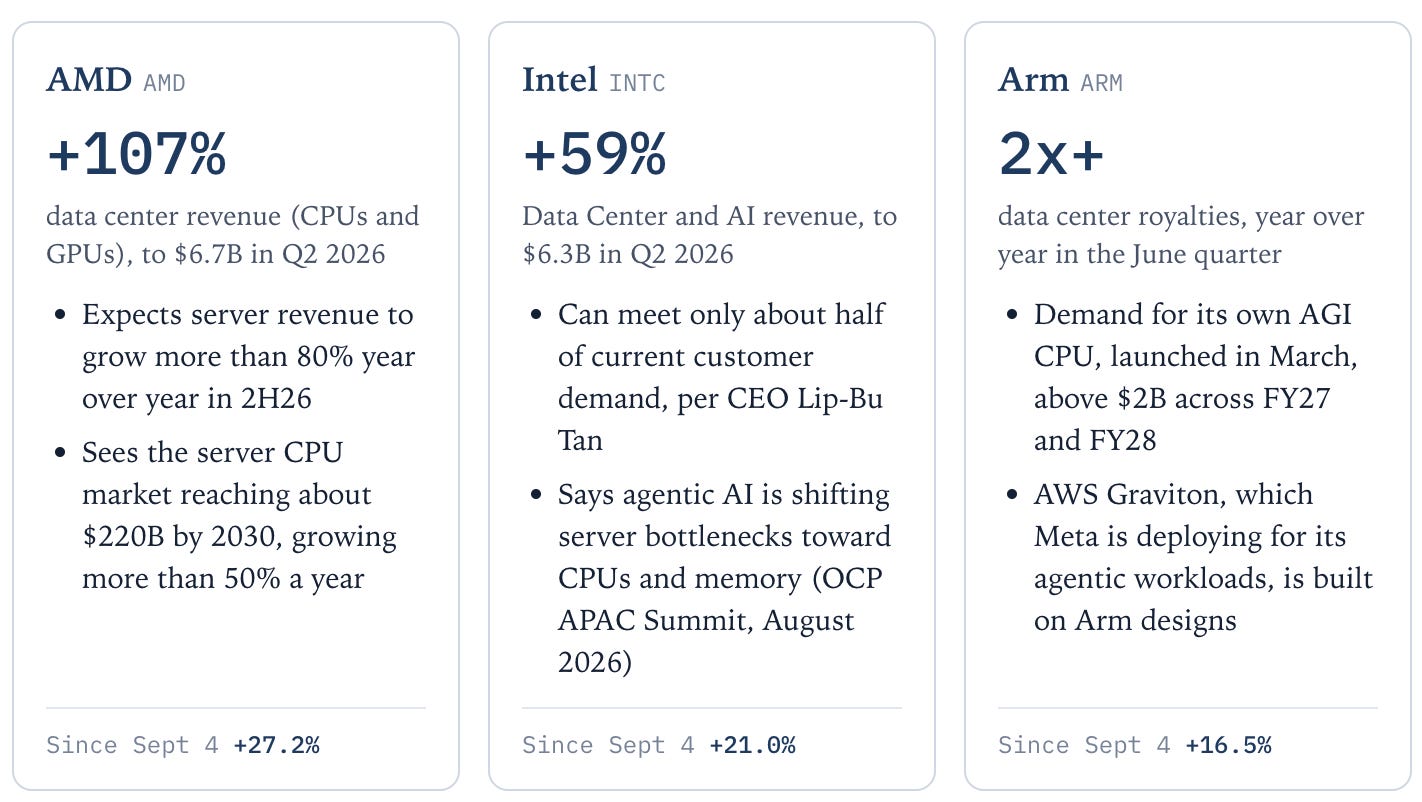
Earlier in April, Meta signed a deal with AWS for tens of millions of Graviton CPU cores to run its agentic workloads, and Graviton is built on Arm designs.
On September 24, Akamai disclosed an $11.6 billion, seven-year agreement with Anthropic, expandable to $20 billion, for cloud capacity to support CPU workloads.
Nvidia’s CFO: “Rising adoption of agentic AI is driving an acceleration in demand for data centre CPUs”
Memory
KV caches can be distributed across various memory and storage tiers. The fastest location is the High Bandwidth Memory (HBM) stack adjacent to the GPU, but this option is expensive. It may also face capacity constraints when attempting to store the KV cache for millions of concurrent background tasks. Alternatively, Dynamic Random Access Memory (DRAM) and shared memory pools connected via Compute Express Link (CXL, a standard supporting memory expansion, pooling, and sharing) offer more feasible solutions.
Earlier this year, Nvidia announced a dedicated storage tier for the KV cache. Shortly thereafter, Intel shared test results demonstrating that shifting the KV cache into server memory allows a server to process more simultaneous requests.
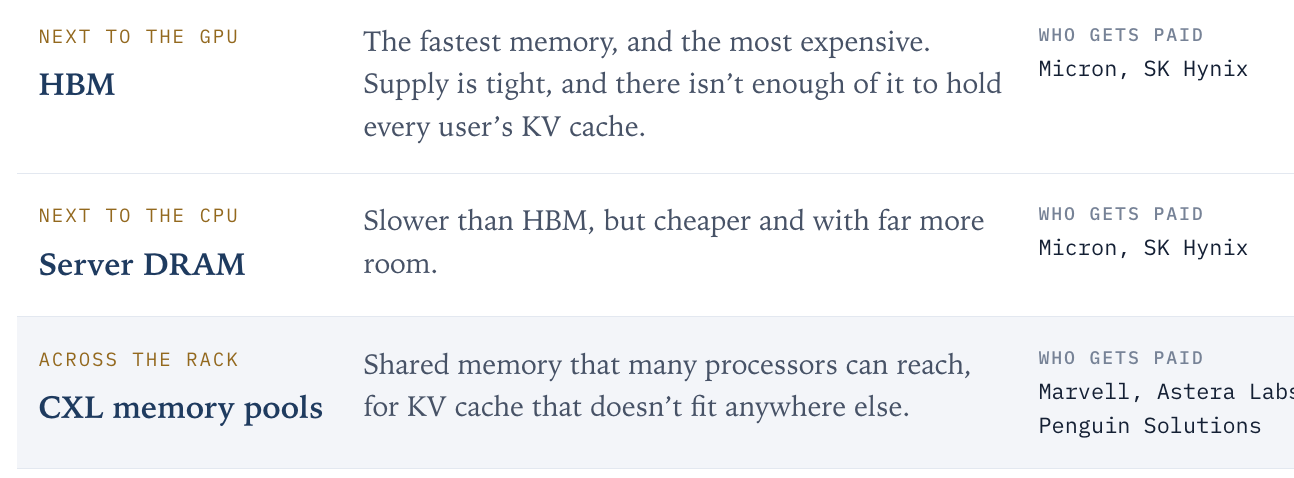
Currently, retaining KV caches generates demand across multiple memory and storage tiers, exacerbating an existing memory shortage. Micron (MU) and SK Hynix (SKHY) are capitalizing on this scarcity and stand to benefit significantly from the adoption of agentic AI.
CXL represents a newer, smaller market with substantial room for expansion as it addresses this memory supply gap. UBS projects the CXL market will reach $7 billion to $10 billion by 2030.
Marvell’s (MRVL) CXL revenue is estimated to reach about $1 billion in 2027 “with support from agentic CPU demand.” (Also according to UBS)
Astera Labs (ALAB) CXL memory extenders are ramping with Microsoft as the lead customer.
Penguin Solutions (PENG) sells MemoryAI, an appliance that holds up to 11TB of memory, of which 8TB is KV cache in CXL-attached memory.
Networking and Cloud Capacity
Data must be processed and transferred continuously between an agent’s computer, a user’s phone, the browser, and the GPU running the underlying model. For agents that operate over extended periods, greater network capacity is required to support this substantial traffic.
The broader adoption of agentic AI is driving heavy demand for cloud computing power and virtual machines, as the agent’s computing environment and CPUs require physical hosting infrastructure. Meta’s recent agreement with Amazon involves deploying Graviton cores on AWS, positioning Amazon (AMZN) to profit directly from agentic AI expansion. Similarly, DigitalOcean (DOCN) provides virtual machines and hosting for platforms like OpenClaw, serving as a cost-effective cloud alternative for smaller AI companies unable to build proprietary data centers. Reflecting this trend, DigitalOcean’s stock has risen approximately 20% since the release of Muse on September 4.
Networking hardware providers such as Ciena (CIEN) and Smartoptics (SMOP) are also likely to experience increased demand. Their technology facilitates the movement of data within data centers. Furthermore, both companies specialize in Data Center Interconnect (DCI) technology, which links separate data facilities into a unified network and allows businesses to pool resources. In an environment where data center capacity is becoming increasingly scarce, DCI is poised for greater adoption alongside the proliferation of AI agents.
Agent Oversight
Once an agent is deployed and operational, the role of hardware suppliers concludes, and agent oversight becomes paramount. While executing tasks, an agent may log into accounts, transfer funds, and process sensitive data, making strict operational governance critical. There are numerous stages throughout an agent’s lifecycle where oversight provides substantial value. These include:
Verifying the agent itself: Meta potentially misstepped by failing to make Muse identifiable when shopping on Amazon, resulting in a platform ban. They could have instead utilized a service like Cloudflare’s (NET) Web Bot Auth. This tool allows an agent to cryptographically sign each request, enabling websites to verify the entity behind it (although it remains uncertain whether this would have prevented the ban).
Managing agent access: SailPoint (SAIL) utilizes Agentic Fabric to discover AI agents across cloud platforms, browsers, and employee devices, including unapproved agents. The platform links each agent to a human owner and maps its associated accounts, credentials, tools, and permissions. Security teams can subsequently identify instances where an agent possesses excessive access, enforce strict policies, and deactivate suspicious entities. The system also maintains ownership and modification records, providing enterprises with comprehensive accountability regarding agent capabilities and authorization.
Providing proof of agent authority: Mitek (MITK) specializes in digital identity verification to mitigate impersonation and identity fraud risks. The company reports that synthetic identity fraud is a major emerging threat, with 40% of financial institutions observing an increase in AI-driven attacks. In response, banks can deploy Mitek’s software to confirm that a legitimate human user is actively authorizing the agent’s operations.
Actively monitoring agent workflows: Dynatrace (DT) tracks agent behavior and execution from the initial user prompt through to the final response. It analyzes execution paths, detailing which agent communicated with specific tools, measuring the latency of each loop, and identifying bottlenecks in the decision process.
Ensuring network security: Every deployed agent introduces a new online entity with proprietary data and network connections that malicious actors could exploit. Network security is therefore highly important, and firms such as Cloudflare (NET), Palo Alto Networks (PANW), Fortinet (FTNT), and Zscaler (ZS) are poised to play a significant role in securing agent infrastructure.
Developing training and test environments: Innodata (INOD) builds training datasets and testing environments for AI agents. An investigative report by Hunterbrook Capital revealed that Meta is reportedly Innodata’s primary client, accounting for a substantial share of its revenue. Innodata’s recent disclosures regarding work on the “personalization of long-horizon agents” likely reference Muse, according to industry speculation. If accurate, Innodata may have facilitated the training and testing of Muse’s capacity to retain user preferences and execute tasks over extended periods. However, this connection to Muse remains unconfirmed.
Potential Losers
A company once universally recognized by students and educators alike is Chegg. Operating as a digital learning subscription hub, Chegg achieved a peak valuation of $15 billion in 2021. Today, that valuation has plummeted to approximately $80 million, following its displacement by ChatGPT and other frontier models. While competitors in the online education sector, such as Coursera, suffered a similar fate, Chegg absorbed the most severe impact.
Similarly, the accelerating adoption of agentic AI has left several corporate leaders concerned that their businesses may face a comparable disruption.
Online Travel
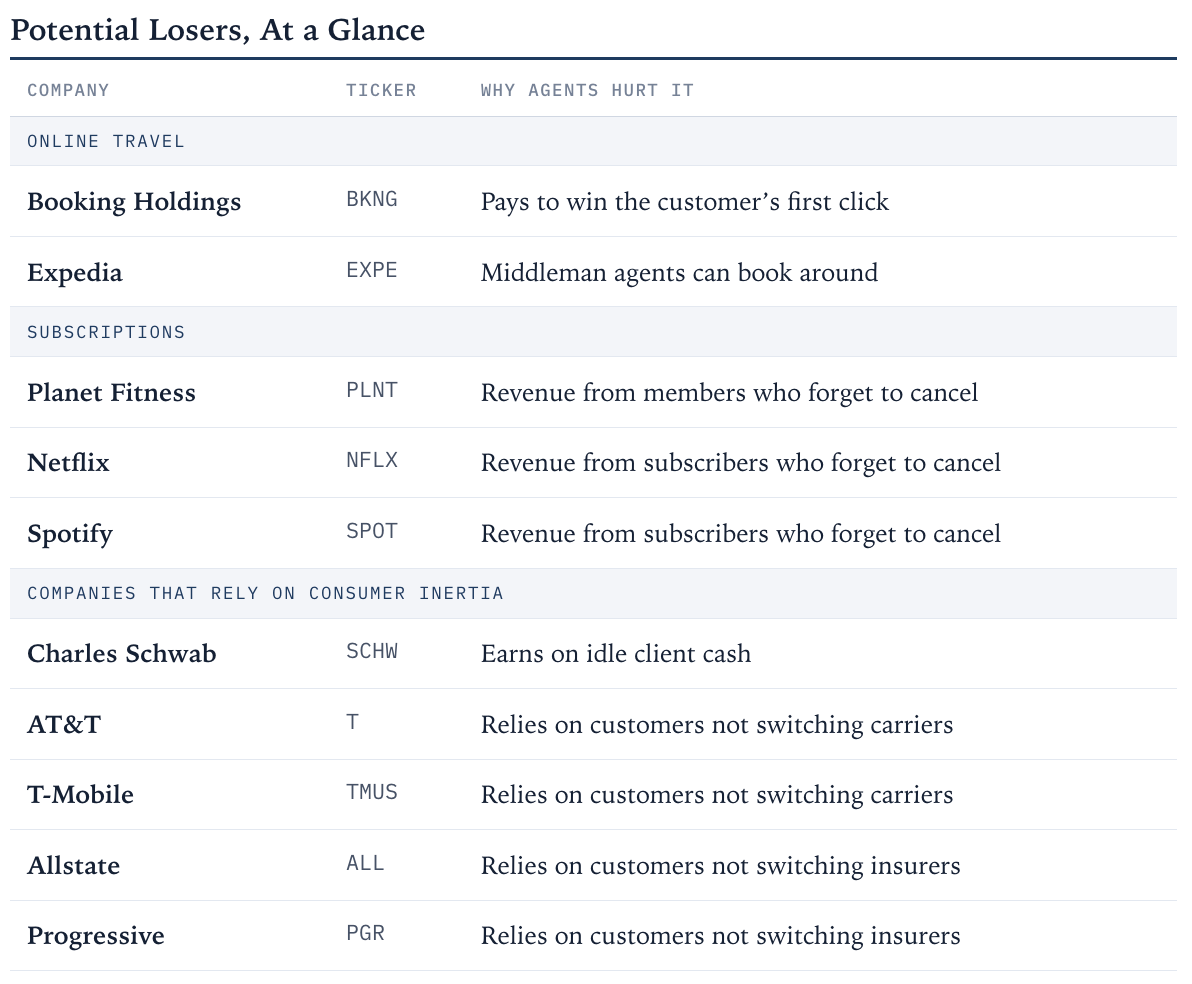
A widely promoted use case for Muse is its ability to autonomously manage flight and hotel bookings. This development is highly concerning for Booking Holdings (BKNG), the parent company of Booking.com. In 2025, the firm allocated $8.2 billion (approximately 30% of its revenue) to marketing. AI agents do not respond to traditional marketing, meaning standard booking and search advertisements will likely be bypassed entirely.
A significant portion of this expenditure is designed to drive traveler traffic to Booking.com via search engines, comparison sites, and affiliate networks. If a consumer initiates their journey with Muse instead, the agent conducts the search and dictates where the reservation is finalized. Consequently, Booking Holdings could lose the opportunity to acquire that customer through an advertisement, even if the platform offers the identical hotel at a matching price. The company’s market position will increasingly depend on whether the AI agent routes the transaction through its platform.
Furthermore, Muse can instantly compare hotels and flights across numerous platforms, including direct channels from specific hotels and airlines. This capability directly threatens the necessity of intermediary services such as Booking.com or Expedia (EXPE). Although Expedia signed on as a Muse partner during Meta Connect last week, this alliance does not resolve the underlying structural threat. It merely contains the risk for as long as Muse remains the dominant agentic AI application. Additionally, Meta will extract a percentage of those transactions.
Subscriptions
A material segment of revenue for subscription-based business models relies on consumers forgetting to cancel unused services. Unfortunately for these companies, AI agents do not forget. Granted access to a user’s billing accounts, an agent can audit recurring charges, flag subscriptions lacking utility, and take action prior to the next renewal cycle. The agent can seamlessly execute the cancellation process or negotiate a reduced rate. Service providers would still incur the initial customer acquisition and retention costs but would likely collect fewer monthly payments or realize lower margins per user. Across a massive subscriber base, even minor reductions in customer retention duration could severely impact top-line revenue.
The fitness and digital streaming sectors are particularly vulnerable to this shift. This dynamic poses a distinct risk to operators such as Planet Fitness (PLNT), Netflix (NFLX), and Spotify (SPOT), among others.
Pricing Reliant on Consumer Inertia
Consumers frequently find switching service providers cumbersome. Transitioning to an unfamiliar alternative is subconsciously perceived as a risk or potential loss, prompting customers to maintain the status quo. This behavioral phenomenon is known as “consumer inertia.”
The tendency to leave accounts untouched heavily influences where individuals store their capital. For example, Charles Schwab’s (SCHW) net interest revenue, generated primarily on uninvested client cash, accounted for $11.8 billion of its $23.9 billion total revenue in 2025. An AI agent programmed to automatically sweep idle cash into the highest-yielding available accounts works directly against this highly profitable revenue stream.
Similarly, AI agents can continuously scan insurance policies, identify superior rates, and undermine retention models that depend primarily on switching friction. This constant monitoring simultaneously increases competitive pressure among suppliers bidding for quotes. Telecommunications and insurance providers rely heavily on consumer inertia, yet AI agents seamlessly facilitate user migration from one provider to another.
Highlighting this vulnerability, Goldman Sachs recently placed telecommunications carriers AT&T (T) and T-Mobile (TMUS), alongside insurance giants Allstate (ALL) and Progressive (PGR), into a basket of consumer inertia stocks facing elevated risk from AI agents.
Industry Tailwinds
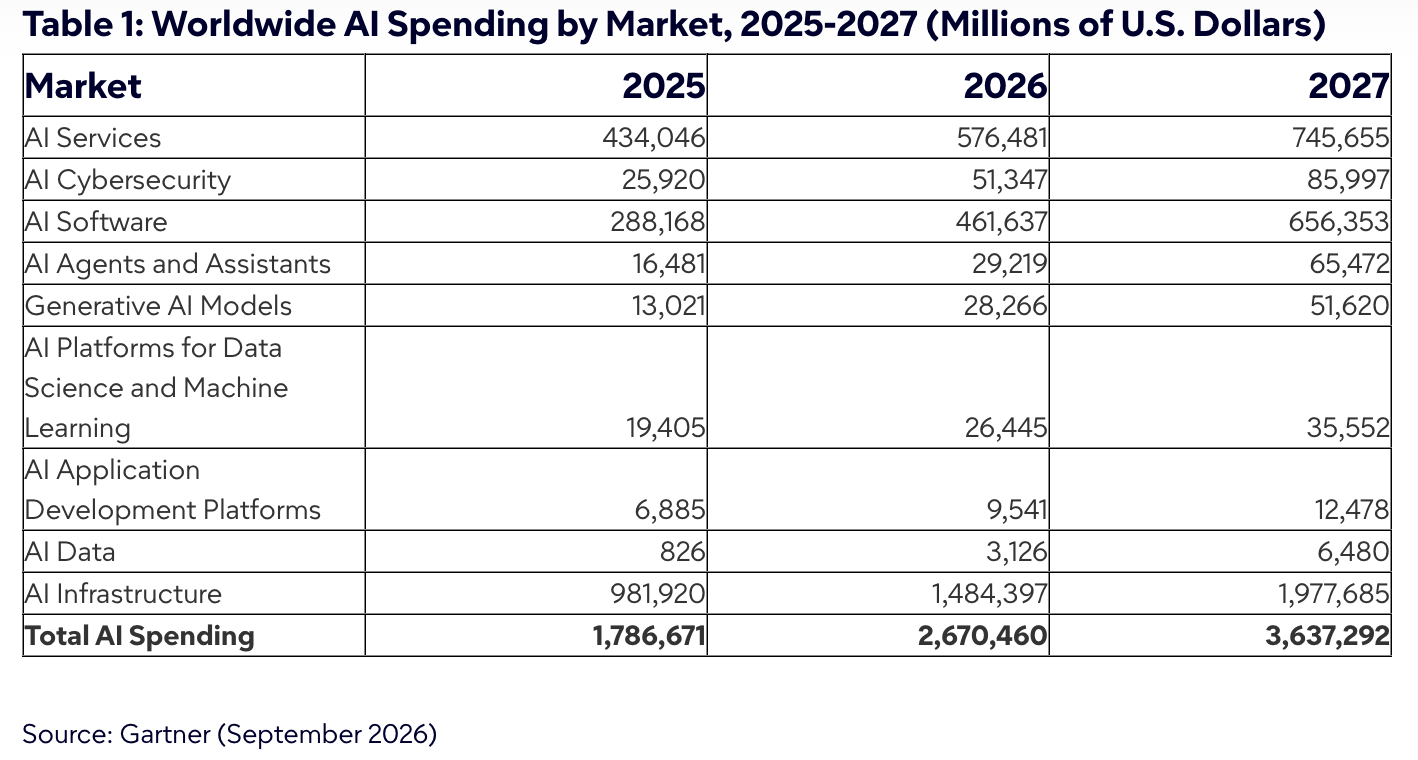
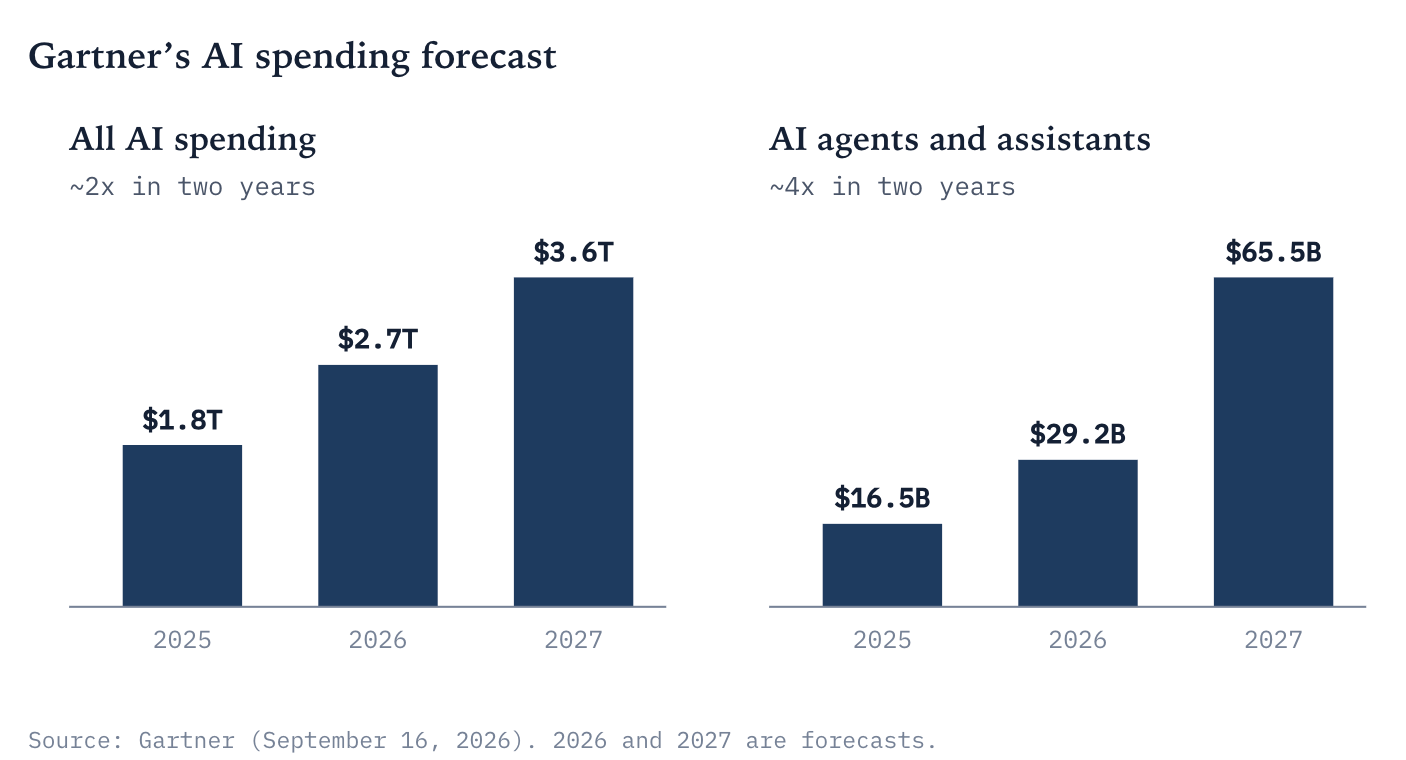
These forecasts point to substantial growth in both the underlying systems that run AI agents and the operational tasks those agents will eventually execute. Gartner projects that worldwide AI spending will reach $2.7 trillion in 2026, representing a 49.5% increase from 2025, before climbing to $3.6 trillion in 2027.
This total encompasses the broader AI market, including infrastructure, software, and services. Within this broader figure, Gartner expects direct spending on AI agents and assistants to surge from $16.5 billion in 2025 to $65.5 billion in 2027. This trajectory represents nearly a fourfold increase in just two years.
On the consumer side, Morgan Stanley estimates that shopping agents could handle between $190 billion (base case) and $385 billion (bull case) in US online purchases by 2030, representing 10% to 20% of e-commerce spending.
Taking a broader view of the US consumer goods market, McKinsey projects that agentic commerce could orchestrate $900 billion to $1 trillion in B2C sales by 2030.
These financial valuations align closely with expectations regarding the sheer volume of agents entering operation. IDC anticipates a tenfold increase in the number of agents deployed by Global 2000 (G2000) enterprises leading into 2027. Furthermore, the firm projects that more than one billion active agents will operate worldwide by 2029, executing over 217 billion actions per day.
While these forecasts measure slightly different market segments, they collectively underscore a massive upward trajectory for agentic AI adoption.
Conclusion
Meta has shipped four Muse Spark models in five months, and the latest iteration ranks among the best models on the market. However, Google, SpaceXAI, Apple, and a long list of startups are building similar products.
As the old saying goes, during a gold rush, sell shovels. Whether a user chooses Muse or another agent, these systems still require hardware to reason, execute tasks, retain context, and remain operational. As agents gain access to accounts, payments, and sensitive information, companies will also need tools to verify identities, control permissions, secure data, and monitor their actions.
This shift creates pressure elsewhere. Travel platforms spend heavily to win a customer’s first click. Subscription businesses benefit when customers put off cancelling. Financial, telecom, and insurance companies often retain customers because they never get around to comparing alternatives. An agent that searches, remembers, and switches providers on a user’s behalf could quickly weaken each of those advantages.
Muse might be the agent that brings this technology to millions of people. Yet, Meta may or may not become the biggest winner in agentic AI, and it doesn’t need to be. Owning the component suppliers is potentially the cleaner way to gain exposure to this theme.
Thank you for reading and if you enjoyed this post, please leave a like and Restack.
Subscribe to the plan that best suits your needs (free or premium), and will see you in the next one!