


On September 23, Anthropic announced that its AI agents had found a new kind of genetic system in the DNA of a virus, one that scientists had never discovered or described before. The agents found it entirely on their own.
The agents were told to explore a huge library of environmental DNA to look for a type of enzyme and its flanking genes. (An enzyme is a protein that does one specific job inside a cell. This type, a reverse transcriptase (RT), reads RNA, the working copy a cell makes from DNA, and writes the matching DNA back out.) At some point, one agent accessed the raw DNA beside one of these enzymes and wrote this:
I can see by eye a tandem repeat array … that’s a CRISPR-like … repeat array?!
In protein sequences, a repeat array of short, highly conserved DNA sequences separated by unique spacers, is a familiar clue: CRISPR, the gene editing tool that began as a bacterial defence. The agent had spotted a unique RT enzyme, a mysterious partner gene, and a long chain of repeating DNA working together inside giant viruses. They named it ART, short for array-associated reverse transcriptase.

Three things about this result stand out. The first is how the AI found it: it noticed something odd, doubted itself, and went to check whether it was already known. This, in practice, is exactly how a human scientist operates.
The second is that no one knows whether ART’s enzyme works or what the system does for the virus. Even more surprising, when the researchers ran the whole search ten more times, the AI missed the pattern every time.
The third is that researchers are still following up on the results via rigorous biological validation.
This experiment provides an interesting premise: AI can now discover things in biological data, at a faster rate than any lab can follow up with those discoveries. This is partly because AI increases speed and efficiency, but also because verifying breakthroughs is slow and expensive. That is where I think the opportunity lies.
This is the third write-up in our “Artificial Intelligence in Healthcare” series":
In part one, we looked at where AI is already delivering results across the lab, clinic and hospital, and where the industry is headed.

In part two, we analysed the preeminent artificial intelligence company in healthcare, Eli Lilly (LLY), and its role in the ecosystem.

In this post, myself and AKS Research walk through the experiment, what it means for healthcare & genomics, and the companies that stand to gain or lose from it.
Layout:
Preface
What the Agents Found
The detour that found ART
What ART is, and is not
Why the Search Couldn’t Be Repeated
After the Discovery: The Lab
The “Genomics & Gene Editing” Trade
Thesis
Potential Winners
Selling to every research team
Human datasets
Editors already working in people
Getting past the liver
Potential Losers
Conclusion
This post is for informational purposes only and does not constitute financial advice. Please conduct your own due diligence before purchasing any equities or assets discussed herein.
What the Agents Found
Before continuing, there’s three things worth quickly mentioning:
All six authors of the publication work at Anthropic
It has not been peer reviewed by other scientists
Anthropic has filed a patent application on the work
With that in mind, let’s dive into the paper.
The paper set out to answer a basic question.
Many past discoveries, from industrial enzymes to gene editing tools, began with a researcher noticing something strange in a sequence. This is a process that could not be automated, because automated tools only find what they have been told to look for. Spotting an unfamiliar sequence takes an expert, and unlike agents, experts don’t scale.
The researchers asked whether AI agents could take over the discovery. One agent plans and carries out a task, a second reviews it, and the reviewer can open new tasks when something interesting turns up. The agents ran for 21.5 hours across 949 sessions with no human involved, and they opened 98 of the 119 tasks themselves. Here is how the search narrowed.
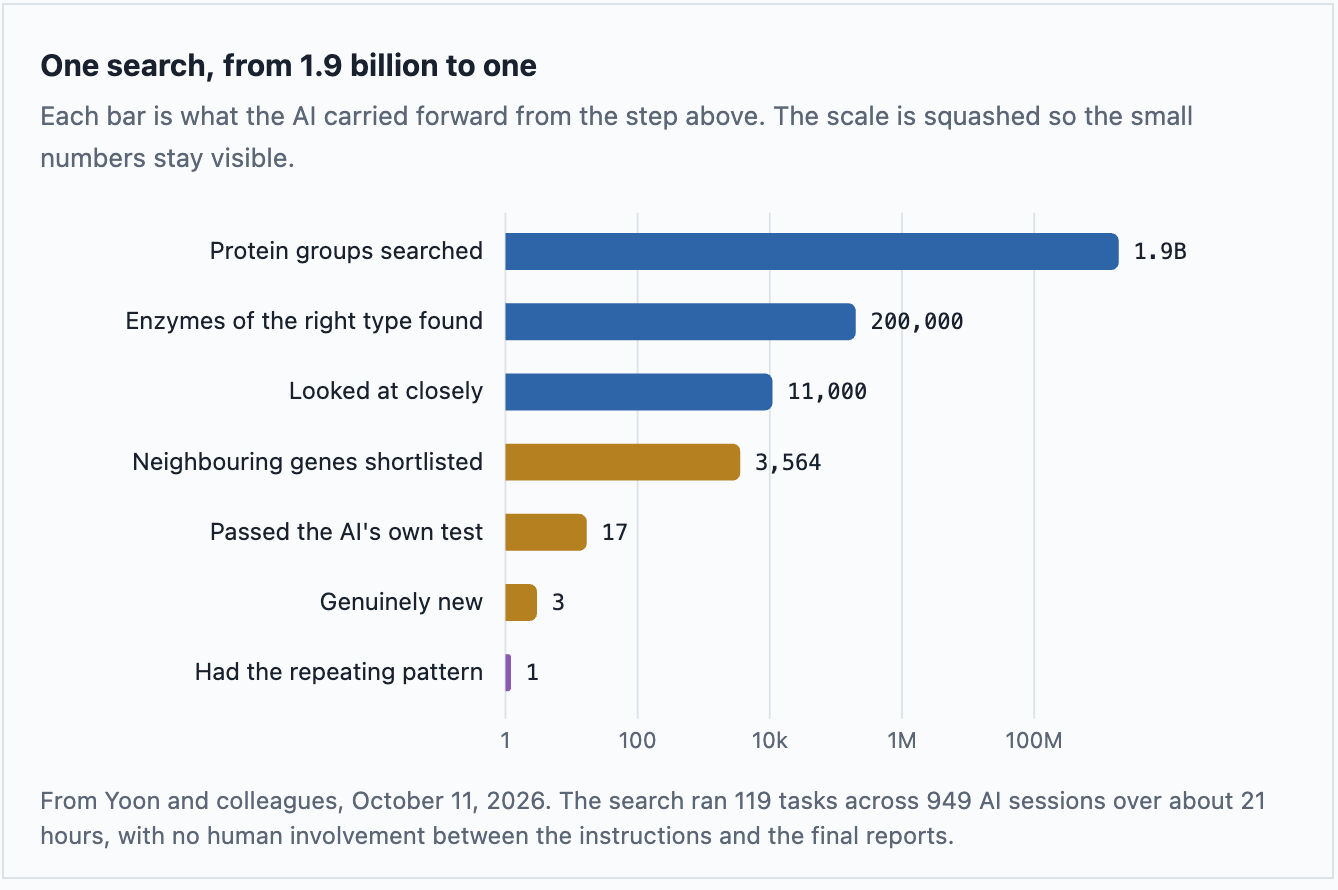
Most of what the agents chased came to nothing: out of 17 gene families investigated as possible partners for the reverse transcriptase (RT) enzyme, only three were confirmed as new. But along the way, the agents also flagged oddities in individual enzymes, and three turned out to be new lineages. ART was one of them.
The detour that found ART
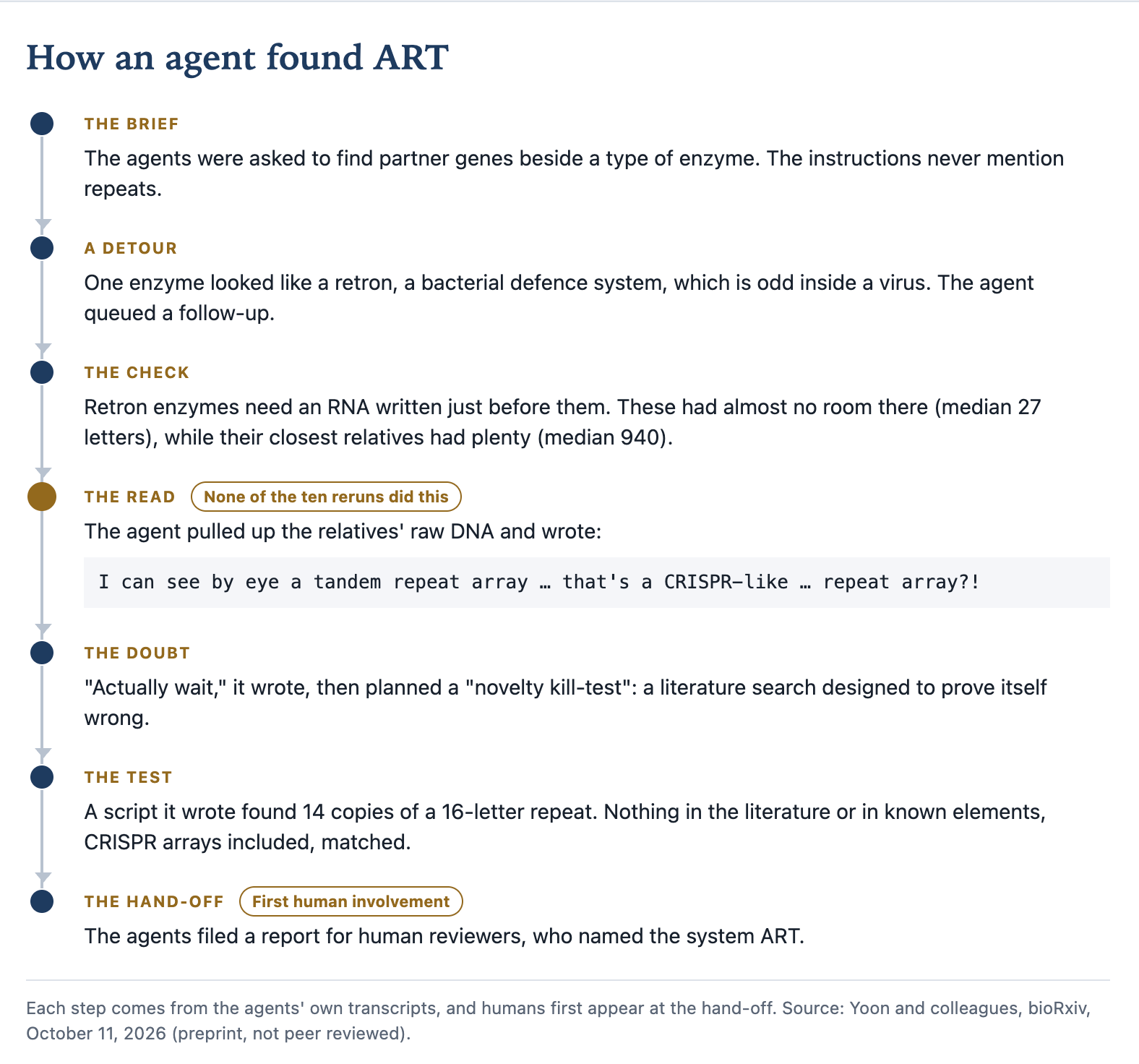
ART did not come from the job the agents were initially given. Neither the instructions nor the research brief mentioned repeating sequences at all. One agent was checking whether a gene next to one of the RT enzymes was an accessory protein. It decided the gene wasn’t, but it noticed that the enzyme looked like a retron. Retrons are defence systems that bacteria use against viruses, so finding one inside a virus was strange enough to be worth following up on.
Retron enzymes work with an RNA that is written just before them in the DNA sequence, so the reviewing agent asked the next agent to check for an RNA. When the agent checked the main group of enzymes it was assigned to look at, it found only a tiny blank space in front of them. This was physically “too small” of a space to hold an RNA. So instead, the agent looked up different versions of the exact same enzyme found in other closely related viruses. The agent then pulled up that stretch of DNA from the relatives and read it, and that is when it reported back with the line quoted at the start.
A tandem repeat array is a short sequence repeated over and over, with different filler between the copies. Upon discovering this repeat array, which is an incredibly distinct, clean, visual pattern, the agent doubted itself, because data is rarely that neat: “Actually wait,” it wrote, and began to wonder whether arrays like this had already been described. Its plan was to measure the pattern properly and then run what it called a “novelty kill-test,” a literature search designed to prove it wrong.
The pattern survived. A script the agent wrote found one stretch of DNA with 14 copies of a 16-letter repeat. It didn’t match any known element, including CRISPR arrays, and a literature search turned up nothing that fit its description. In other words, this functional system was undiscovered.
The authors make a point I think is the heart of the paper. In earlier work on automating discovery, humans decided whether a sequence contained something unusual, and whether that oddity was worth chasing. Here, the agents made both calls themselves.
So what had the agents actually found?
What ART is, and is not
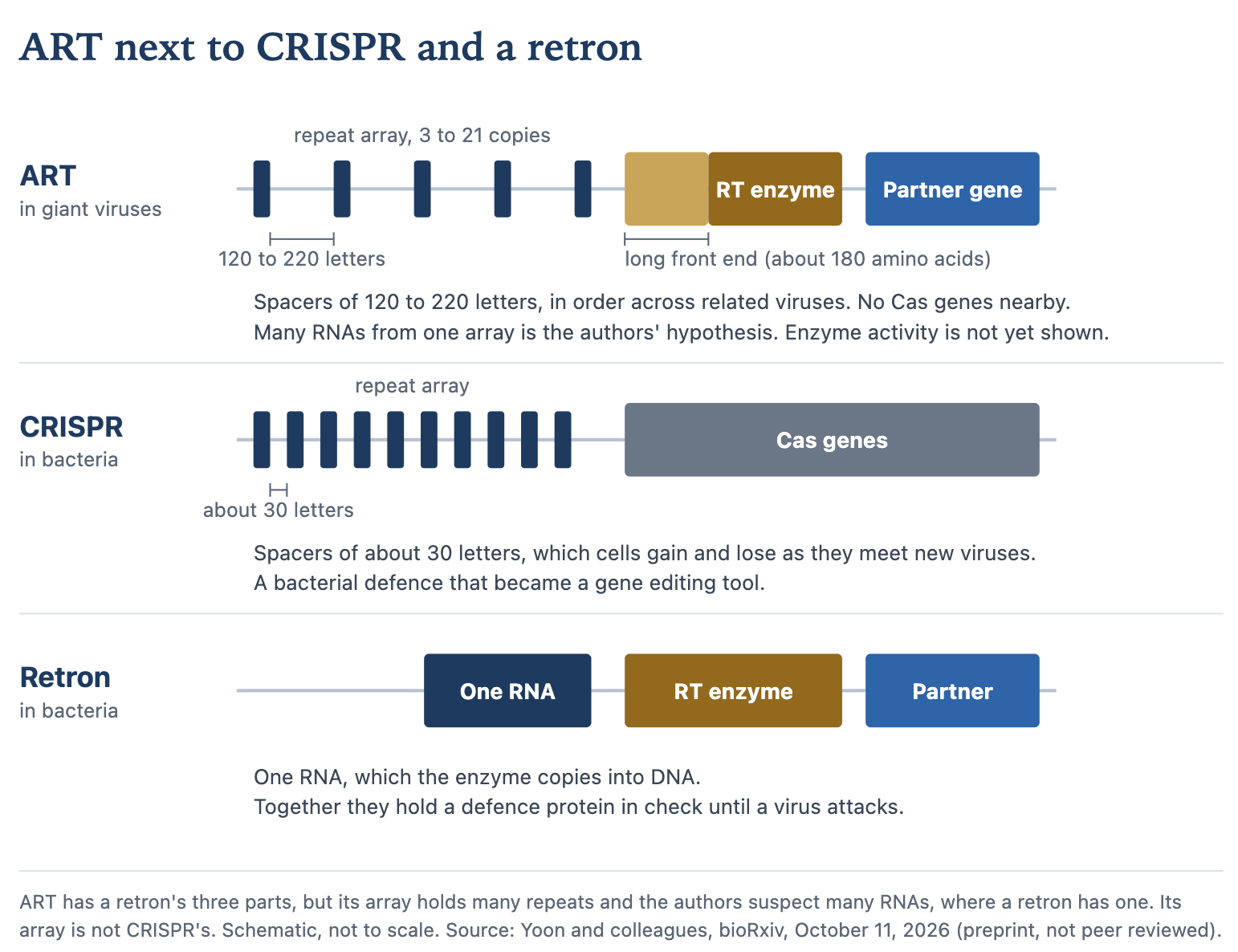
What the search landed on is a stretch of DNA with three parts in a row:
The Reverse Transcriptase Enzyme: This is a newly discovered molecular engine that converts RNA back into DNA, serving as the core biochemical driver of the system.
The Partner Gene: Sitting directly next to the enzyme, this gene codes for a completely mysterious protein that scientists believe binds to or regulates the system’s activity.
The Repeating DNA Array: This is an organized library of repeating genetic sequences that pumps out short strands of RNA, likely acting as a map or guide to tell the system what to target.
The system shows up mainly in jumbo phages, which are unusually large viruses that infect bacteria.
Human researchers then took over, working with Claude, to check whether ART was a legitimate functional family. They found 95 distinct versions of the enzyme, in giant viruses and in virus DNA from environmental samples, and 28 of them carried a detectable repeat array just before the enzyme.
Three features define the family:
The repeat array sits before the enzyme
A partner gene sits right after it
The enzyme has an unusually long front end, about 180 amino acids where similar enzymes carry 50 or fewer.
The array isn’t CRISPR. CRISPR keeps short snippets of about 30 letters that cells gain and lose as they meet new viruses. ART’s repeats are separated by stretches of 120 to 220 letters that stay in the same order across related viruses, and no CRISPR genes sit nearby. The authors call it a new type of repeat element.
From there the authors make a careful guess. ART looks a lot like a retron (which is what the agent concluded) , which has an enzyme, a partner protein and an RNA. In a retron, the enzyme copies the RNA into a piece of DNA, and together they keep a lethal protein locked up until a virus attacks. Once a virus attacks, they release it to kill the cell. The difference is that a retron carries one RNA and ART carries a whole bank of them. Each might form its own complex and let one system respond to several triggers. The authors are clear that this is a hypothesis.
What they haven’t shown is just as important, and the authors admit this themselves:
“Beyond these observations, we have not shown that the RT is active or that the unit RNAs are its substrates. Whether the RT and its partner interact, and what the system does for the phage, are currently unknown.”
In plain terms, they haven't shown that the enzyme (the RT) works, uses those RNAs, works with its partner, or does anything for the virus.
Why the Search Couldn’t Be Repeated
The authors ran the same search ten more times to see whether the find would repeat. In nearly every run the agents came across ART’s enzymes. In two of those runs they followed the lineage. However, none read the DNA just before the enzyme, so the array was missed every time. The authors blame the enormous number of enzymes the agent was given to search and the fact that the agents don’t behave the same way twice.
So was the first find a fluke? When given the DNA directly, the most capable AI models recognized the repeat array up to 90% of the time.
However, when forced to use analysis software, their success rate dropped as low as 32% because they failed to actually open and read large enough sections of the files (missing the 200+ letter lengths needed to see a pattern repeat). Once a model read enough DNA, its success jumped back up to 96%, proving the discovery relied on thorough data reading rather than luck.
The first find, then, wasn’t a fluke. It depended on an agent deciding, for whatever reason, to read the raw DNA. In the ten reruns none of them did.
To test how the AI recognized the pattern, researchers monitored 12 internal neural signals using fake repeating sequences.
The main takeaways from this internal test show:
The Signals Fired: Two of those pre-selected internal signals immediately switched on when the model read the ART DNA array.
The “DNA” Claim Was Overstated: While the study’s abstract claimed these signals specifically respond to DNA, control tests proved they actually fire on any repeating pattern (not just genetic code).
Reasoning Finished the Job: Once those general pattern-detecting signals flared up, the AI’s logical reasoning engine took over, analyzed the context, and correctly identified the sequence as a “tandem repeat array.”
That leaves us with a question the paper doesn’t answer. Is this a model that has learned something about biology? Or is it a general pattern spotter that was pointed at DNA, and then reasoned about what it saw?
This is a very important distinction . If the AI is just a general pattern spotter, the real opportunity (and profits) belongs to the companies that own the data and labs, not the tech companies building the AI models.
If the breakthrough is because of the model’s unique capabilities, then the investment thesis for genomics and life science stocks includes Anthropic.
Either way, the AI’s part of this story ends with a report. Everything after that is lab work.
After the Discovery: The Lab
The authors end with a comparison I find useful. A mathematician can work entirely from first principles, while a biologist often must test their ideas in the laboratory. Much can be inferred from sequence alone, but the ART findings still “await experimental characterization.”
Every open question about ART is a question for scientists at a lab:
Is the enzyme active?
Does it use those RNAs?
Does it work with its partner?
Someone has to make the proteins and the RNAs, mix them and see what happens. A better model doesn’t speed any of these steps up by itself.
Even if ART turns out to work, there is a second wall. Once you have an editor, it has to be delivered. A study from Stanford addresses this directly.
Almost every editing treatment given inside the body today goes in through a drip and ends up in the liver. That is where the tiny fat bubbles carrying the editor tend to land once they’re in the bloodstream.
However, there are certain risks associated with liver targeted gene editing:
The “Sponge” Effect: The liver absorbs so much of the medicine that it leaves too little for other organs, which can also cause a liver overdose.
Immune Reactions: The immune system can attack the delivery vehicles, causing liver inflammation and preventing patients from ever receiving a second dose.
Accidental Cuts: The gene-editing tool might accidentally cut the wrong part of the DNA, which could theoretically cause liver cancer.
Fading Effects: Because liver cells constantly divide and regenerate, the corrected genes can get diluted and lose their effectiveness over time.
In a paper in the journal Cell, Daesun Song and colleagues at Stanford describe a workaround. They started with a small editor called Cas12f, small enough to fit inside one of those fat bubbles, and modified it so it only switches on when light hits it. Light can’t travel through a body, so they paired it with tiny particles that circulate in the blood and give off light when ultrasound hits them. Ultrasound can travel through a body. Point a focused beam at one spot, the particles there glow, and the editor switches on in that spot only.
They tested it in mice engineered so that tissue glows when an edit succeeds. When they aimed the beam at one side of the brain, that side lit up and the other stayed dark.
Nothing has been tested on a human yet, but it’s a promising technology that goes after the problem associated with gene editing in the liver.
The “Genomics & Gene Editing” Trade
In July, Morgan Stanley’s Tech Momentum Index fell 35% over 17 trading days. That was worse than the dot-com crash, the 2008–09 financial crisis and the 2020 COVID selloff, and the worst selloff in the index’s 27 year history.
Goldman Sachs’ read was that the selloff reflected crowded positioning unwinding, rather than fundamental deterioration in the underlying AI businesses. Positioning in AI-related momentum names had gotten very heavy, driven by just how bullish everyone had become on the same trade. Once selling pressure increased, there was no one left to buy, and AI-related names sold off as a result.
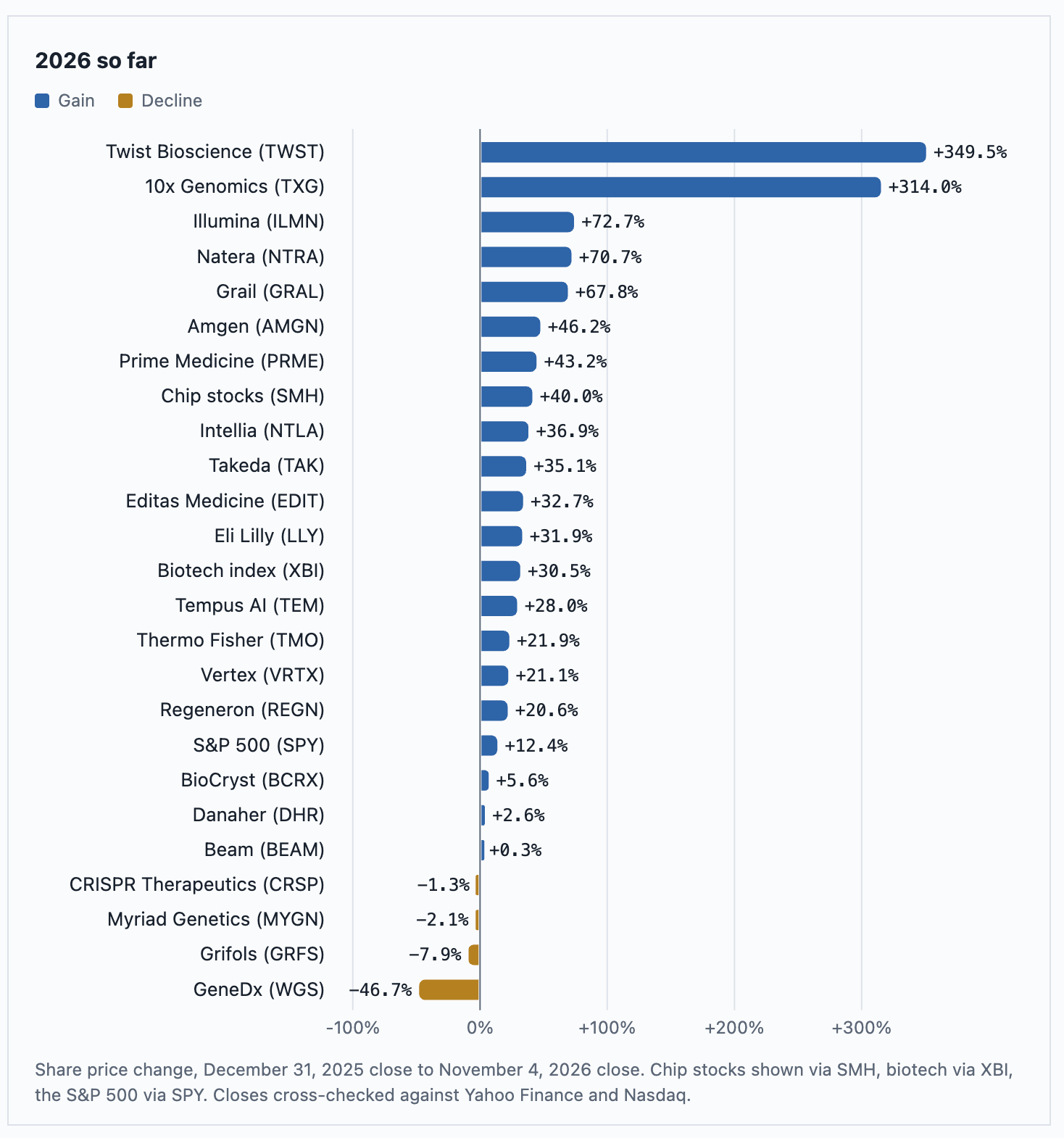
Meanwhile, genomics & gene editing names were holding up far better. During the momentum crash, the semiconductor ETF (SMH) fell 16.6%, while Regeneron rose 7.0%, Amgen 5.8% and Thermo Fisher 11.4%.
Genomics & Gene Editing is a less crowded trade that still offers exposure to AI.
The recent market selloff showed that still holds true. The Global X Genomics & Biotechnology ETF (GNOM) has held up significantly better than SMH over the last 6 or so months.
In the SixSigmaCapital Portfolio we had a big winner with TWST which we sold on October 7th for >500% return.

Thesis:
Put Anthropic’s paper and the Stanford’s study together, and the picture is pretty clear.
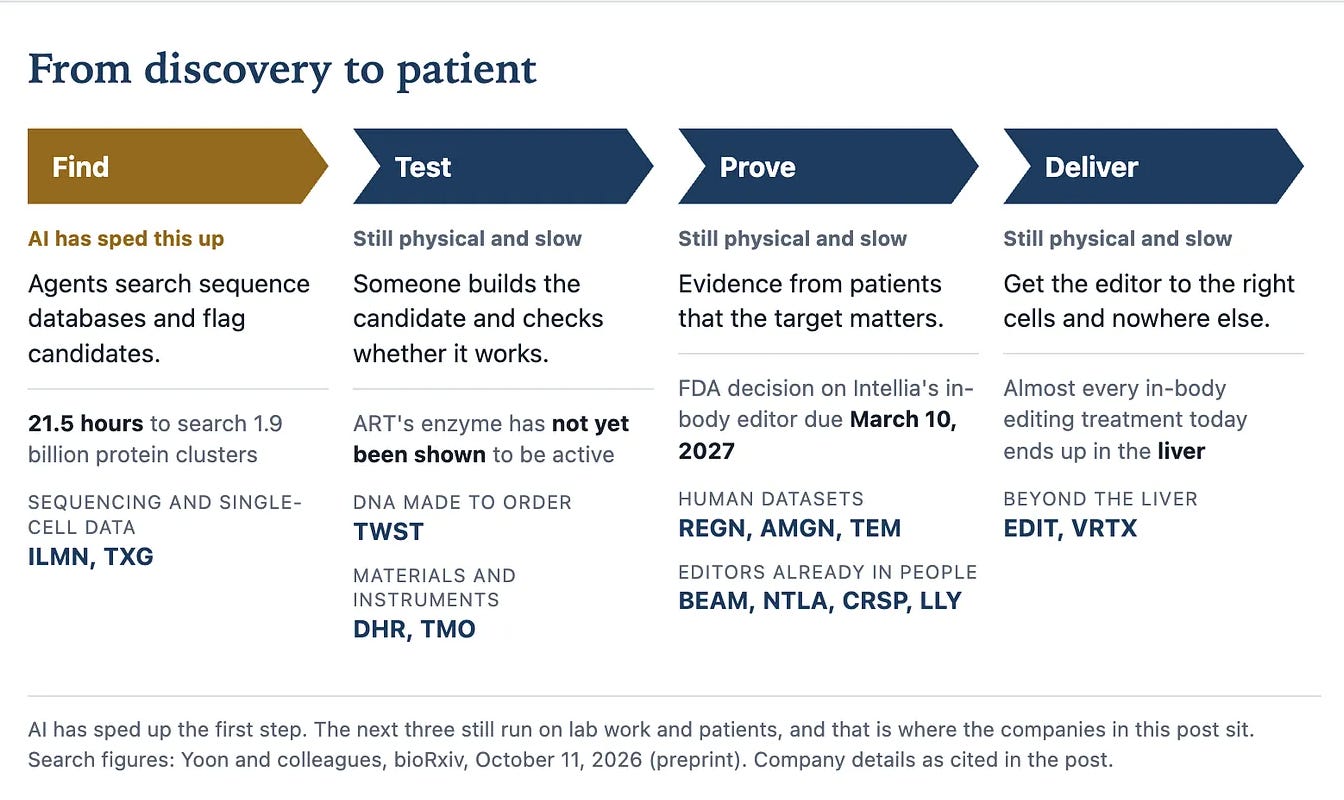
The authors point out that sequence databases keep doubling, and that expert attention is a limitation, which AI agents have started to solve. As a result, the list of promising candidates for discovery may grow faster than anyone can test them.
I think that points at three places the money could go.
The first is whoever sells to every lab, because every discovery candidate has to be built and tested.
The second is whoever owns evidence from real patients, such as large human datasets, which agents can now read directly. These databases are slow to build.
The third is the editors that already work in people, and whoever works out how to deliver them beyond the liver.
Potential Winners
(Not financial advice. SixSigmaCapital has no current positions in the names listed below, besides LLY.)
1. Selling to every research team
Twist Bioscience (TWST)
Twist makes DNA to order and is the largest supplier. In August, Anthropic said Claude had designed protein binders (proteins built to latch onto a chosen target) for 15 targets, and Twist built and tested 1,260 of those designs in under three weeks.
Revenue grew 23% to a record $118.4 million in its June quarter, and it shipped about 369,000 genes against 237,000 a year earlier. At the time of writing, the stock is up about 350% this year, though, so a lot of that is already in the price.
Illumina (ILMN) and 10x Genomics (TXG)
Searches like Anthropic’s run on libraries of genetic sequences, and sequencing machines fill those libraries. Most of those machines are made by Illumina, which raised its 2026 revenue guidance to between $4.64 billion and $4.66 billion on October 29.
10x makes instruments that measure what individual cells are doing. Biological AI models require a massive, continuous supply of single-cell data to train and validate genetic edits.
Danaher (DHR) and Thermo Fisher (TMO)
Every research effort here needs materials made to order, and both names supply those materials. Danaher’s units built the custom components for a gene editing treatment designed for a single infant in 2025, in about six months. Thermo Fisher’s protein measurement technology is being used on volunteers in UK Biobank (a large UK health study) for a group of 14 companies. Neither name is a pure gene editing bet, so they don’t depend on any one type of editor working.
2. Human datasets:
Regeneron (REGN)
Regeneron has sequenced more than 3 million people and matched the results to their medical records, with about a third from non-European backgrounds. Two of its drugs came straight out of genetic quirks found this way. Third-quarter revenue rose 36% to $5.1 billion, almost all of it from medicines, meaning the data sits inside a business with multiple sources of revenue.
Amgen (AMGN)
Amgen bought deCODE in 2012 for $415 million, mostly for Iceland’s family records. Because those go back generations, it’s easier to tell which genes cause a disease and which just travel alongside it. Repatha, Amgen’s cholesterol drug, was created from that kind of work and made more than $3 billion in 2025.
Amgen is also exposed to the other side of this story, since the one-time gene edits for cholesterol, would compete with drugs like Repatha.
Tempus AI (TEM)
Tempus sequences tumours, and links the results to patient records and licenses that. Third-quarter revenue rose 23% to $411.5 million, with the data side up 33%, and data licensing bookings have passed $550 million this year.
3. Editors already working in people (part 1):
Beam Therapeutics (BEAM)
Beam’s lead treatment corrects the single wrong letter of DNA behind a condition that damages the lungs and liver. Data from September showed a singular dose keeps the missing protein above protective levels for up to 18 months.
Intellia Therapeutics (NTLA)
Intellia is closest to an approval for an editor given inside the body. Its treatment targets a condition that causes sudden and sometimes dangerous swelling attacks. In the trial it cut attacks by 87% against placebo, and 62% of patients had none over six months. The FDA is due to decide by March 10, 2027.
It also has the most safety history in this group, and part of it is bad. A patient in one of its trials died after a severe liver reaction last year. Intellia and Regeneron then read the DNA of more than 600 patients in that programme and found that the worst reactions clustered in people carrying one particular immune system gene. Patients are now tested for it before they’re dosed. That is a direct application of genomics being used to make gene editing safer.
CRISPR Therapeutics (CRSP)
One year results published in August showed its cholesterol treatment cuts the protein it targets by 79% and triglycerides (a type of blood fat) by 48% at the top dose. This effect held for a full year.
Regulators have since granted it two designations that speed up review. It held $2.28 billion in cash at the end of September and splits the economics of Casgevy, the first approved CRISPR treatment, with Vertex.
Eli Lilly (LLY)
Lilly owns Verve, a gene editing company, and its one-dose cholesterol editor, which cut LDL (the “bad” cholesterol) by up to 62%. This effect lasted up to 18 months. It also signed a deal worth up to $2.25 billion with Profluent for AI-designed enzymes. It is one of the few names in this group large enough to comfortably wait out a slow start for a treatment people only buy once.
3. Getting past the liver (part 2)
Editas Medicine (EDIT)
Editas rebuilt itself around reaching cells other than those in the liver. It reported editing 58% of blood stem cells in monkeys five months after a single dose, using a delivery particle designed to seek those cells out. Its stated goal is to show the same in another type of tissue by 2027.
Editas also earns money licensing CRISPR patents, which is why it shows up again as a potential loser
Vertex (VRTX)
Vertex shows what reaching other cells costs today. Its approved treatment, Casgevy, gets to blood stem cells by taking them out of the body, editing them in a lab and putting them back. On top of that, patients need chemotherapy as part of the treatmenet. Vertex now guides to $500 million or more this year from Casgevy and a new pain medicine combined. A delivery method that works inside the body would make that whole process unnecessary.
Potential Losers
The risk for the following names stems from three places:
Some companies sell a test that is paid for once and never again.
Some sell a licence to technology that may soon be free.
Others sell lifelong treatments that a single dose could replace.
Myriad Genetics (MYGN)
Myriad’s best-known product is a hereditary cancer test, which a person pays for once.
Permanently curing hereditary mutations with AI based gene-editing eliminates the need for their tests, while open-source AI will simultaneously destroy the proprietary data moat they use to price them.
Editas Medicine (EDIT), the other side
Editas holds rights to some CRISPR patents from the Broad Institute, which is why Vertex paid to license them for Casgevy. It has since sold the right to part of those future payments to DRI Healthcare for $57 million upfront.
The biggest threat to their business is Profluent’s OpenCRISPR-1, which was designed by an AI model. A study in May reported that it edits about as well as the original CRISPR tool while cutting in the wrong place up to 553 times less often. Profluent lets anyone license it for free, so if their editors hold up in patients, licences become much harder to sell.
Takeda (TAK) and BioCryst (BCRX)
Both sell lifelong treatments for the same swelling condition Intellia’s editor is made for. Takeda’s injection is given every two to four weeks and brought in roughly $1.5 billion in the year to March. BioCryst’s daily pill grew 41% to $623 million in 2025.
If a single infusion solution is found (and it works), these are the products that will see a decrease in demand first. Takeda is up 34% this year, though, so the market isn’t worried yet.
Grifols (GRFS)
Patients with the lung disease that Beam is targeting currently, get weekly infusions of the protein they’re missing, made from donated plasma. Grifols describes itself as the global market leader in those products. If the liver can be made to produce that protein by itself, many of those infusions become unnecessary.
Conclusion
What I find most interesting about this write-up is that our whole thesis came from two studies, neither of which tested a real treatment.
In one, AI agents searched 1.9 billion groups of proteins and, partly by accident, found a new kind of genetic system. In the other, a beam of ultrasound switched on a gene editor in half a mouse brain, leaving the other half alone.
AI has made noticing things much faster. What it can’t do is lab work and gathering patient evidence. To sum it all up:
An AI agent noticed a repeating pattern in raw DNA that wasn’t part of its job, doubted itself and checked the literature. Nobody yet knows whether ART’s enzyme works or what it does, and the first find couldn’t be repeated because the agents never read the DNA beside the enzyme.
Everything after a find is physical and slow: making the proteins, testing them, proving them in patients and getting editors into the right cells. Companies that sell to every lab, and those that own evidence from real patients, stand to benefit no matter which discovery or editor eventually wins.
AI based gene-editing could displace companies with tests paid for once, licences that may become free, and lifelong treatments a single dose could replace.
Out of the names mentioned in this post, SixSigmaCapital currently holds a position in Eli Lilly (LLY), which we covered in full in Part Two. The rest are names we believe are worth following.
Genomics isn’t early the way some AI themes are, since treatments exist and several are already approved. What is early is the impact of AI on discovery, as well as the step from a new sequence to a working tool. Another developing part of the story is how that tool or drug is administered in ways apart from through the liver.
Going forward, a few things we will be watching:
Whether the growing pile of AI-generated candidates translates into orders (and revenue) for the companies that discover them, or whether most of these experiments remain in the lab.
Which type of human datasets give health data aggregators a competitive advantage
Whether anyone gets an editor working reliably outside the liver.
How long it takes before we move from papers in academia to earning prints.
The next write-up in the series is mRNA and personalised cancer vaccines, looking at Merck, Moderna, Tempus and Personalis. The underlying question we hope to address is: what it takes to manufacture a bespoke medicine for every individual patient at commercial scale?
Thank you for reading. If you enjoyed this post, please leave a like and Restack. Subscribe to the plan that best suits your needs and will see you in the next one!