


Vertiv Holdings Co (VRT)
Vertiv manufactures the power and cooling equipment used inside AI data centres, and few listed companies offer more direct exposure to the AI buildout. Even though it raised its 2026 earnings forecast in April, the stock has fallen 33% at the time of writing, significantly underperforming its peers.
In this post, myself and AKS Research break down the investment case for Vertiv Holdings Co (VRT): what the company does, why the stock has fallen behind its peers, and what would need to happen for it to catch up.
This post is for informational purposes only and does not constitute financial advice. Please conduct your own due diligence before purchasing any equities or assets discussed herein.
Layout:
Overview
Business Model
What’s Behind the Recent Underperformance
What the Market May Be Missing
Competitive Landscape
Industry Tailwinds
Risks
Financials and Valuation
Thesis
Overview of Vertiv
Vertiv Holdings Co is a maker of power and cooling equipment for data centres. Data centres make up about 85% of its sales, and its customers range from hyperscale cloud providers and colocation operators to neoclouds and large enterprises.
The company is experiencing massive demand, generating $10.2 billion in sales in 2025. It entered 2026 with a $15.0 billion order backlog, more than double the year before, providing clear visibility for future growth.
At its investor conference in May, management raised its long-term targets. The company now aims for organic sales growth of about 20% to 22% a year from 2025 to 2030 (up from 12% to 14%), and an adjusted operating margin of about 27% by 2030. It sizes its served market at about $75 billion, growing 16% to 18% a year, and expects to deploy about $28 billion of capital from 2026 to 2030 to capture that demand.
Business Model
Vertiv sells the equipment that powers and cools data centres. Every data centre has two physical problems. First, electricity from the grid arrives in a form servers can’t use. It has to be converted, routed to every rack, and backed up by batteries in case the grid fails. I discussed this in more depth in the post below:

Second, the chips turn almost all of that electricity into heat, which has to be removed before the servers overheat. That second problem is getting harder to solve with every generation of chips.
Data centre racks once drew about 20 kilowatts each. Today’s hyperscale facilities can support more than 135 kilowatts per rack. Nvidia says managing that much heat with air alone would require below-freezing temperatures or near-gale airflow, which is why the newest AI racks are cooled with liquid instead.
Vertiv makes the equipment to solve both of these issues:
Switchgear and power distribution units route the electricity.
UPS systems (battery backups) keep servers running during outages.
Chillers and liquid-cooling units carry the heat away.
According to Vertiv, it is the largest supplier of data centre cooling equipment (per Dell’Oro) and large UPS systems (per Omdia).
Vertiv makes money in two ways:
About 80% of sales come from selling the equipment.
The other 20% comes from servicing it after installation, through maintenance, repairs, and spare parts.
Data centre operators often return to their original equipment manufacturers (OEMs) and installation suppliers for ongoing maintenance. Because data centres require “five nines” uptime (99.999%), operators prioritize reliability over the potential cost savings of switching vendors.
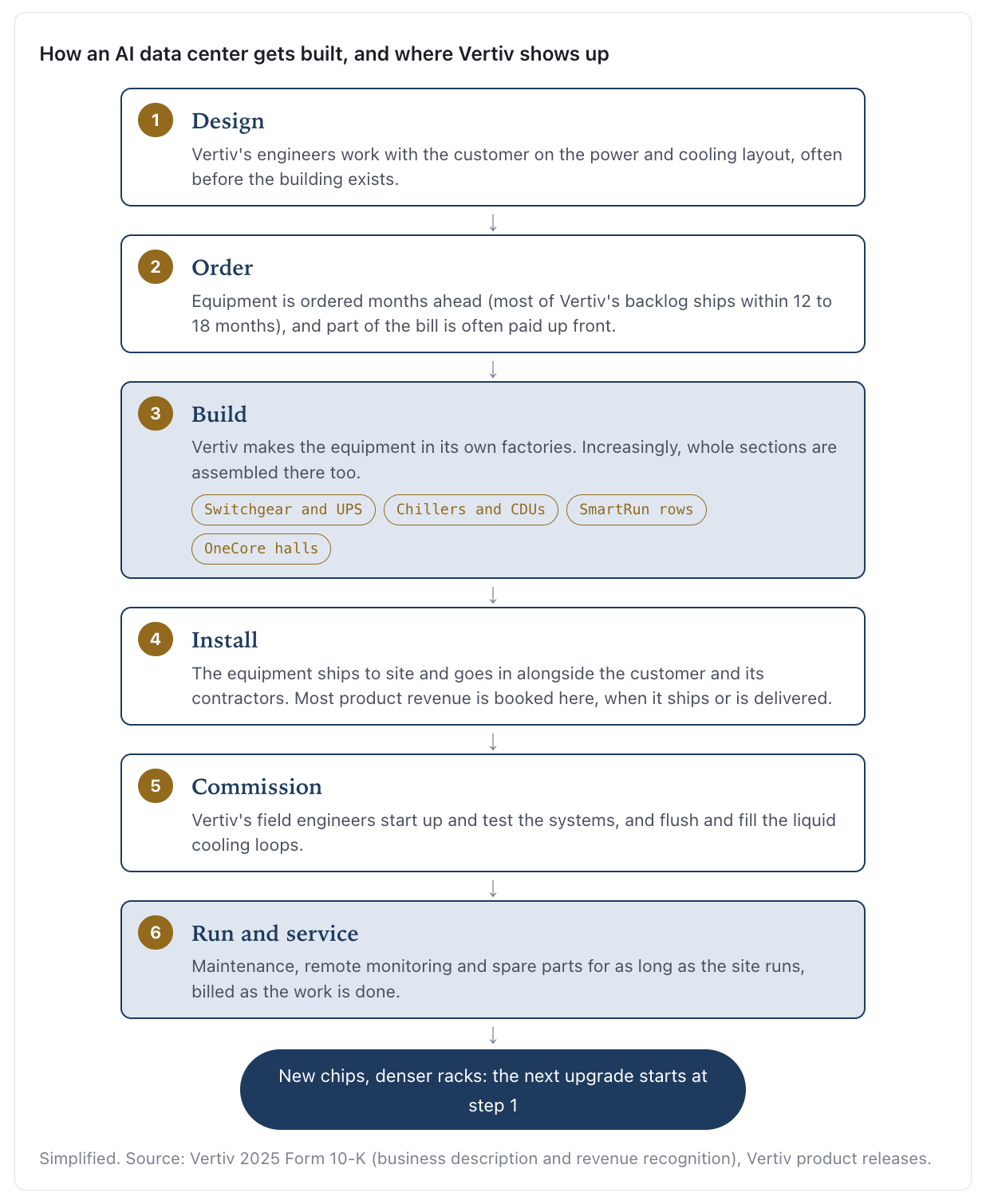
Regarding payment and delivery, customers usually order 12 to 18 months in advance, paying part of the price upfront. This has allowed Vertiv to generate a backlog of $15.0 billion worth of orders. Initially, its business was primarily built on shipping individual machines that contractors assembled on site. Vertiv recently added to its service offering by assembling larger pieces in its own factories, including a complete prefabricated data hall (a room inside a data centre that houses rows of server racks, storage devices, and networking hardware) called OneCore. Vertiv estimates it can now sell $3.25 million to $3.75 million of equipment into each megawatt of capacity, up 10% to 15% from its prior range.
The downside is that Vertiv now carries the risk when the assembly of those parts runs late. Management traced its second-quarter miss to exactly this risk.
What’s Behind the Recent Underperformance
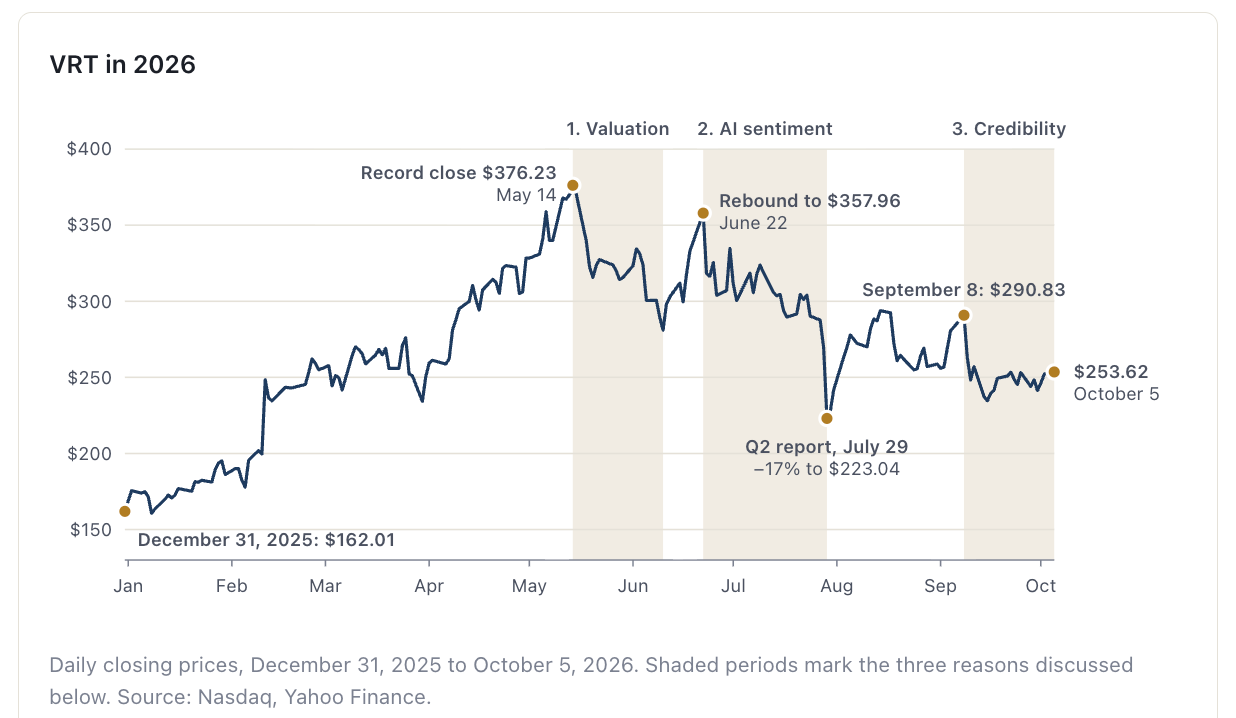
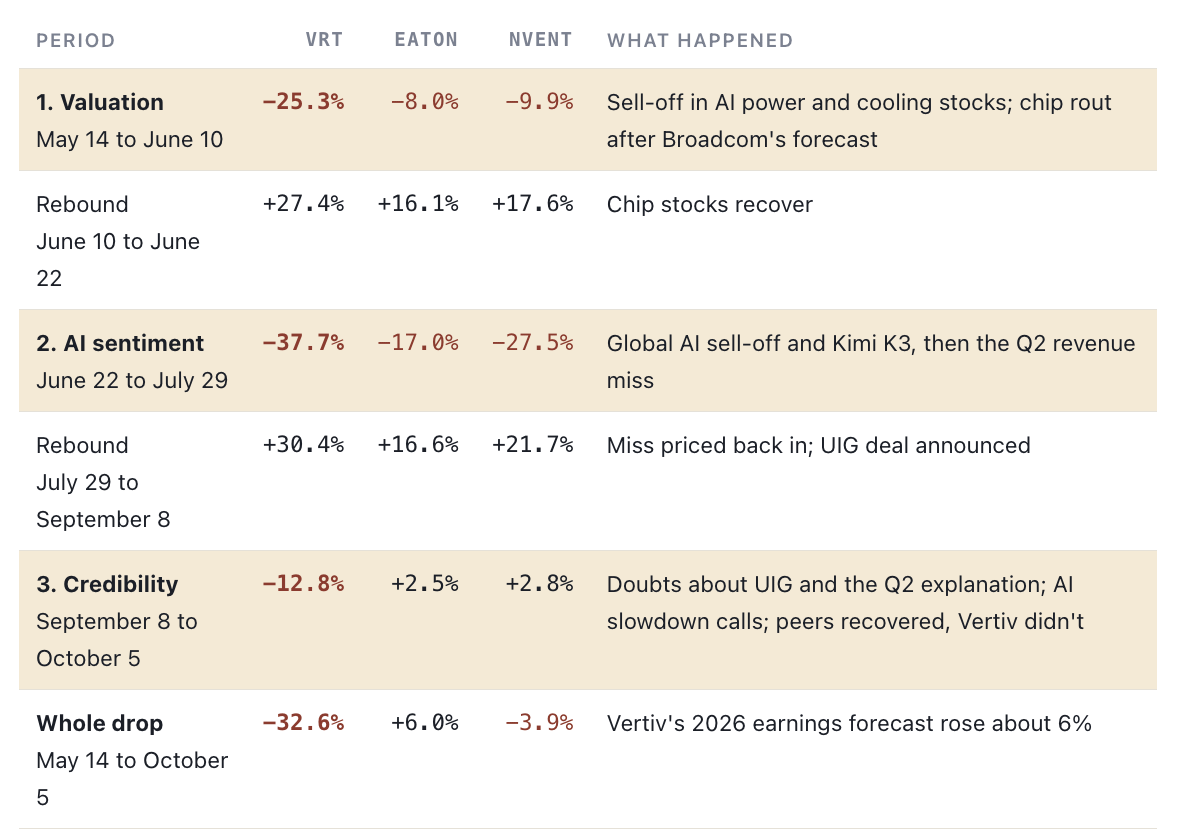
From its May 14 all-time-high to October 5, VRT fell 33%, while Eaton rose 6% and nVent slipped 4%. This happened despite Vertiv raising its earnings forecast over that time. VRT’s decline from its all-time high wasn’t a straight line. It rebounded twice along the way, but each subsequent leg down exposed a different worry.
An Expensive Stock (May)
By May 14, VRT was at an all time high, up 132% for the year, and investors were paying about 59 times Vertiv’s expected 2026 earnings. For comparison, nVent traded at about 39 times and Eaton at about 31 times their own forecasts. A premium that large is a bet that Vertiv’s fast growth will last for years, and it is the part of the price most exposed when investors get nervous about AI.
The nervousness spread rather quickly, but not based on Vertiv itself. Its April report beat profit forecasts by about 15% and raised its outlook. At its investor conference on May 19, it set a long-term target of 20% to 22% annual sales growth. Instead, the reason for the selloff was industry-wide.
On May 18, AI power and cooling stocks fell while the S&P 500 was flat, and VRT fell 8.4%, then another 5.0% on the day of the conference. On June 5, Broadcom’s weaker-than-expected AI forecast set off the worst day for chip stocks since April 2025 (Reuters), and VRT fell 7.2%.
By June 10, VRT was down 25%, about three times as much as Eaton and nVent. Its earnings forecast hadn’t changed, so the whole drop came from investors paying less for each dollar of earnings, about 44 times instead of 59. When chip stocks recovered, VRT rose 27% in seven-eight trading days, but the multiple never fully returned to its May level.
The Purest Way to Bet on AI?
With about 85% of its revenue coming from data centres, Vertiv is nearly a pure bet on the AI infrastructure buildout. Bernstein, when initiating coverage, called Vertiv “the only pure-play with scale in the sector.” Market sensitivity reflects this: VRT has a beta of 2.05 compred to 1.13 for Eaton, and ~1.35 for nVent, which helps it when AI spending is strong but hurts it when sentiment turns.
Sentiment turned in late June. On June 23, AI and chip stocks fell around the world on worries that valuations were too high and that the war with Iran would push inflation higher. As a result, VRT fell 11.1%, more than Eaton and nVent. The selling continued into July, as China’s Moonshot AI released Kimi K3, an open-weight model with frontier-level results. By July 28, VRT was 25% below its June 22 close, in line with other AI hardware stocks such as Modine and Delta Electronics, while Eaton had fallen just 11%.
Then, the second-quarter report gave investors a reason to worry that was specific to Vertiv. Sales were $3.27 billion, below the $3.37 billion to $3.39 billion analysts expected, and organic growth (growth that excludes acquisitions and currency effects) was 18%, below the 20% to 24% Vertiv had forecast. Profits beat expectations and Vertiv raised its full-year forecast, but its third-quarter forecast only matched analysts’ expectations. Vertiv blamed “minor timing shifts,” mainly from supply chain congestion and large projects being delivered in phases. The stock fell 17% that day.
Doubts about Execution
The miss itself was forgiven quickly. By September 8, VRT had rebounded 30% and traded 8% above where it stood before the report, helped by Vertiv’s September 2 agreement to buy Utility Innovation Group (UIG), which designs on-site power systems for data centres.
Then, over the following two days, VRT fell 15%, while Eaton and nVent fell 3% and 5%. Two things worried investors. First, the UIG deal could cost up to $2.6 billion, but Vertiv gave no figures for UIG’s current sales or profits, so investors had no way to judge the price. Second, on September 8, CEO Gio Albertazzi described the second-quarter miss differently. In July, Vertiv had blamed it mainly on supply chain congestion. In September, he said it was “not about supply chain” but about “coordination and maturity” in building its new factory-assembled products, which made investors wonder whether there were any internal issues.
On September 14, the whole sector fell. Anthropic CEO Dario Amodei called for a deliberate and global slowdown in the development of AI, and OpenAI’s Sam Altman backed the idea (BNN Bloomberg). The same day, the 10-year Treasury yield, the benchmark for long-term interest rates, briefly rose above 5% for the first time in nearly three years. Higher rates make future profits worth less today, which hurts growth stocks. VRT, Eaton, nVent, and GE Vernova fell between 7.6% and 9.7% that day.
What followed is worth analyzing. Other names involved in the AI infrastructure buildout, including Eaton, nVent, GE Vernova, Quanta, Nvidia, and the VanEck Semiconductor ETF, are all back above where they traded before the slowdown calls.
On the other hand, Vertiv is still below that level, and 13% below its September 8 price.
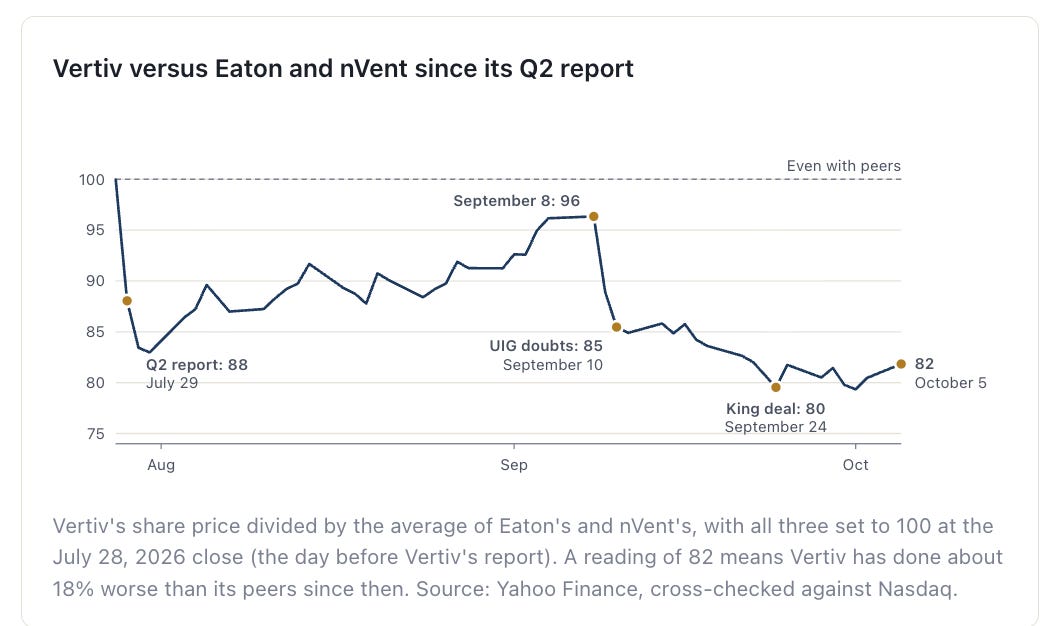
I think the crux of the matter is execution. A timing miss blamed on supply chain congestion can be fixed by the next quarter. However, a “coordination and maturity” problem inside the company’s fastest-growing products can only be proven fixed with actual results. Management has also said revenue on these products can shift “by several days,” which is enough to move it from one quarter into the next. On top of that, Vertiv stopped publishing order figures after February. Eaton and nVent still publish theirs, so Vertiv has less to point to while it works through these problems.
Investors have also been focusing on Vertiv’s second-half sales compared to its first. Vertiv’s full-year forecast of $14.0 billion implies about $8.1 billion in sales from July to December, 36% more than what it reported in the first half. Its cash flow also leans heavily on customer prepayments. Inventory rose by $1.05 billion in the first half as Vertiv built equipment for later delivery, and without those prepayments, its cash flow after capital spending would have been about -$240 million (10-Q). That is normal for a company building to order, but it means Vertiv’s reported cash flow depends on projects shipping on time.
Acquisitions and positioning add to the uncertainty. Since June, Vertiv has closed its purchase of ThermoKey and agreed to buy UIG and King Environmental Services. On September 24, the day it announced the King acquisition, VRT fell 1.4% while its peers were flat. Short sellers have also returned, with shares sold short rising from 11.2 million in mid-July to 14.2 million in mid-September, representing about 3.7% of shares outstanding (FINRA).
None of these narratives suggests customers want less of Vertiv’s equipment. In my eyes, the major question is whether Vertiv can deliver it.
What the Market May Be Missing
Vertiv began 2026 with $15.0 billion of orders waiting to be delivered, more than its entire $14.0 billion sales forecast for the year (10-K). To illustrate this simply, suppose every dollar of first-half sales came out of that backlog and Vertiv won no new orders at all. It would still have about $9.1 billion left, more than the $8.1 billion it needs from July to December. On top of that, at the end of June, customers had already paid $3.6 billion in advance for equipment and services Vertiv expects to deliver within a year (10-Q).
The caveat is that not all of the backlog is due this year. Vertiv says most of it should ship within 12 to 18 months, and customers can reschedule or cancel. That is why the “coordination” problem and the third quarter matter more than demand.
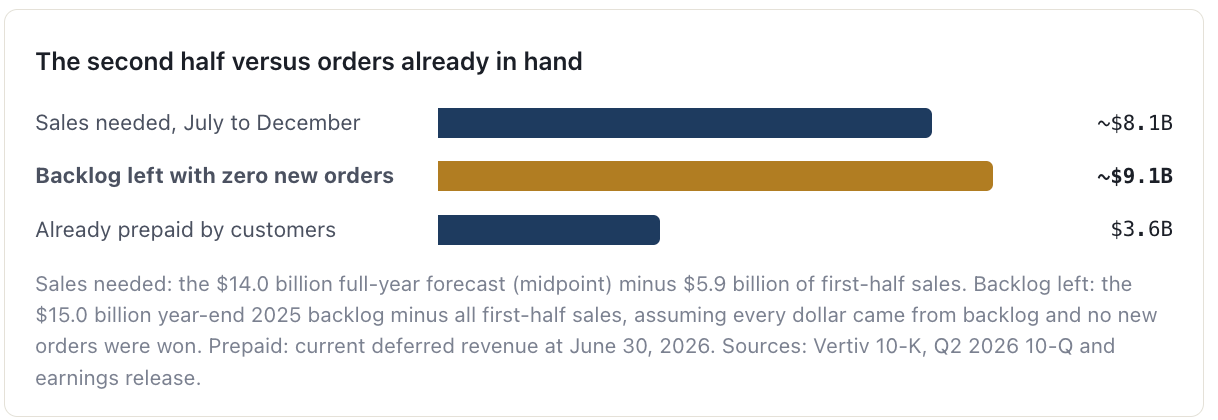
The prepayments also stand in for the order figures Vertiv stopped publishing. In the first half, customers paid $1.82 billion upfront, compared with $172 million a year earlier (10-Q). Customers only prepay for equipment they have ordered, so this suggests new orders are still strong.
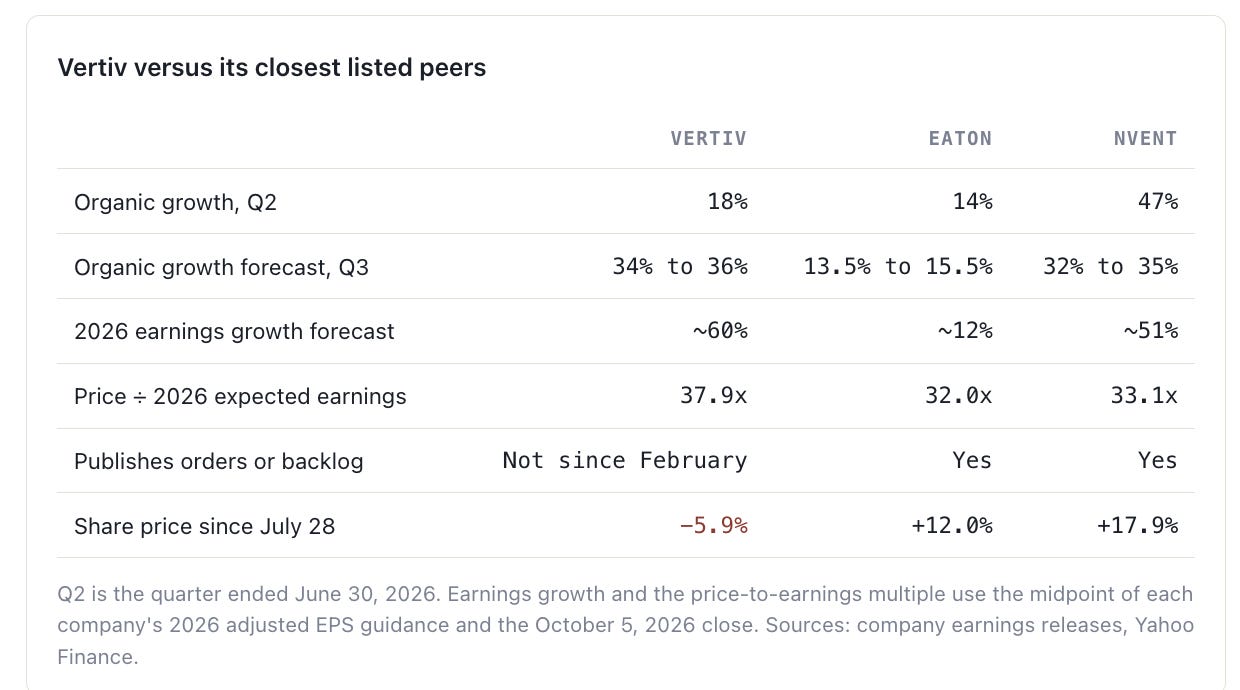
The third quarter could also support its case in the growth comparison. Vertiv forecasts organic growth of 34% to 36%, above nVent’s 32% to 35% and Eaton’s 13.5% to 15.5%.
Competitive Landscape:
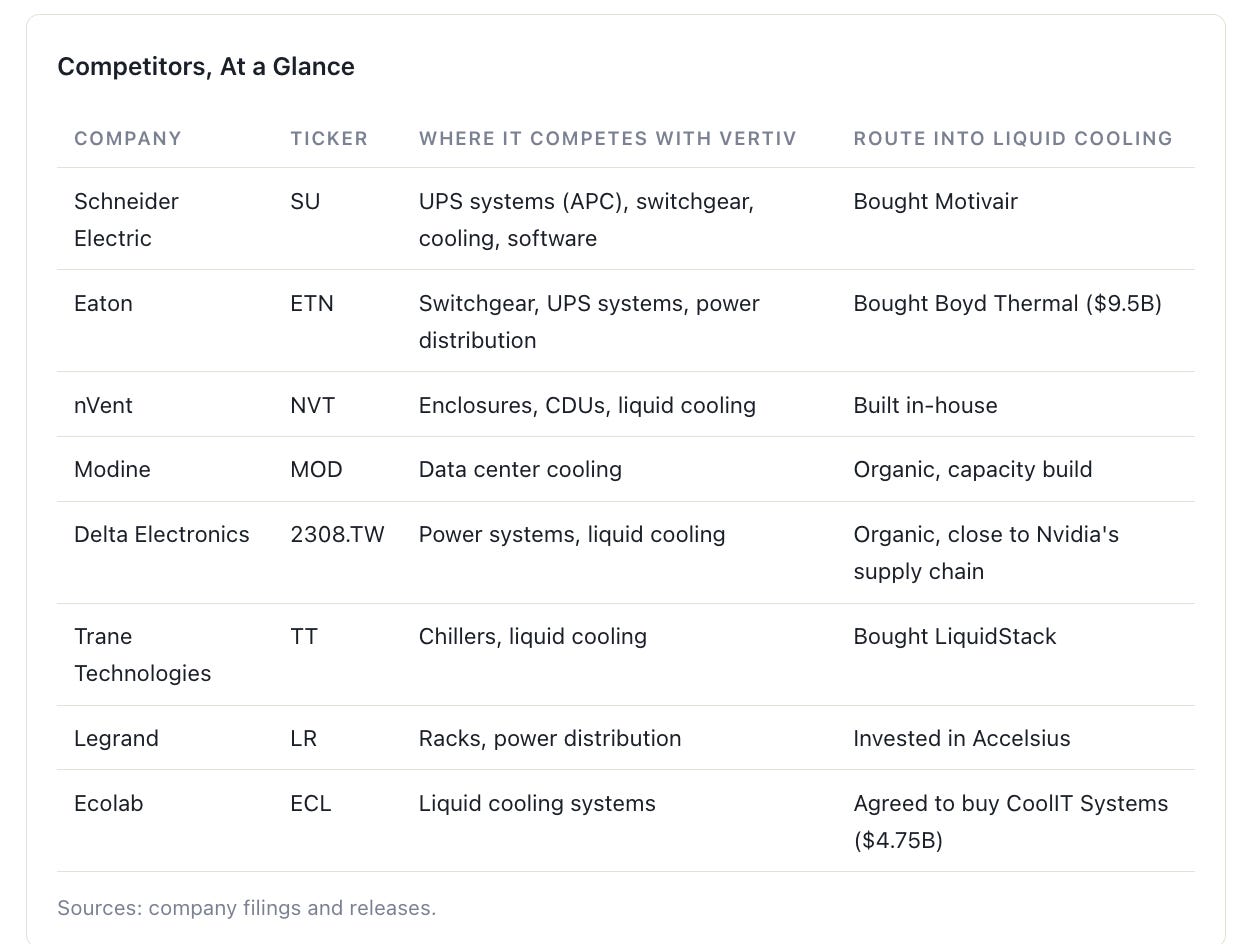
Vertiv’s 10-K splits its competitors into two groups: large global companies such as Schneider Electric, Eaton, Legrand, and Huawei, and specialists such as Delta Electronics, Stulz, Johnson Controls, and Socomec. Most of them compete with Vertiv in only a few categories, which is why a portion of Vertiv’s pitch rests on offering one of the broadest product ranges across both power and cooling.
Liquid cooling is where the field has changed most. Over the past two years, larger companies have bought their way in, and some cloud companies now design their own cooling.
The stock also looks less expensive once growth is considered. VRT trades at about 38 times this year’s expected earnings (based on 2026 expectations), more than Eaton (32 times) or nVent (33 times). However, Vertiv expects its earnings to grow about 60% this year, compared with about 51% for nVent and 12% for Eaton. Measured against that growth, Vertiv is valued about the same as nVent and well below Eaton.
Industry Tailwinds:
The structural tailwind behind VRT is closely tied to the AI data centre buildout.
Spending on AI data centres is still rising. Microsoft, Alphabet, Amazon, and Meta are on track to spend more than $700 billion on buildings and equipment in 2026. Goldman Sachs expects the five largest US cloud companies to spend about 50% more on AI in 2027, reaching $1.2 trillion (Bloomberg).
Looking at data centre power, cooling, racks and related physical systems, Dell’Oro expects spending to grow 22% a year to $120 billion by 2030. Additionally, McKinsey estimates that about 25% of the $5.2 trillion needed for AI data centres through 2030 will go to power, cooling, and electrical equipment.

Electricity is the biggest bottleneck. About 2,061 gigawatts of new power plants and batteries are waiting to connect to the US grid. The typical wait is more than five years, which is why Vertiv bought UIG. Its systems let a data centre generate its own power instead of waiting for the grid.
New chips also need new equipment. Nvidia’s 2027 server racks will each draw 600 kilowatts to 1 megawatt. Those power demands are too much for today’s systems, so Nvidia is moving to an 800-volt design with Vertiv as a named partner. That ties Vertiv to the same 800-volt shift I covered in the Power Semiconductors writeup.
Risks
The clearest warning sign would be third-quarter organic growth below Vertiv’s 34% to 36% forecast, especially if the company blames timing again. A drop in customer prepayments would be the next warning sign, as it would suggest new orders are slowing. Outside Vertiv, the biggest risk is that large cloud companies cut their 2027 spending plans, or that calls to slow AI development persist and are enforced by governments.
There are also risks in Vertiv’s own strategy. First, UIG still has to prove it is worth up to $2.6 billion. On top of that, larger competitors such as Schneider Electric, Eaton, Trane, and Ecolab have bought, or agreed to buy, liquid-cooling companies, and some cloud companies design their own cooling. Nvidia’s new 800-volt design could also reduce demand for some of the battery backup systems Vertiv sells.
Financials and Valuation
At the time of writing, VRT has a Market Cap of $97.64B with Net Debt of $145.6M (Fiscal AI's number includes $316.4M of lease liabilities). The Debt to Equity ratio is 0.7.
Net Debt to TTM EBITDA sits under 0.1x, and EBIT covers interest expense 43.6 times.
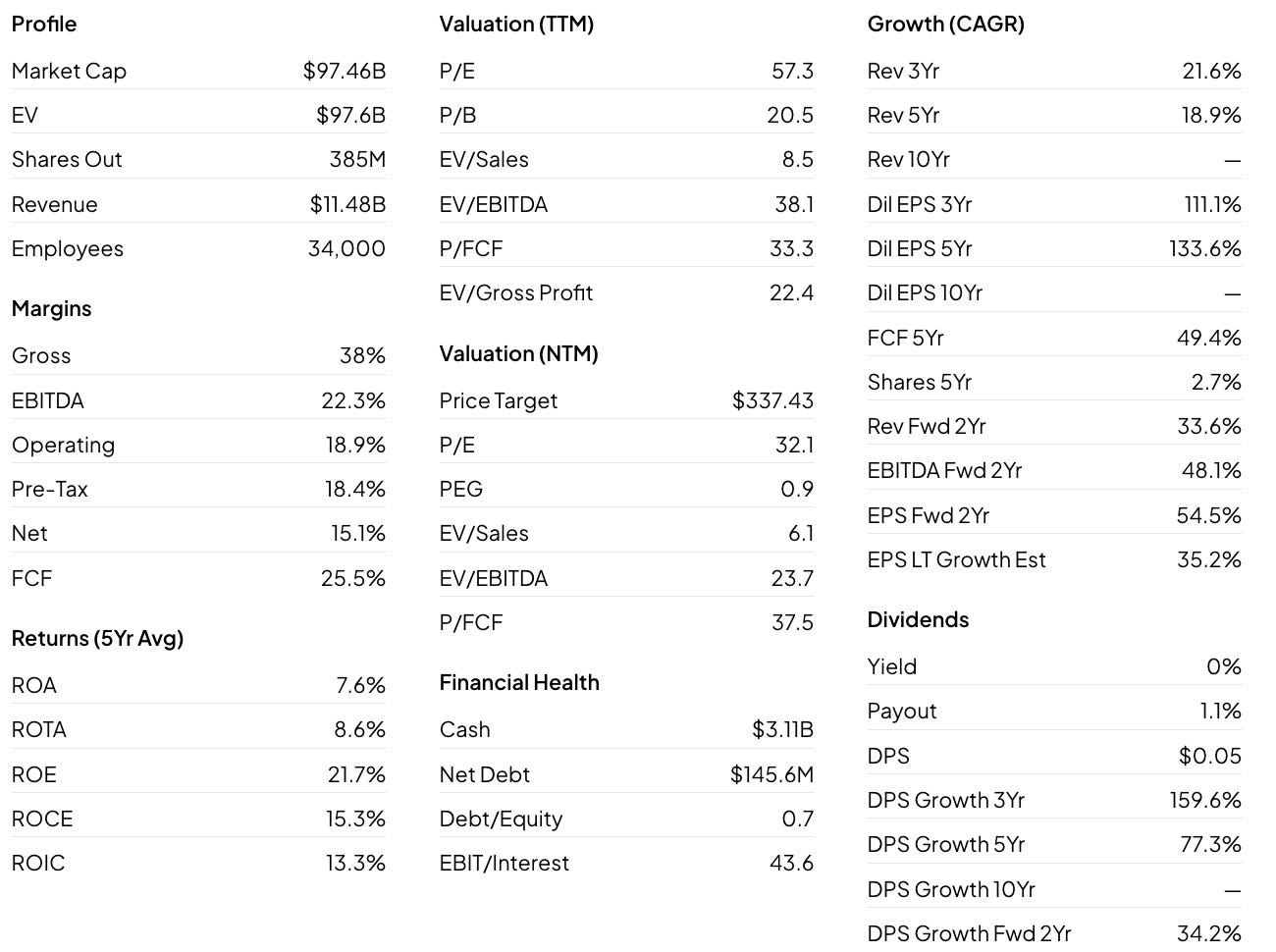
All financial data in this post was sourced from Fiscal AI. You can access a free trial of their premium platform via the link below (no credit card required). This link also includes a 15% discount on a premium subscription: Fiscal AI: SSC
TTM Performance:
Revenue TTM: $11.48B
Gross Profit TTM: $4.37B
Operating Income TTM: $2.17B
Net Income TTM: $1.73B
Q2 2026 Highlights:
Revenue of $3.27B, up 24.1% YoY
Gross Margin of 37.7%, up from 34.0% YoY
Operating Income of $637.9M, up 44.2% YoY
Net Income of $497.8M, up 53.5% YoY ($1.27 per diluted share, up from $0.83)
EBITDA of $753.7M, up 46.2% YoY
Revenue is compounding quickly:
Over the past three years, revenue has grown 21.6% a year, from $5.69B in 2022 to $10.23B in 2025. Consensus expects $14.0B in 2026 (30 analysts), in line with the midpoint of guidance, and $18.2B in 2027. Morningstar’s estimates are similar, at $13.9B and $18.1B, with adjusted EPS of $6.72 and $8.28.
Profit is growing faster than revenue:
Operating margin expanded from 3.9% in 2022 to 17.9% in 2025 (18.9% on a TTM basis). Net income jumped from $495.8M in 2024 to $1.33B in 2025, although 2024 included a $449.2M non-cash loss on warrant liabilities, so the underlying improvement is smaller. Excluding that item, pre-tax income grew ~43%.
Valuation:
VRT trades at:
8.5x LTM EV/S and 6.1x NTM EV/S
38.2x LTM EV/EBITDA and 23.7x NTM EV/EBITDA
57.4x LTM P/E and 32.1x NTM P/E
33.3x LTM P/FCF and 36.8x NTM P/FCF
The wide gap between trailing and forward multiples shows that the valuation depends on Vertiv delivering its 2026 and 2027 ramp. One detail stands out: forward P/FCF is higher than trailing P/FCF, which suggests trailing free cash flow (a 25.5% margin, against a 15.1% net margin) benefited from customer prepayments that may not repeat at the same pace.
The consensus price target is $337.43 (Fiscal AI). Goldman Sachs rates the stock Buy with a $301 target (July 30), Wells Fargo initiated at Overweight with a $340 target (September 25), and Jefferies is at Hold with $245. Morningstar’s fair value estimate is $236 (~35x its 2026 adjusted EPS estimate), which leaves the shares fairly valued in its view, with a narrow moat (based on brand and switching costs) and a Very High uncertainty rating. Morningstar models sales reaching $27.1 billion in 2029 before a 15% decline in 2030, and it was blunt about the risk: “If Vertiv’s growth declines back into the low teens, its valuation will take a massive hit.”
Forward Guidance:
For the third quarter of 2026, Vertiv anticipates:
Net sales of $3.65 billion to $3.85 billion, with organic growth of 34% to 36%
Adjusted operating margin of 24.0% to 25.0%
Adjusted diluted EPS of $1.77 to $1.83, 43% to 48% growth
For the full year 2026 (raised on July 29, with the midpoint of net sales going to $14.0 billion from $13.75 billion and adjusted EPS to $6.70 from $6.35):
Net sales of $13.8 billion to $14.2 billion, with organic growth of 30% to 32%
Adjusted operating margin of 23.3% to 24.3%
Adjusted diluted EPS of $6.65 to $6.75
Adjusted free cash flow of $2.4 billion to $2.6 billion
Thesis
Putting it all together, the market currently treats Vertiv as an execution story it can’t verify, which makes sense considering its struggles over the last few months. Its multiple has fallen from about 59 times this year’s expected earnings in May to about 38 times today. That leaves it priced roughly in line with nVent once growth is accounted for, even though Vertiv is guiding for faster growth next quarter.
Underneath, though, the business has kept getting stronger. Since May, Vertiv has raised its earnings forecast, customers have prepaid about ten times more than a year earlier, and on paper, its backlog would cover the second half even if no new orders came in. On top of that, the industry backdrop remains supportive, with hyperscaler spending still set to rise in 2027 and power shortages pushing data centres toward the kind of on-site power UIG provides. So, the question has narrowed to whether Vertiv can deliver on schedule.
The longer-term focus is Vertiv’s 2030 plan. On my rough math, the low end of that plan (20% organic growth a year and a 27% adjusted operating margin) would take sales to about $25 billion and adjusted operating profit to about $7 billion by 2030. That is roughly double this year’s ~$3.3 billion, before any acquisitions. Today’s enterprise value of about $98 billion is roughly 14 times that 2030 figure.
If the following happen, VRT is well positioned to move higher:
Third-quarter results land inside the guide: organic growth of 34% to 36%, sales of $3.65 to $3.85 billion, and an adjusted operating margin of 24% to 25%, with no new scheduling or timing mishaps. That would show the coordination problems in its factory-built products are behind it.
The roughly $14.0 billion full-year outlook holds, implying a fourth quarter of about $4.3 billion, and management shows the backlog is still growing.
Management puts numbers on UIG’s current sales and profits before the deal closes in the fourth quarter, showing it can earn back a price of up to $2.6 billion.
If those play out, VRT could close the September gap with its peers, since that gap came from doubts about Vertiv’s execution. After that, the stock would be measured against how well Vertiv tracks its 2030 growth plan.
Otherwise, the market is accurately pricing VRT. Another quarter blamed on timing, a cut to the full-year outlook, or a drop in customer prepayments would confirm that the lower multiple reflects real execution problems rather than sentiment.
Thank you for reading. If you enjoyed this post, please leave a like and Restack.
Subscribe to the plan that best suits your needs and will see you in the next one!